I gave a talk at the Minneapolis Fed's "Ending Too Big to Fail" symposium, May 16. Agenda and video of the event here.
My talk is based on "towards a run-free financial system," and a bit on a new structure for federal debt, and blog readers will notice many recycled ideas. But it incorporates some current thinking both on substance and on marketing -- the proposal is so simple, most of the work is on meeting objections.
Here's my talk. This is also available as a pdf here.
Equity-financed banking and a run-free financial system
Premises
We have to define what “sytstemic” and “crisis” mean before we can try to fix them.
My premise is that, at its core, our financial crisis was a systemic run. The mechanism is familiar from Diamond and Dybvig, and especially Gary Gorton’s description of how “information-insensitive” assets suddenly lose that property and become illiquid.
You see a problem at a bank – a word I will use loosely to include shadow-banks, overnight debt, and other intermediaries. You wonder, what about my bank? You don’t really know. The point of short-term debt is that you don’t generally pay attention to the bank’s assets. But you also have the right to take your money out at any time, and the last one out gets the rotten egg. When uncertain, you might as well forego a few basis points of interest and get out now. Everyone does this, and the bank fails.
Runs at specific institutions, caused by identifiable problems, are not really a danger. My story includes a specific “contagion,” that troubles at one institution spread to another, because they cause people to wonder about the other bank’s assets. That “systemic run” element means that banks cant’ easily sell assets to raise cash, or issue new equity.
This description is important for what it denies, and thus for “problems” we don’t have to “solve.”
It’s not a chain of dominoes: A fails, B loses money, B falls, and so forth, so by saving A the whole system is saved.
Contrariwise, even saving A is not enough to assure investors that B’s assets are ok. In fact, saving A might verify investor’s worries about B’s assets, and set off a run!
It’s not huge losses on particularly unsafe assets. Bank assets are not that risky. Bank liabilities are fragile. Small losses spark large runs.
Our crisis and recession were not the result of specific business operations failing. Failure is failure to pay creditors, not a black hole where there once was a business. Operations keep going in bankruptcy. The ATMs did not go dark.
In my premises, the 2000 stock market bust was not a crisis, because it was not a run. Yes, there were huge losses. But when stocks plunge, all you can do is go home, pour a drink, yell at the dog, and bemoan your dumb decisions. You can’t demand your money back from the issuing company, and you can’t drive the company to bankruptcy if it does not pay. Panic selling, even if “irrational,” even if it causes “herding” by others, even if it drives prices down, is not a crisis, and it’s not a run, because the issuing company doesn’t have to do anything about it.
If we want to stop crises, we have to describe when we will say “good enough” and stop trying to fix things in the name of crisis prevention. My premise: an economy with booms and busts, risks taken, and losses transparently absorbed by falling prices, is good enough for now.
If we try to create a financial system in which nobody ever loses money, we will just create a system in which nobody ever takes any risk, and does not fund any remotely risky investment opportunity. That is the direction we are going. And steps that actually matter to fixing crises are getting lost in the effort rush to “fix” every perceived financial “problem.”
(A small random sample of current causes being commingled with crisis prevention, some worthy but separate, some silly: Fannie and Freddie, the community reinvestment act, “predatory lending,” insufficient down payments, FICO scores, Wall Street "greed," executive compensation, credit card fees, disparate-impact analysis, the last names of auto-loan customers, the terms of student loans, hedge fund fees, active management and its fees, “herding” and “crowding” by equity portfolio managers (OFR), over-the-counter versus exchange-traded derivatives, swap margins, position limits, risk-weights, credit ratings, the Volker rule, insider trading, global imbalances, savings gluts, bubbles in houses and stocks, and the ridiculous tiny type on my credit-card agreement.)
I do not mean that other financial regulation is not necessarily bad, or even that one shouldn’t contemplate policies to reduce stock market volatility. But if we actually want to fix crises, or end TBTF, we have to separate those other measures into everyday regulation.
A better world
Given these premises, the central weakness in financial system is clear: fragile, run-prone liabilities.
The answer then is simple too: we should have no more large-scale funding of risky or potentially illiquid assets by run-prone securities – short term debt in particular, but any promise that is fixed-value, first-come first-served, if unpaid instantly bankrupts the company, and in volumes that could even remotely trigger such bankruptcy.
(The caveats here exempt bills, receivables, trade credit, and so on, which are fixed value but not run-prone. “Funding” is the important qualifier. You can trade in short term debt without funding the bulk of investments with it.)
Banks and shadow banks must get the money they use to hold risky and potentially illiquid loans and securities overwhelmingly from run-proof, floating-value assets – common equity mostly, some long term debt. (I say “hold” specifically to distinguish it from “originate” or “make” loans, which are then securitized and sold. )
Once we have done this, financial crises are over. A 100% equity-financed institution cannot fail, and cannot suffer a run. Fail means fail to pay your debts, and if you have no debts you cannot fail.
(OK, technically you can take on such a huge derivatives position that you can lose more than 100% of equity, but it takes very little attention from regulators and analysts to make sure that doesn’t happen.)
Such an institution needs next to no risk regulation, beyond the regular transparency we demand of any public corporation.
Any remaining fixed-value demandable assets must be backed entirely by short-term government debt, or reserves. These are run-proof because there is no doubt on the value and liquidity of the assets (at least for the US, and away from sovereign debt worries, which I also put off the table for now.)
Objections
The major objection is the flow of credit. If banks can’t issue conventional deposits and unconventional short-term debt, they won’t have money to lend and the economy will dry up, the objection goes. Others object similarly that without bank “transformation” of maturity and risk, economic growth would be slower.
This perception is false. Not one cent more or less money needs to be provided, not one iota more risk needs to be shouldered, not one cent less credit need be extended. And I think the case is strong that growth will be substantially higher than the current run-prone but highly regulated system. Let’s look.
Structure (1) is a simplified version of today’s “bank.” There are a lot of complex or illiquid assets. The bank is too complicated to go through bankruptcy. It is funded by very little equity and a huge amount of debt. The debt is prone to runs. (“People” here includes non financial business and institutions such as pension funds and endowments.)
Structure (2) is the simplest equity-financed bank. Banks issue only equity. Households hold that equity, in a diversified form, potentially through a mutual fund or ETF.
In this structure, households provide the same amount of money, and shoulder the same amount of risk, and the bank makes the same amount of loans. But runs and crises are now eliminated.
You will laugh, but I’d like to take this structure seriously. With today’s technology, people can have floating-value accounts.
This was not technically possible in the 1930s, when our country chose instead the path of deposit insurance and risk regulation. But now, you could easily go to an ATM, ask for $20, and it sells $20 of bank shares at the current market value, within milliseconds. “Liquidity” now is divorced from “fixed-value” and “runnable.” Even better, you could go to the ATM, or swipe your card or smartphone, and instantly sell shares in an ETF that holds mortgage-backed securities. This is a “bank,” providing transactions services based on a pool of mortgages and shows that money still flows from people to mortgages. But with floating value, it is run proof.
Unlevered bank equity would have 1/10 or less the volatility it has today. So, we’re talking about something like 2% volatility on an annual basis. Shouldering 2% price volatility is not hard for the majority of depositors (especially dollar-weighted). To argue otherwise, you need some fundamentally non-economic, psychological theory; you need to assert that the same households who are up to their ears in debt, handle 401(k) stock investments, health care copayments, cable and phone bills, and vacation in Las Vegas, can’t somehow stomach 2% volatility in their bank accounts.
(Wait, you ask, the Modigliani-Miller theorem fails for banks, no? The MM theorem for risk is an identity, not a theorem. Risk is not created, destroyed or transformed, it is simply parceled up differently and people end up holding all of it one way or another (even as taxpayers). The contentious part of the MM theorem is whether the price of risk or cost of capital depends on how you slice it. A pizza sliced 10 ways has the same calories, but might sell for more or less than whole.)
But if you want, we can even keep exactly the household assets we have today. Consider structure 3. Banks still issue 100% equity, but that equity is held in a mutual fund, ETF, or similar holding company, which in turn issues debt and equity.
The bank – complex, full of illiquid assets, Ben Bernanke’s specialized human capital, hard to resolve – still can’t fail. The fund can fail. But this failure can be resolved in a morning, and still make it to a 3-martini lunch and golf. The fund’s assets are publicly traded bank equity and nothing else. The bank’s liabilities are common equity and debt. The equity holders get zero, the debt holders get the bank equity. It can be done by computer.
The funds do have debt. But there is little risk of a systemic run on the funds, because their assets are supremely liquid, and visible on a millisecond basis. The failure of one fund need not inspire a run on the next one.
One might object to structure (2) that the Modigliani Miller theorem fails for banks, so it would imply a higher cost of equity. If so, structure (3), by giving households exactly the same assets as they have not, must give exactly the same cost of capital as now — minus the value of taxpayer guarantees.
Structure (3) emphasizes that the issue is not whether “transformation” must occur, whether people really need to hold a lot of fixed-value debt. The issue is whether “transformation,” if it is needed, must be tied to bankruptcy and liquidation of the institution handling the complex assets. One can cook up stories why this must be the case — corporate finance and banking theorists are a clever lot — but are such stories remotely understood and well-tested enough to justify either our occasional crises, or our massive regulatory response? I think not, but I’ll leave that case to be made by our panelists, if they are so inclined.
Structure (3) is a rhetorical point, not a proposal. I do not think it is necessary or desirable to exactly replicate the securities on both ends of the financial system. The point is just that eliminating financial crises by moving to equity-financed banking does not require any new money, any less credit, any less economic growth or any different risk taking. People will likely choose different assets in my world, and thereby improve on it.
Structure (4) elaborates. Not all bank assets are complex and illiquid. Once we remove short-term financing, I suspect that securitized debt and other liquid securities will move off bank balance sheets. They will migrate to long-only floating-value mutual funds and ETFs, and people will move money out of savings accounts and bank CDs into those very safe investment vehicles. The banks will be smaller, holding only those complex and illiquid risks that can’t easily be securitized.
On the other side, banks now have about $2.3 trillion of reserves, (May 5 H.4.1) and $1.2 trillion of demand deposits. Narrow deposit taking is here! We just need to move the deposits and their backing reserves to bankruptcy-remote vehicles (which banks can still operate for a fee, if that makes sense).
How much risk-free assets do people really need? We can provide them up to $14 trillion and counting with narrow deposits backed directly or indirectly (through the Fed) by Treasury debt.
The Fed’s huge balance sheet is a great innovation. Better yet, the Treasury should issue fixed-value floating rate debt so we can all have “reserves.” The last 8 years have taught a revolutionary lesson in monetary economics: huge quantities of interest-bearing money are not inflationary. We can live the Friedman optimal quantity of money, and displace all the private interest-bearing moneys that fell apart in the crisis. As our ancestors got rid of run-prone banknotes in favor of treasury notes, we can get rid of run-prone debt in favor of treasury and fed interest bearing-electronic money. Let’s do it.
How do we get there
We’ve defined and limited the problem, outlined a better world, but we’re still not ready to write regulations. We should check for failures and unintended consequences of current regulations before we go adding new ones.
Our government subsidizes debt, in numerous ways. Let’s start by not simultaneously subsidizing something and also regulating against its use! We can leave that to energy policy.
The tax deductibility of interest payments is an obvious distortion. It’s not the whole story, as nonfinancial corporations don’t all lever this much, but it’s a part of it. I’d rather just get rid of the whole corporate tax, which eliminates demand for a hundred other tax distortions. But treating dividends and interest equally, or better yet reversing the treatment — deduct dividends, not interest — would help.
Implicit and explicit debt guarantees are a bigger part of the distortion in favor of debt. But, while it’s easy to say “end debt guarantees,” I fear the government will always bail out ex-post, and that inability to precommit is an important justification for limiting debt debt. ( V. V. Chari and Patrick Kehoe have elegantly made this case, in “A Proposal to Eliminate the Distortions Caused by Bailouts” Minneapolis Fed Working Paper.)
A lot of law, regulation and accounting subsidizes debt as a liability by privileging it as an asset. Liquidity regulations encourage institutions to hold very short-term debt, with a run option to save themselves individually in times of trouble. Well, that incentivizes someone else to issue that debt, and encourages the fallacy of “sell if things go bad” risk management. Accounting regulations also treat run-prone short-term debt as safe as cash.
Using floating-value funds for transactions purposes would trigger short-term capital gains taxes and an accounting nightmare. That needs to be fixed if we want free liquidity.
In sum, throughout the regulatory system, we should treat non-government short-term debt as poison in the well, both as an asset and as a liability, and we should remove the impediments to the use of liquid floating-value assets. Will this take some effort? Sure. But just carrying the tens of thousands of pages of regulations over to the Dodd-Frank bonfire will take some effort.
Regulatory relief would be a potent carrot and it is my strongest suggestion. We could say, any institution that is financed by more than (say) 75% equity and long term debt is exempt from asset risk regulation, systemic designation, bank regulation and so forth; it will be treated like a non-financial company. I suspect they would come running. MetLife’s suit and other companies’ efforts to downsize suggests that banks really do not like regulation and will do a lot to rearrange their operations to avoid it.
This suggestion reflects a deeper problem: Where is the safe harbor in Dodd-Frank? Where does it say “this is how we want you to set up a systemically safe financial institution. If you do this, you’re doing a good job, and we’ll leave you alone.” Nowhere. Not even an equity ETF, about the most run-proof structure in creation, is exempt.
Adding a safe harbor is an especially attractive way to move to better policy. If we need to repeal Dodd-Frank, we’re asking a lot. Too many people have too much invested in it. If we just add to Dodd-Frank its missing definition of “systemic,” and thus a definition of “not systemic,” a specification of how an institution can be exempt from detailed regulation, they will run for it, and the rest can die on the vine.
At last a bit of regulation
Finally, if after removing all the subsidies and inducements for debt, and a regulatory safe harbor, banks are still using too much run-prone financing, ok, we get to add a bit of stick.
The usual approach to boosting capital combines complex regulation, taking the form of a limit on a ratio of complex numbers, with extensive discretion and regulatory remediation. The ratios don’t work for all sorts of reasons. The denominator is the big problem. Simple leverage — debt to assets ratios — is silly. We require equity on holding reserves, and a stock vs a call option have much different risk for the same asset value. Risk weights violate the fundamental principle of finance, that a portfolio is less risky than the sum of its parts. Risk weights are deeply distorting investing decisions – loans carry large risk weights, while securities formed of the same loans carry small risk weights. Greek debt is still 0 risk weight.
And what level of capital is “safe?”17.437%? 35.272%? Really, the answer is “so much that it doesn’t matter,” and “more is always better.” Since costs and benefits do not suggest a hard and fast number, why regulate one – and then endlessly argue about it?
We need something simple, transparent, and that avoids these pathologies. The best I can think of is a Pigouvian tax, say 5 cents for each dollar of short-term debt (less than a year) and 2 cents for longer term debt. By taxing the amount of debt, arguments about the denominator vanish. So we don’t have to get in to riskweights, leverage, book values market values, and so forth.
Everywhere in economics, charging a price is better than a quantitative limit.
You will ask, just what is the right tax? I don’t know. I suspect however, that the benefits of short-term financing are much less than banks claim when they are trying to convince regulators to lower a quantitative limit. If they faced even a quite low tax, I suspect we would see a swift rediscovery of the Modigliani-Miller theorem. In any case, we don’t have to decide that ahead of time. Adjust the tax rate as needed until you get the capital you want.
As it is sensible to demand more capital of more “dangerous” firms, so the tax could rise on some simple measures of danger. I distrust any accounting measures, so following Chari and Kehoe’s recent suggestion, the tax could be a rising function of the ratio of short-term debt to the market – not book -- value of equity. The market value of equity is easily measurable. Let the firm figure out whether to issue more equity, retain more earnings, find a buyer, restructure debt, pay the tax for a while, or whatever they want to do.
Most importantly though, we are not trying to carefully craft a way for banks to get by on the minimal amount of capital. The point is that capital is not expensive, socially if not privately. We don’t want to jigger the absolute minimum amount of the tax, we want to induce banks to shift overwhelmingly to floating-value run-proof liabilities.
The current path
This all may seem a bit radical, so I think it’s worth emphasizing just how broken the current system is.
Since the 1930s, we have tried a fundamentally different approach to stopping runs and financial crises, emphasizing minimal equity and lots of debt. When depositors run, really the only way to stop it is for the government to guarantee debts. But, once people expect debt guarantees, banks to take too much risk, and their creditors lend without regard to that risk. So, we tried to substitute regulatory supervision of asset risk for both ends of market information processing and discipline. It’s not enough, we have another crisis, guarantee more debt, and so on. The little old lady swallowed a fly, a spider to catch the fly, as the song goes, and now she is trying to digest the horse.
That we are having a conference on “ending too big to fail” reflects he widespread perception that we have not ended this cycle, the “resolution authority” will not work, and it will institutionalize creditor bailouts rather than precommit against them—which might be impossible and unwise anyway.
Regulation quickly failed its first test after the 2008 subprime crisis. Europe’s bank regulators, with that crisis fresh in the rear view mirror, still allowed Greek debt at zero risk weights, and promptly bailed out the French and German banks who were over exposed. Will the same regulators artfully prick asset bubbles, diagnose imbalances, macro-prudentially raise capital standards, promptly resolve nearing failures, and sternly haircut debt holders… next time?
We are devoting enormous resources and suffering large economic distortions to regulate the risk of bank assets. But bank assets aren’t risky! A diversified, mostly marketable portfolio of loans and mortgage backed securities is far safer than the profit stream of any company.
So why are we, as a society, investing so much in regulating some of the safest corporate assets on the planet? Well, because they’re leveraged to the hilt, and we’re holding the bag. We don’t have to.
And asset risk regulation is now spilling over into efforts to regulate asset prices themselves. For example, the OFR proposed to regulate equity asset managers, even though they just trade equity on customer’s behalf. Why? Because the managers might sell, drive asset prices down; and someone might have borrowed money on those assets that asset risk regulators didn’t notice. The Fed is discussing “macroprudential” policy to allocate credit to target house prices, and raising interest rates to manage stock prices.
The result is an increasingly uncompetitive and sclerotic financial system. We are the financial system of zero interest rates where nobody who actually needs one can get a loan.
Already, financial innovators are springing up around the banking system, in peer to peer lending, finance tech, and so on. These give me hope. Maybe equity-financed banking will spring up like weeds around the ruins of the big banks. But those don’t have to be ruins.
If it really does cost 25 bp more for a mortgage in my world, and if we really want to subsidize home mortgages, we can do so by writing checks to homeowners, on budget, rather than set up a dangerous and sclerotic financial system.
Discussion
I got great comments at the conference from panelists Michael Hasenstab, Michael Keen, Donald Marron, and Thomas Phillips. A few points that come out of the discussion:
100% Equity is not necessary. I focus on this option because it is, in fact, cleanest, and I want to make the case that 100% equity is possible and reasonable. Once you accept that, then 75% equity can work too. It would be just about bulletproof: the institutions would have to be at risk of losing 75% of its value before a run could start.
To emphasize, not all debt or fixed value debt is equally dangerous. Your gas bill is a fixed value claim, but the gas company can’t bankrupt you tomorrow if they call and say “we want our money” and you don’t pay up.
The transition sounds hard. Issuing gobs of equity sounds costly. But again, look at structure (3). No new money is needed. We are simply replacing debt with equity. In fact, we could do it in a day. The Bank’s current liabilities are transferred to the fund, in return for newly issued equity. Nobody has to go to the market! That’s not necessary, but I think it makes clear that we don’t need more money or a lot of discombobulation. In fact, I think banks would slowly redeem debt for equity without much trouble.
Michael, as a manager of a bond fund, emphasized the necessity of large banks with global reach to be reliable counterparties and market makers on all sorts of assets. But equity-financing helps them! If equity financed, banks can be as “big” as anyone wants, without causing risks. We don’t need to break up the banks or fear size.
Michael Keen gave a great introduction to tax issues. The tax code is also a bunch of patches applied to cure the consequences of other taxes. He pointed out that the total tax wedge includes the taxes paid by the bank, and the taxes on interest paid by investors. My head hurts, and I can’t help but never to the fact that Eliminating corporate and rate of return taxes, leaving a simple consumption tax, solves all these problems!
Michael also thought in some detail about how to make equity deductible, and even with debt. This has troubled me: allowing a deduction for dividends like interest sounds nice, but we want to encourage banks to keep dividends, which builds capital. He outlined “ACE” rules that allow banks to deduct a “notional cost of equity,” usually a risk free rate plus a few percent. I asked later, why not deduct the actual return.
Donald Marron gave quite a few examples in which the government simultaneously taxes and subsidizes, including carbon, tobacco, and sugar.
Donald pointed out that it’s not always best to regulate via a price rather than a quantity. This is a good question, but I think run-prone securities are a good case for price regulation. Like pollution, the regulator doesn’t really know what the costs of compliance are, and there are lots of creative ways for the business to rearrange things to reduce the pollution.
Donald pointed out that the word “tax” is pollution in our politics. Also “tax” rates have to be voted by congress. Agencies can impose “fees.” Economists understand “taxes” in terms of incentives, politics understands “taxes” as income transfers and ignores incentives. He’s spot on. Forever more, let us call it a “Pigouvian fee” on debt!
Thomas Phillipon questioned whether mutual funds are truly run-free. He has a point, there is a small incentive to run with big losses given the option to redeem at NAV. Answer: exchange tried funds, or an exchange traded backstop, in which you can or must sell your shares to another investor rather than demand money from the fund solves the problem. ETFs are really run free!
Thomas also gave a long and detailed explanation of why leverage ratios or leverage charges don’t work. That’s exactly why I propose to tax debt itself, not a leverage ratio.
In a later section, David Skeel pointed out that Lehman when it failed, had 25,000 employees — fewer than the current compliance staff at citigroup.
I closed with a warning: my vision of a monetary system based on short-term government debt depends on government solvency. If Greece comes to the US, and banks are deeply involved in government debt, considered risk free, we’re in really deep trouble. Insulating a financial system from sovereign debt problems is a separate, and important, question.
Update: A correspondent sent a thoughtful email advocating floating-value equity-like securities for many cases on the asset side as well. Then, from twitter, "a few more steps and whole world for sharia compliant financing ie 100% equity both on asset and liability side." I'm not sure if that is praise or criticism.
Hiển thị các bài đăng có nhãn Monetary Policy. Hiển thị tất cả bài đăng
Thứ Ba, 17 tháng 5, 2016
Thứ Sáu, 6 tháng 5, 2016
Global Imbalances
I gave some comments on “Global Imbalances and Currency Wars at the ZLB,” by Ricardo J. Caballero, Emmanuel Farhi, and Pierre-Olivier Gourinchas at the conference, “International Monetary Stability: Past, Present and Future”, Hoover Institution, May 5 2016. My comments are here, the paper is here
The paper is a very clever and detailed model of "Global Imbalances," "Safe asset shortages" and the zero bound. A country's inability to "produce safe assets" spills, at the zero bound, across to output fluctuations around the world. I disagree with just about everything, and outline an alternative world view.
A quick overview:
Why are interest rates so low? Pierre-Olivier & Co.: countries can't “produce safe stores of value”
This is entirely a financial friction. Real investment opportunities are unchanged. Economies can’t “produce” enough pieces of paper. Me: Productivity is low, so marginal product of capital is low.
Why is growth so low? Pierre-Olivier: The Zero Lower Bound is a "tipping point." Above the ZLB, things are fine. Below ZLB, the extra saving from above drives output gaps. It's all gaps, demand. Me: Productivity is low, interest rates are low, so output and output growth are low.
Data: I Don't see a big change in dynamics at and before the ZLB. If anything, things are more stable now that central banks are stuck at zero. Too slow, but stable. Gaps and unemployment are down. It's not "demand" anymore.
Exchange rates. Pierre-Olivier "indeterminacy when at the ZLB” induces extra volatility. Central banks can try to "coordinate expectations." Me: FTPL gives determinacy, but volatility in exchange rates. There is no big difference at the ZLB.
Safe asset Shortages. Pierre-Olivier: driven by a large mass of infinitely risk averse agents. Risk premia are therefore just as high as in the crisis. Me: Risk premia seem low. And doesn't everyone complain about "reach for yield" and low risk premia?
Observation. These ingredients are plausible about fall 2008. But that's nearly 8 years ago! At some point we have to get past financial crisis theory to not-enough-growth theory.
But, finally, praise. This is a great paper. It clearly articulates a world view, and you can look at the assumptions and mechanisms and decide if you think they make sense. I am in awe that Pierre-Olivier & Co. were able to make a coherent model of these buzzwords.
But great theory is great theory. To a critic, the assumptions are necessary as well as sufficient. I read it as a brilliant negative paper, almost a parody: Here are the extreme assumptions that it takes to justify all the policy blather about "savings gluts" "global imbalances" "safe asset shortages" and so on. To me, it shows just how empty the idea is, that our policy-makers understand any of this stuff at a scientific, empirically-tested level, and should take strong actions to offset the supposed problems these buzzwords allude to.
I hope this taste gets you to read my comments and the paper.
The paper is a very clever and detailed model of "Global Imbalances," "Safe asset shortages" and the zero bound. A country's inability to "produce safe assets" spills, at the zero bound, across to output fluctuations around the world. I disagree with just about everything, and outline an alternative world view.
A quick overview:
Why are interest rates so low? Pierre-Olivier & Co.: countries can't “produce safe stores of value”
This is entirely a financial friction. Real investment opportunities are unchanged. Economies can’t “produce” enough pieces of paper. Me: Productivity is low, so marginal product of capital is low.
Why is growth so low? Pierre-Olivier: The Zero Lower Bound is a "tipping point." Above the ZLB, things are fine. Below ZLB, the extra saving from above drives output gaps. It's all gaps, demand. Me: Productivity is low, interest rates are low, so output and output growth are low.
Data: I Don't see a big change in dynamics at and before the ZLB. If anything, things are more stable now that central banks are stuck at zero. Too slow, but stable. Gaps and unemployment are down. It's not "demand" anymore.
Exchange rates. Pierre-Olivier "indeterminacy when at the ZLB” induces extra volatility. Central banks can try to "coordinate expectations." Me: FTPL gives determinacy, but volatility in exchange rates. There is no big difference at the ZLB.
Safe asset Shortages. Pierre-Olivier: driven by a large mass of infinitely risk averse agents. Risk premia are therefore just as high as in the crisis. Me: Risk premia seem low. And doesn't everyone complain about "reach for yield" and low risk premia?
Observation. These ingredients are plausible about fall 2008. But that's nearly 8 years ago! At some point we have to get past financial crisis theory to not-enough-growth theory.
But, finally, praise. This is a great paper. It clearly articulates a world view, and you can look at the assumptions and mechanisms and decide if you think they make sense. I am in awe that Pierre-Olivier & Co. were able to make a coherent model of these buzzwords.
But great theory is great theory. To a critic, the assumptions are necessary as well as sufficient. I read it as a brilliant negative paper, almost a parody: Here are the extreme assumptions that it takes to justify all the policy blather about "savings gluts" "global imbalances" "safe asset shortages" and so on. To me, it shows just how empty the idea is, that our policy-makers understand any of this stuff at a scientific, empirically-tested level, and should take strong actions to offset the supposed problems these buzzwords allude to.
I hope this taste gets you to read my comments and the paper.
Thứ Tư, 4 tháng 5, 2016
Central Bank Governance and Oversight Reform
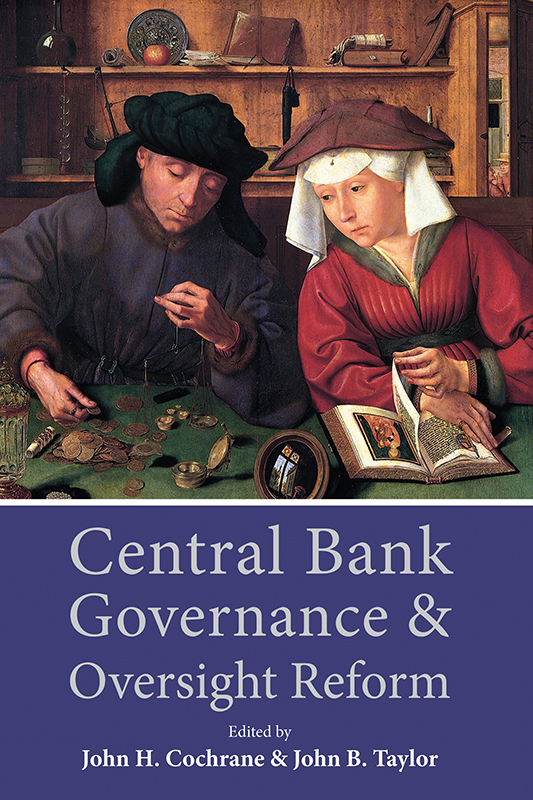
The Hoover Institution Press just published "Central Bank Governance and Oversight Reform," the collected volume of papers, comments, and discussion from last May's conference here by the same name. You can get the book or e-book here at the Hoover press or here at amazon.com. The individual chapter pdfs are available here. Press release here.
(My modest contributions are in the preface and a discussion of Paul Tucker's Chapter 1. I agree it would be nice to have a more rule-based approach to lender of last resort and bailout functions, but wouldn't lots of equity so you don't have to mop up so often be even better?)
This is part of an emerging series of monetary policy conferences at Hoover. Tomorrow we will have a conference on international monetary policy. Stay tuned...
The blurb:
Preface
By John H. Cochrane and John B. Taylor
Chapter 1: How Can Central Banks Deliver Credible Commitment and Be “Emergency Institutions”?
By Paul Tucker
Chapter 2: Policy Rule Legislation in Practice
By David H. Papell, Alex Nikolsko-Rzhevskyy and Ruxandra Prodan
Chapter 3: Goals versus Rules as Central Bank Performance Measures
By Carl E. Walsh
Chapter 4: Institutional Design: Deliberations, Decisions, and Committee Dynamics
By Kevin M. Warsh
Chapter 5: Some Historical Reflections on the Governance of the Federal Reserve
By Michael D. Bordo
Chapter 6: Panel on Independence, Accountability, and Transparency in Central Bank Governance
By Charles I. Plosser, George P. Shultz, and John C. Williams
(My modest contributions are in the preface and a discussion of Paul Tucker's Chapter 1. I agree it would be nice to have a more rule-based approach to lender of last resort and bailout functions, but wouldn't lots of equity so you don't have to mop up so often be even better?)
This is part of an emerging series of monetary policy conferences at Hoover. Tomorrow we will have a conference on international monetary policy. Stay tuned...
The blurb:
How can we balance the central bank’s authority, including independence, with accountability and constraints? Drawn from a 2015 Hoover Institution conference, this book features distinguished scholars and policy makers’ discussing this and other key questions about the Fed. Going beyond the simple decision of whether to raise interest rates, they focus on a deeper set of questions, including, among others, How should the Fed make decisions? How should the Fed govern its internal decision-making processes? What is the trade-off between greater Fed power and less Fed independence? And how should Congress, from which the Fed ultimately receives its authority, oversee the Fed?The contents:
The contributors discuss, for instance, whether central banks can both follow rule-based policy in normal times but then take a discretionary, do-what-it-takes approach to stopping financial crises. They evaluate legislation, recently proposed in the U.S. House and Senate, that would require the Fed to describe its monetary policy rule and, if and when the Fed changed or deviated from its rule, explain the reasons. And they discuss to best ways to structure a committee—like the Federal Open Market Committee, which sets interest rates—to make good decisions, as well as offer historical reflections on the governance of the Fed and much more. They conclude with an important reminder: how important it is to have a “healthy separation between government officials who are in charge of spending and those who are in charge of printing money,” the most essential part of good governance.
Preface
By John H. Cochrane and John B. Taylor
Chapter 1: How Can Central Banks Deliver Credible Commitment and Be “Emergency Institutions”?
By Paul Tucker
Chapter 2: Policy Rule Legislation in Practice
By David H. Papell, Alex Nikolsko-Rzhevskyy and Ruxandra Prodan
Chapter 3: Goals versus Rules as Central Bank Performance Measures
By Carl E. Walsh
Chapter 4: Institutional Design: Deliberations, Decisions, and Committee Dynamics
By Kevin M. Warsh
Chapter 5: Some Historical Reflections on the Governance of the Federal Reserve
By Michael D. Bordo
Chapter 6: Panel on Independence, Accountability, and Transparency in Central Bank Governance
By Charles I. Plosser, George P. Shultz, and John C. Williams
Thứ Ba, 26 tháng 4, 2016
Macro Musing Podcast
I did a podcast with David Beckworth, in his "macro musings" series, on the Fiscal Theory of the Price Level, blogging, and a few other things.
(you should see the link above, if not click here to return to the original).
You can also get the podcast at Sound Cloud, along with all the other ones he has done so far, or on itunes here. For more information, see David's post on the podcast.
(you should see the link above, if not click here to return to the original).
You can also get the podcast at Sound Cloud, along with all the other ones he has done so far, or on itunes here. For more information, see David's post on the podcast.
Thứ Bảy, 23 tháng 4, 2016
Lessons Learned I
I spent last week traveling and giving talks. I always learn a lot from this. One insight I got: Real interest rates are really important in making sense of fiscal policy and inflation.
Harald Uhlig got me thinking again about fiscal policy and inflation, in his skeptical comments on the fiscal theory discussion, available here. At left, two of his graphs, asking pointedly one of the standard questions about the fiscal theory: Ok, then, what about Japan? (And Europe and the US, too, in similar situations. If you don't see the graphs or equations, come to the original.) This question came up several times and I had the benefit of several creative seminar participants views.
The fiscal theory says
\[ \frac{B_{t-1}}{P_t} = E_t \sum_{j=0}^{\infty} \frac{1}{R_{t,t+j}} s_{t+j} \]
where \(B\) is nominal debt, \(P\) is the price level, \(R_{t,t+j}\) is the discount rate or real return on government bonds between \( t\) and \(t+j\) and \(s\) are real primary (excluding interest payments) government surpluses. Nominal debt \(B_{t-1}\) is exploding. Surpluses \(s_{t+j}\) are nonexistent -- all our governments are running eternal deficits, and forecasts for long-term fiscal policy are equally dire, with aging populations, slow growth, and exploding social welfare promises. So, asks Harald, where is the huge inflation?
I've sputtered on this one before. Of course the equation holds in any model; it's an identity with \(R\) equal to the real return on government debt; fiscal theory is about the mechanism rather than the equation itself. Sure, markets seem to have faith that rather than a grand global sovereign default via inflation, bondholders seem to have faith that eventually governments will wake up and do the right thing about primary surpluses \(s\). And so forth. But that's not very convincing.
This all leaves out the remaining letter: \(R\). We live in a time of extraordinarily low real interest rates. Lower real rates raise the real value surpluses s. So in the fiscal theory, other things the same, lower real rates are a deflationary force.
The effect is quite powerful. For a simple back of the envelope approach, we can apply the Gordon growth formula to steady states. Surpluses \(s\) grow at the rate \(g\) of the overall economy. So, in steady state terms,
\[ \frac{B_{t-1}}{P_t s_t} = E_t \sum_{j=0}^{\infty} \frac{(1+g)^j}{(1+r)^j} \approx \frac{1}{ r - g} \]
\[ \frac{P_t s_t}{B_{t-1}} \approx r - g \; \; (1) \]
(and exact in continuous time). The left hand side is the steady state ratio of surpluses to debt. The right hand side is the difference between the real interest rate and the long-run growth rate.
So, with (say) a 2% growth rate g, and a 4% long-run interest rate r, surpluses need to be 2% of the real value of debt. But suppose interest rates decline to 3%. This change cuts in half the needed long-run surpluses! Or, holding surpluses constant, if long-run interest rates fall to 3%, the price level falls by half.
You can see the punchline coming. Long term real interest rates are really low right now. If anything, we're flirting with \(r \lt g\), the magic point at which governments can borrow all they want and never repay the debt.
With this insight, Harald should have been asking of the fiscal theory, where is the huge deflation? And the answer is, well, we're sort of there. The puzzle of the moment is declining inflation and even slight deflation despite all our central bankers' best efforts.
Pursuing this idea, there is a larger novel story here about growth, interest rates, and inflation.
Obviously, there is an opposite prediction for what happens when real interest rates rise. Higher real rates, unless accompanied by higher surpluses, will drive inflation upwards.
In conventional terms, looking at flows rather than present values, suppose a government that is $20 Trillion in debt faces interest rates that rise from 2% to 5%. Well, then it has to increase surpluses by $600 billion per year; and if it cannot do so inflation will result.
A similar story makes sense for the cyclical falls in inflation. What happened to our equation in 2008? Surpluses fell -- deficits exploded -- and future surpluses fell even more. Debt rose sharply. Why did we see deflation? Well, real interest rates on government debt fell to unprecedentedly low levels. This really isn't even economics, it's just accounting. The equation holds, ex-post, as an identity!
To think a bit more about real rates, growth, and inflation, remember the standard relation that the real interest rate equals the subjective discount rate (how much people prefer current to future consumption) plus a constant times the per capita growth rate
\[ r = \delta + \gamma (g-n) \]
The constant \(\gamma\) is usually thought to be a bit above one.
With \(\gamma=1\) (log utility), then we have \(r-g = \delta-n\). The magic land of unbounded government debt can occur because government surpluses can grow at the population growth rate, while interest rates are determined by the individual growth rate. But population growth is tapering off, and must eventually cease, and bondholders prefer their money now. With \(\gamma \gt 1 \) ,
\[ r-g = \delta - n + (\gamma-1)(g-n) \; \; (2)\]
The new term is the per capita growth rate, which is positive, further distancing us from the land of magic.
More to the point, though, we now have before us the central determinant of long run real interest rates. Real interest rates are higher when economic growth is higher. And \(r-g\) rises when economic growth \(g\) rises.
So, going back to my equation (1), we actually had a puzzle before us. Higher real interest rates would mean lower values of the debt, and would thus be inflationary if not accompanied by austerity to pay more to bondholders. But higher real interest rates must come with higher economic growth, and higher economic growth would raise surpluses, helping the situation out. Which force wins? Well, equation (2) answers that question: With \(\gamma \gt 1\), the usual case (a 1% rise in consumption growth comes with a more than 1% rise in real interest rates), higher growth g comes with higher still interest rates r, and thus remains an inflationary force, again holding surpluses constant.
All in all then, we have the hint of a fiscal theory Phillips curve: Inflation should be procyclical. In good times, interest rates rise and the real value of government debt falls, producing more inflation. In bad times, interest rates fall and the real value of government debt rises, producing less inflation.
Central banks have been absent in all this. The natural next question is, does this provide another reinforcing channel by which central banks might raise inflation if they raise interest rates? I don't think so, but one needs more equations to really answer the question.
What matters here are very long-term real interest rates, the kind that discount expectations of surpluses -- yes, we need some surpluses! -- 20 to 30 years from now to establish bondholder's willingness to hold debt today.
In no model I have played with can central banks affect real interest rates for that long. I think a quick look out the window convinces us that central banks cannot substantially raise interest rates in a slump, with supply of global savings so strong compared to demand for global investment. Long-term interest rates really must come from supply and demand, not monetary machination. Higher real interest rates require higher marginal products of capital, and thus higher economic growth, not louder promises, more speeches, or more energetic attempts to avoid the logic of a liquidity trap.
Harald Uhlig got me thinking again about fiscal policy and inflation, in his skeptical comments on the fiscal theory discussion, available here. At left, two of his graphs, asking pointedly one of the standard questions about the fiscal theory: Ok, then, what about Japan? (And Europe and the US, too, in similar situations. If you don't see the graphs or equations, come to the original.) This question came up several times and I had the benefit of several creative seminar participants views.
The fiscal theory says
\[ \frac{B_{t-1}}{P_t} = E_t \sum_{j=0}^{\infty} \frac{1}{R_{t,t+j}} s_{t+j} \]
where \(B\) is nominal debt, \(P\) is the price level, \(R_{t,t+j}\) is the discount rate or real return on government bonds between \( t\) and \(t+j\) and \(s\) are real primary (excluding interest payments) government surpluses. Nominal debt \(B_{t-1}\) is exploding. Surpluses \(s_{t+j}\) are nonexistent -- all our governments are running eternal deficits, and forecasts for long-term fiscal policy are equally dire, with aging populations, slow growth, and exploding social welfare promises. So, asks Harald, where is the huge inflation?
I've sputtered on this one before. Of course the equation holds in any model; it's an identity with \(R\) equal to the real return on government debt; fiscal theory is about the mechanism rather than the equation itself. Sure, markets seem to have faith that rather than a grand global sovereign default via inflation, bondholders seem to have faith that eventually governments will wake up and do the right thing about primary surpluses \(s\). And so forth. But that's not very convincing.
This all leaves out the remaining letter: \(R\). We live in a time of extraordinarily low real interest rates. Lower real rates raise the real value surpluses s. So in the fiscal theory, other things the same, lower real rates are a deflationary force.
The effect is quite powerful. For a simple back of the envelope approach, we can apply the Gordon growth formula to steady states. Surpluses \(s\) grow at the rate \(g\) of the overall economy. So, in steady state terms,
\[ \frac{B_{t-1}}{P_t s_t} = E_t \sum_{j=0}^{\infty} \frac{(1+g)^j}{(1+r)^j} \approx \frac{1}{ r - g} \]
\[ \frac{P_t s_t}{B_{t-1}} \approx r - g \; \; (1) \]
(and exact in continuous time). The left hand side is the steady state ratio of surpluses to debt. The right hand side is the difference between the real interest rate and the long-run growth rate.
So, with (say) a 2% growth rate g, and a 4% long-run interest rate r, surpluses need to be 2% of the real value of debt. But suppose interest rates decline to 3%. This change cuts in half the needed long-run surpluses! Or, holding surpluses constant, if long-run interest rates fall to 3%, the price level falls by half.
You can see the punchline coming. Long term real interest rates are really low right now. If anything, we're flirting with \(r \lt g\), the magic point at which governments can borrow all they want and never repay the debt.
With this insight, Harald should have been asking of the fiscal theory, where is the huge deflation? And the answer is, well, we're sort of there. The puzzle of the moment is declining inflation and even slight deflation despite all our central bankers' best efforts.
Pursuing this idea, there is a larger novel story here about growth, interest rates, and inflation.
Obviously, there is an opposite prediction for what happens when real interest rates rise. Higher real rates, unless accompanied by higher surpluses, will drive inflation upwards.
In conventional terms, looking at flows rather than present values, suppose a government that is $20 Trillion in debt faces interest rates that rise from 2% to 5%. Well, then it has to increase surpluses by $600 billion per year; and if it cannot do so inflation will result.
A similar story makes sense for the cyclical falls in inflation. What happened to our equation in 2008? Surpluses fell -- deficits exploded -- and future surpluses fell even more. Debt rose sharply. Why did we see deflation? Well, real interest rates on government debt fell to unprecedentedly low levels. This really isn't even economics, it's just accounting. The equation holds, ex-post, as an identity!
To think a bit more about real rates, growth, and inflation, remember the standard relation that the real interest rate equals the subjective discount rate (how much people prefer current to future consumption) plus a constant times the per capita growth rate
\[ r = \delta + \gamma (g-n) \]
The constant \(\gamma\) is usually thought to be a bit above one.
With \(\gamma=1\) (log utility), then we have \(r-g = \delta-n\). The magic land of unbounded government debt can occur because government surpluses can grow at the population growth rate, while interest rates are determined by the individual growth rate. But population growth is tapering off, and must eventually cease, and bondholders prefer their money now. With \(\gamma \gt 1 \) ,
\[ r-g = \delta - n + (\gamma-1)(g-n) \; \; (2)\]
The new term is the per capita growth rate, which is positive, further distancing us from the land of magic.
More to the point, though, we now have before us the central determinant of long run real interest rates. Real interest rates are higher when economic growth is higher. And \(r-g\) rises when economic growth \(g\) rises.
So, going back to my equation (1), we actually had a puzzle before us. Higher real interest rates would mean lower values of the debt, and would thus be inflationary if not accompanied by austerity to pay more to bondholders. But higher real interest rates must come with higher economic growth, and higher economic growth would raise surpluses, helping the situation out. Which force wins? Well, equation (2) answers that question: With \(\gamma \gt 1\), the usual case (a 1% rise in consumption growth comes with a more than 1% rise in real interest rates), higher growth g comes with higher still interest rates r, and thus remains an inflationary force, again holding surpluses constant.
All in all then, we have the hint of a fiscal theory Phillips curve: Inflation should be procyclical. In good times, interest rates rise and the real value of government debt falls, producing more inflation. In bad times, interest rates fall and the real value of government debt rises, producing less inflation.
Central banks have been absent in all this. The natural next question is, does this provide another reinforcing channel by which central banks might raise inflation if they raise interest rates? I don't think so, but one needs more equations to really answer the question.
What matters here are very long-term real interest rates, the kind that discount expectations of surpluses -- yes, we need some surpluses! -- 20 to 30 years from now to establish bondholder's willingness to hold debt today.
In no model I have played with can central banks affect real interest rates for that long. I think a quick look out the window convinces us that central banks cannot substantially raise interest rates in a slump, with supply of global savings so strong compared to demand for global investment. Long-term interest rates really must come from supply and demand, not monetary machination. Higher real interest rates require higher marginal products of capital, and thus higher economic growth, not louder promises, more speeches, or more energetic attempts to avoid the logic of a liquidity trap.
Thứ Ba, 5 tháng 4, 2016
Next Steps for FTPL
Last Friday April 1, Eric Leeper Tom Coleman and I organized a conference at the Becker-Friedman Institute, "Next Steps for the Fiscal Theory of the Price Level." Follow the link for the whole agenda, slides, and papers.
The theoretical controversies are behind us. But how do we use the fiscal theory, to understand historical episodes, data, policy, and policy regimes? The idea of the conference was to get together and help each other to map out this the agenda. The day started with history, moved on to monetary policy, and then to international issues.
A common theme was various forms of price-related fiscal rules, fiscal analogues to the Taylor rule of monetary policy. In a simple form, suppose primary surpluses rise with the price level, as
\[ b_t = \sum_{j=0}^{\infty} \beta^j \left( s_{0,t+j} + s_1 (P_{t+j} - P^\ast) \right) \]
where \(b_t\) is the real value of debt, \(s_{0,t}\) is a sequence of primary surpluses budgeted to pay off that debt, \(P^\ast\) is a price-level target and \(P_t\) is the price level. \(b_t\) can be real or nominal debt \( b_{t}= B_{t-1}/P_t\), but I write it as real debt to emphasize the point: This equation too can determine price levels \(P_t\). If inflation rises, the government raises taxes or cuts spending to soak up extra money. If inflation declines, the government does the opposite, putting extra money and debt in the economy but in a way that does not trigger higher future surpluses, so it does push up prices.
(Note: this post has embedded figures and mathjax equations. If the last paragraph is garbled or you don't see graphs below, go here.)
That idea surfaced in many of the papers.
The morning had several papers studying the gold standard and related historical arrangements. To a fiscal theorist the gold standard is really a fiscal commitment. No gold standard has ever backed its note issue 100%; and none has even dreamed of backing its nominal government debt 100%. If a government had that much gold, there would be no point to borrowing.
So a gold standard is a commitment to raise taxes, or to borrow against credible future taxes, to get enough gold should it ever be needed. The gold standard says, we commit to pay off this debt at one, and only one, price level. If inflation gets big, people will start to want to exchange money for gold, and we'll raise taxes. If inflation gets too low, people wills tart to exchange gold for money, and we'll print it up as needed. Usually, in the fiscal theory,
\[ \frac{B_{t-1}}{P_t} = E_t \sum_{j=0}^{\infty} \beta^j s_{t+j}\]
the expectation of future surpluses is a bit nebulous, so inflation might wander around a lot like stock prices. The gold standard is a way to commit to just the right path of surpluses that stabilize the price level.
A summary, with apologies in advance to authors whose points I missed or misunderstood:
Part I: History
George Hall presented his work with Tom Sargent on the history of US debt limits, together with a fantastic new data set on US debt that will be very useful going forward.
François Velde and Christophe Chalmley took us on a lighting tour of monetary arrangements across history, prompting a thoughtful discussion on just where Fiscal theory starts to matter and where it really is not relevant. (François easily gets the prize for the best set of slides. Picking just one was hard.)
Michael Bordo and Arunima Sinha presented an analysis of suspensions of convertibility: Governments temporarily abandon the gold standard during war, then go back at parity afterward. Maybe. By going back afterward, people are willing to hold a lot of unbacked debt and currency during the war. But sometimes the fiscal resources to go back afterward are tough to get, the benefits of establishing credibility so you can borrow in the next war seem further off. When people are unsure whether the country will go back, the wartime inflation is worse, and the cost of going back on parity are heavier. They analyze France vs. UK after WWI.
Martin Kleim took us on a tour of a big inflation in a previous European currency union, the Holy Roman Empire in the early 1600s. Europe has had currency union without fiscal union for a long time, under various metallic standards and coinages. In this case small states, under fiscal pressure from the 30 years' war, started to debase small coins, leading to a large inflation. It ended with an agreement to go back to parity, with the states absorbing the losses. (In my equation, they needed a lot of surpluses to match \(P\) with \(P^\ast\)). We had an interesting discussion on just where those funds came from. Disinflation is always and everywhere a fiscal reform.
Margaret Jacobson presented her work with Eric Leeper and Bruce Preston on the end of the gold standard in the US in the 1930s. (Eric modestly stated his contribution to the paper as finding the matlab color code for gold, as shown in the graph.) Margaret and Eric interpret the fiscal statements of the Roosevelt Administration to say that they would run unbacked deficits until the price level returned to its previous level, the \(P^\ast\) in my above equation. Much discussion followed on how governments today, if they really want inflation, could achieve something similar.
Part II Monetary Policy
Chris Sims took on that issue directly. If you want inflation, just running big deficits might not help. Hundreds of years in which governments built up hard-won reputations that when they borrow money, they pay it off, are hard to upend immediately. Even if you want to break that expectation -- all our governments have mixed promises of stimulus now with deficit reduction later. A devaluation would help, but we don't have a gold standard against which to devalue, and not everyone can devalue relative to each other's currency.
Chris' bottom line is a lot like Margaret and Eric's, and my fiscal Taylor rule,
Steve Williamson followed with a thoughtful model full of surprising results. The stock of money does not matter, but fed transfers to the treasury do. (I hope I got that right!)
My presentation (slides also here on my webpage) took on the "agenda" question. The basic fiscal equation is
\[\frac{B_{t-1}}{P_t} = E_t \sum M_{t,t+j} s_{t+j} \]
For the project of matching history, data, analyzing policy and finding better regimes, I opined we have spent too much time on the \(s\) fiscal part, and not nearly enough time on the \(M\) discount rate part, or the \(B\) part, which I map to monetary policy.
I argued that in order to understand the cyclical variation of inflation -- in recessions inflation declines while \(B\) is rising and \(s\) is declining -- we need to focus on discount rate variation. More generally, changes in the value of government debt due to interest rate variation are plausibly much bigger than changes in expected surpluses. As interest rates rise, government debt will be worth a lot less, an additionan inflationary pressure that is often overlooked.
Then I presented short versions of recent papers analyzing monetary policy in the fiscal theory of the price level. Interest rate targets with no change in surpluses can determine expected inflation, but the neo-Fisherian conundrum remains.
Harald Uhlig presented a skeptical view, provoking much discussion. Some main points: large debt and deficits are not associated with inflation, and M2 demand is stable.
I found Harald's critique quite useful. Even if you don't agree with something, knowing that this is how a really sharp and well informed macroeconomist perceives the issues is a vital lesson. I answered somewhat impertinently that we addressed these issues 15 years ago: High debt comes with large expected surpluses, just as in financing a war, because governments want to borrow without creating inflation. The stability of M2 velocity does not isolate cause and effect. The chocolate/GDP ratio is stable too, but eating more chocolate will not increase GDP.
But Harald knows this, and his overall point resonates: You guys need to find something like MV=PY that easily organizes historical events. The obvious graph doesn't work. Irving Fisher came up with MV=PY, but it took Friedman and Schwartz using it to make the idea come alive. That is the purpose of the whole conference.
Francesco Bianchi presented his work with Leonardo Melosi on the Great Recession. New Keynesian models typically predict huge deflation at the zero bound. Why didn't this happen? They specify a model with shifting fiscal vs money dominant regimes. The standard model specifies that once we leave the zero bound we go right back to a money-dominant, Taylor-rule regime with passive fiscal policy. However, if there is a chance of going back to a fiscal-dominant regime for a while, that changes expectations of inflation at the end of the zero bound. Even small changes in those expectations have big effects on inflation during the zero bound (Shameless plug for the New Keynesian Liquidity Trap which explains this point very simply.) So, as you see in the graph above, the "benchmark" model which includes a probability of reverting to a fiscal regime after the zero bound, produces the mild recession and disinflation we have seen, compared to the standard model prediction of a huge depression.
Fiscal policy is political of course. Campbell Leith presented, among other things, an intriguing tour of how political scientists think about political determinants of debt and deficits. My snarky quip, we learned with great precision that political scientists don't know a heck of a lot more than we do! But if so, that is also wisdom.
Part III International
Alexander Kriwoluzky presented thoughts on a fiscal theory of exchange rates, applying it to the US vs. Germany, the abandonment of the gold standard and switch to floating rates in the early 1970s. An exchange rate peg means that Germany must import US fiscal policy as well, importing the deficits that support more inflation. Germany didn't want to do that. People knew that, so a shift to floating rates was in the air. Expectations of that shift can explain the interest differential and apparent failure of uncovered interest parity.
Last but certainly not least, Bartosz Maćkowiak presented a thoughtful analysis of "Monetary-Fiscal Interactions and the Euro Area’s Malaise" joint work with Marek Jarosińsky.
Echoing the fiscal Taylor rule idea running through so many talks, they propose a fiscal rule
\[ S_{n,t} = \Psi_n + \Psi_B \left( B_{n,t-1} - \sum_n \theta_n B_{n,t-1} \right) + \psi_n (Y_{n,t}-Y_n) \]
In words, each country's surplus must react to that country's debt \(B_n\), but total EU surpluses do not react to total EU debt. In this way, the EU is "Ricardian" or "fiscal passive" for each country, but it is "non-Ricardian" or "fiscal active" for the EU as a whole. In their simulations, this fiscal commitment has the same beneficial effects running through Leeper and Jabcobson, Bianchi and Melosi, Sims, and others -- but maintaining the idea that individual countries pay their debts.
A big thanks to the Harris School and the Becker-Friedman Institute who sponsored the conference.
The theoretical controversies are behind us. But how do we use the fiscal theory, to understand historical episodes, data, policy, and policy regimes? The idea of the conference was to get together and help each other to map out this the agenda. The day started with history, moved on to monetary policy, and then to international issues.
A common theme was various forms of price-related fiscal rules, fiscal analogues to the Taylor rule of monetary policy. In a simple form, suppose primary surpluses rise with the price level, as
\[ b_t = \sum_{j=0}^{\infty} \beta^j \left( s_{0,t+j} + s_1 (P_{t+j} - P^\ast) \right) \]
where \(b_t\) is the real value of debt, \(s_{0,t}\) is a sequence of primary surpluses budgeted to pay off that debt, \(P^\ast\) is a price-level target and \(P_t\) is the price level. \(b_t\) can be real or nominal debt \( b_{t}= B_{t-1}/P_t\), but I write it as real debt to emphasize the point: This equation too can determine price levels \(P_t\). If inflation rises, the government raises taxes or cuts spending to soak up extra money. If inflation declines, the government does the opposite, putting extra money and debt in the economy but in a way that does not trigger higher future surpluses, so it does push up prices.
(Note: this post has embedded figures and mathjax equations. If the last paragraph is garbled or you don't see graphs below, go here.)
That idea surfaced in many of the papers.
The morning had several papers studying the gold standard and related historical arrangements. To a fiscal theorist the gold standard is really a fiscal commitment. No gold standard has ever backed its note issue 100%; and none has even dreamed of backing its nominal government debt 100%. If a government had that much gold, there would be no point to borrowing.
So a gold standard is a commitment to raise taxes, or to borrow against credible future taxes, to get enough gold should it ever be needed. The gold standard says, we commit to pay off this debt at one, and only one, price level. If inflation gets big, people will start to want to exchange money for gold, and we'll raise taxes. If inflation gets too low, people wills tart to exchange gold for money, and we'll print it up as needed. Usually, in the fiscal theory,
\[ \frac{B_{t-1}}{P_t} = E_t \sum_{j=0}^{\infty} \beta^j s_{t+j}\]
the expectation of future surpluses is a bit nebulous, so inflation might wander around a lot like stock prices. The gold standard is a way to commit to just the right path of surpluses that stabilize the price level.
A summary, with apologies in advance to authors whose points I missed or misunderstood:
Part I: History
George Hall presented his work with Tom Sargent on the history of US debt limits, together with a fantastic new data set on US debt that will be very useful going forward.
![]() |
| Price of a Chariot Horse: 100,000 Denarii |
Michael Bordo and Arunima Sinha presented an analysis of suspensions of convertibility: Governments temporarily abandon the gold standard during war, then go back at parity afterward. Maybe. By going back afterward, people are willing to hold a lot of unbacked debt and currency during the war. But sometimes the fiscal resources to go back afterward are tough to get, the benefits of establishing credibility so you can borrow in the next war seem further off. When people are unsure whether the country will go back, the wartime inflation is worse, and the cost of going back on parity are heavier. They analyze France vs. UK after WWI.
Martin Kleim took us on a tour of a big inflation in a previous European currency union, the Holy Roman Empire in the early 1600s. Europe has had currency union without fiscal union for a long time, under various metallic standards and coinages. In this case small states, under fiscal pressure from the 30 years' war, started to debase small coins, leading to a large inflation. It ended with an agreement to go back to parity, with the states absorbing the losses. (In my equation, they needed a lot of surpluses to match \(P\) with \(P^\ast\)). We had an interesting discussion on just where those funds came from. Disinflation is always and everywhere a fiscal reform.
Margaret Jacobson presented her work with Eric Leeper and Bruce Preston on the end of the gold standard in the US in the 1930s. (Eric modestly stated his contribution to the paper as finding the matlab color code for gold, as shown in the graph.) Margaret and Eric interpret the fiscal statements of the Roosevelt Administration to say that they would run unbacked deficits until the price level returned to its previous level, the \(P^\ast\) in my above equation. Much discussion followed on how governments today, if they really want inflation, could achieve something similar.
Part II Monetary Policy
Chris Sims took on that issue directly. If you want inflation, just running big deficits might not help. Hundreds of years in which governments built up hard-won reputations that when they borrow money, they pay it off, are hard to upend immediately. Even if you want to break that expectation -- all our governments have mixed promises of stimulus now with deficit reduction later. A devaluation would help, but we don't have a gold standard against which to devalue, and not everyone can devalue relative to each other's currency.
Chris' bottom line is a lot like Margaret and Eric's, and my fiscal Taylor rule,
Coordinating fiscal and monetary policy so that both are explicitly contingent on reaching an inflation target — not only interest rates low, but no tax increases or spending cuts until inflation rises.But,
• This might work because it would represent such a shift in political economy that people would rethink their inflation expectations.Chris led a long discussion including thoughts on rational expectations -- it's a stretch to impose rational expectations on policies that have never been tried before (though our history lesson reminded us just how few genuinely novel policies there are!)
Steve Williamson followed with a thoughtful model full of surprising results. The stock of money does not matter, but fed transfers to the treasury do. (I hope I got that right!)
My presentation (slides also here on my webpage) took on the "agenda" question. The basic fiscal equation is
\[\frac{B_{t-1}}{P_t} = E_t \sum M_{t,t+j} s_{t+j} \]
For the project of matching history, data, analyzing policy and finding better regimes, I opined we have spent too much time on the \(s\) fiscal part, and not nearly enough time on the \(M\) discount rate part, or the \(B\) part, which I map to monetary policy.
I argued that in order to understand the cyclical variation of inflation -- in recessions inflation declines while \(B\) is rising and \(s\) is declining -- we need to focus on discount rate variation. More generally, changes in the value of government debt due to interest rate variation are plausibly much bigger than changes in expected surpluses. As interest rates rise, government debt will be worth a lot less, an additionan inflationary pressure that is often overlooked.
Then I presented short versions of recent papers analyzing monetary policy in the fiscal theory of the price level. Interest rate targets with no change in surpluses can determine expected inflation, but the neo-Fisherian conundrum remains.
Harald Uhlig presented a skeptical view, provoking much discussion. Some main points: large debt and deficits are not associated with inflation, and M2 demand is stable.
I found Harald's critique quite useful. Even if you don't agree with something, knowing that this is how a really sharp and well informed macroeconomist perceives the issues is a vital lesson. I answered somewhat impertinently that we addressed these issues 15 years ago: High debt comes with large expected surpluses, just as in financing a war, because governments want to borrow without creating inflation. The stability of M2 velocity does not isolate cause and effect. The chocolate/GDP ratio is stable too, but eating more chocolate will not increase GDP.
But Harald knows this, and his overall point resonates: You guys need to find something like MV=PY that easily organizes historical events. The obvious graph doesn't work. Irving Fisher came up with MV=PY, but it took Friedman and Schwartz using it to make the idea come alive. That is the purpose of the whole conference.
Francesco Bianchi presented his work with Leonardo Melosi on the Great Recession. New Keynesian models typically predict huge deflation at the zero bound. Why didn't this happen? They specify a model with shifting fiscal vs money dominant regimes. The standard model specifies that once we leave the zero bound we go right back to a money-dominant, Taylor-rule regime with passive fiscal policy. However, if there is a chance of going back to a fiscal-dominant regime for a while, that changes expectations of inflation at the end of the zero bound. Even small changes in those expectations have big effects on inflation during the zero bound (Shameless plug for the New Keynesian Liquidity Trap which explains this point very simply.) So, as you see in the graph above, the "benchmark" model which includes a probability of reverting to a fiscal regime after the zero bound, produces the mild recession and disinflation we have seen, compared to the standard model prediction of a huge depression.
Fiscal policy is political of course. Campbell Leith presented, among other things, an intriguing tour of how political scientists think about political determinants of debt and deficits. My snarky quip, we learned with great precision that political scientists don't know a heck of a lot more than we do! But if so, that is also wisdom.
Part III International
![]() |
red line regime switching probability of 30%, blue line 0 % |
Alexander Kriwoluzky presented thoughts on a fiscal theory of exchange rates, applying it to the US vs. Germany, the abandonment of the gold standard and switch to floating rates in the early 1970s. An exchange rate peg means that Germany must import US fiscal policy as well, importing the deficits that support more inflation. Germany didn't want to do that. People knew that, so a shift to floating rates was in the air. Expectations of that shift can explain the interest differential and apparent failure of uncovered interest parity.
Last but certainly not least, Bartosz Maćkowiak presented a thoughtful analysis of "Monetary-Fiscal Interactions and the Euro Area’s Malaise" joint work with Marek Jarosińsky.
Echoing the fiscal Taylor rule idea running through so many talks, they propose a fiscal rule
\[ S_{n,t} = \Psi_n + \Psi_B \left( B_{n,t-1} - \sum_n \theta_n B_{n,t-1} \right) + \psi_n (Y_{n,t}-Y_n) \]
In words, each country's surplus must react to that country's debt \(B_n\), but total EU surpluses do not react to total EU debt. In this way, the EU is "Ricardian" or "fiscal passive" for each country, but it is "non-Ricardian" or "fiscal active" for the EU as a whole. In their simulations, this fiscal commitment has the same beneficial effects running through Leeper and Jabcobson, Bianchi and Melosi, Sims, and others -- but maintaining the idea that individual countries pay their debts.
A big thanks to the Harris School and the Becker-Friedman Institute who sponsored the conference.
Thứ Năm, 31 tháng 3, 2016
Neo-Fisherian caveats
Raise interest rates to raise inflation? Lower interest rates to lower inflation? It's not that simple.
A correspondent from an emerging market wrote enthusiastically. His country has somewhat too high inflation, currency depreciation and slightly negative real rates. A discussion is going on about raising rates to combat inflation. Do I think that lowering rates in this circumstance is instead the way to go about it?
As you can tell, posing the question this way makes me very uncomfortable! So, thinking out loud, why might one pause at jumping this far, this fast?
Fiscal policy. Fiscal policy deeply underlies monetary policy. In my own "Fisherian" explorations, the fiscal theory of price level is a deep foundation. If the government is printing up money to pay its bills, the central bank can do what it wants with interest rates, inflation is coming anyway.
Conversely, underlying the decline in inflation in the US, Europe, and Japan is an extraordinary demand for nominal government debt.
Bond markets seem to think we'll pay it off. And that is not too terribly an irrational expectation. Sovereign debts are self-inflicted wounds. A little structural reform to get growing again, tweaks to social security and medicare, and next thing you know we're back in the 1990s and wondering what to do when all the government bonds are paid off. Also, valuation is more about discount rates than cashflows. People seem happy -- for now -- to hold government debt despite unusually low prospective returns.
My correspondent answers that his country is actually doing well fiscally. However, his country is also a bit low on reserves and having exchange rate and capital flight problems.
But current deficits are not that important to inflation either in theory or in fact. The fiscal policy that matters is expectations of very long term stability, not just a few years of surpluses. Also, contingent liabilities matter a lot. If investors in government debt see a government that will bail out all and sundry in the next downturn, or faces political risks, even temporary surpluses are not an assurance to investors. (Craig Burnside, Marty Eichenbaum and Sergio Rebelo's "Prospective Deficits and the Asian Currency Crises, in the JPE and ungated here is a brilliant paper on this point.)
Rational expectations. The Fisherian proposition also relies deeply on rational expectations. In the simplest version, \( i_t = r + E_t \pi_{t+1} \), people see nominal interest rates rise, they expect inflation to be higher, so they raise their prices. As a result of that expectation inflation is, on average, higher. (Loose story alert.)
How do they expect such a thing? Well, rational expectations is sensible when there is a long history in one regime. People see higher interest rates, they remember times of high interest rates in the past, like the late 1970s, so they ratchet up their inflation expectations. Or, people see higher interest rates, and they've gotten used to the Fed raising interest rates when the Fed sees inflation coming, so they raise their expectations. The motto of rational expectations is "you can't fool all of the people all of the time," not "you can never fool anyone," nor "people are clairvoyant."
The Fisherian prediction relies on the interest rate change to be credible, long-lasting, and to lead to the right expectations. A one-off experiment, that might be read as cover for a dovish desire to boost growth at the expense of more inflation, and that might be quickly reversed doesn't really map to the equations. Europe and Japan, stuck at the zero bound, with a fiscal bonanza (low interest costs on the debt) and slowly decreasing inflation expectations is much more consistent with those equations.
Liquidity. When interest rates are positive and money does not pay interest, lowering rates means more money in the system, and potentially more lending too. This classic liquidity channel, which goes the other way, is absent for the US, UK, Japan and Europe, since we're at the zero bound and since reserves pay interest. (Granted, I couldn't get the equations of the liquidity effect to be large enough to offset the Fisher effect, but that depends on the particulars of a model. )
Successful disinflations. Disinflations are a combination of fiscal policy, monetary policy, expectations, and liquidity. Tom Sargent's classic ends of four hyperinflations tells the story beautifully.
Large inflations result from intractable fiscal problems, not central bank stupidity. In Tom's examples, the government solves the fiscal problem; not just immediately, but credibly solves it for the forseeable future. For example, the German government in the 1920s faced enormous reparations payments. Renegotiating these payments fixed the underlying fiscal problem. When the long-term fiscal problem was fixed, inflation stopped immediately. Since everybody knew what the fiscal problem was, expectations were quickly rational.
The end of inflation coincided with a large money expansion and a steep reduction in nominal interest rates. During a time of high inflation, people use as little money as possible. With inflation over, real money demand expands. There was no period of monetary stringency or interest-rate raising preceding these disinflations.
So these are great examples in which the Fisher story works well -- lower interest rates correspond to lower inflation, immediately. But you can see that lower interest rates are not the whole story. The central bank of Germany 1922 could not have stopped inflation on its own by lowering rates. I suspect the same is true of high inflation countries today -- usually something is wrong other than just the history of interest rates.
So, apply new theories with caution!
To the raising interest rates question for the US and Europe, some of the same considerations apply. We won't have any liquidity effects, as central banks are planning to just pay more interest on abundant reserves. Higher real interest rates will raise fiscal interest costs, which is an inflationary shock by fiscal theory considerations. The big question is expectations. Will people read higher interest rates as a warning of inflation about to break out, or as a sign that inflation will be even lower?
A correspondent from an emerging market wrote enthusiastically. His country has somewhat too high inflation, currency depreciation and slightly negative real rates. A discussion is going on about raising rates to combat inflation. Do I think that lowering rates in this circumstance is instead the way to go about it?
As you can tell, posing the question this way makes me very uncomfortable! So, thinking out loud, why might one pause at jumping this far, this fast?
Fiscal policy. Fiscal policy deeply underlies monetary policy. In my own "Fisherian" explorations, the fiscal theory of price level is a deep foundation. If the government is printing up money to pay its bills, the central bank can do what it wants with interest rates, inflation is coming anyway.
Conversely, underlying the decline in inflation in the US, Europe, and Japan is an extraordinary demand for nominal government debt.
Bond markets seem to think we'll pay it off. And that is not too terribly an irrational expectation. Sovereign debts are self-inflicted wounds. A little structural reform to get growing again, tweaks to social security and medicare, and next thing you know we're back in the 1990s and wondering what to do when all the government bonds are paid off. Also, valuation is more about discount rates than cashflows. People seem happy -- for now -- to hold government debt despite unusually low prospective returns.
My correspondent answers that his country is actually doing well fiscally. However, his country is also a bit low on reserves and having exchange rate and capital flight problems.
But current deficits are not that important to inflation either in theory or in fact. The fiscal policy that matters is expectations of very long term stability, not just a few years of surpluses. Also, contingent liabilities matter a lot. If investors in government debt see a government that will bail out all and sundry in the next downturn, or faces political risks, even temporary surpluses are not an assurance to investors. (Craig Burnside, Marty Eichenbaum and Sergio Rebelo's "Prospective Deficits and the Asian Currency Crises, in the JPE and ungated here is a brilliant paper on this point.)
Rational expectations. The Fisherian proposition also relies deeply on rational expectations. In the simplest version, \( i_t = r + E_t \pi_{t+1} \), people see nominal interest rates rise, they expect inflation to be higher, so they raise their prices. As a result of that expectation inflation is, on average, higher. (Loose story alert.)
How do they expect such a thing? Well, rational expectations is sensible when there is a long history in one regime. People see higher interest rates, they remember times of high interest rates in the past, like the late 1970s, so they ratchet up their inflation expectations. Or, people see higher interest rates, and they've gotten used to the Fed raising interest rates when the Fed sees inflation coming, so they raise their expectations. The motto of rational expectations is "you can't fool all of the people all of the time," not "you can never fool anyone," nor "people are clairvoyant."
The Fisherian prediction relies on the interest rate change to be credible, long-lasting, and to lead to the right expectations. A one-off experiment, that might be read as cover for a dovish desire to boost growth at the expense of more inflation, and that might be quickly reversed doesn't really map to the equations. Europe and Japan, stuck at the zero bound, with a fiscal bonanza (low interest costs on the debt) and slowly decreasing inflation expectations is much more consistent with those equations.
Liquidity. When interest rates are positive and money does not pay interest, lowering rates means more money in the system, and potentially more lending too. This classic liquidity channel, which goes the other way, is absent for the US, UK, Japan and Europe, since we're at the zero bound and since reserves pay interest. (Granted, I couldn't get the equations of the liquidity effect to be large enough to offset the Fisher effect, but that depends on the particulars of a model. )
Successful disinflations. Disinflations are a combination of fiscal policy, monetary policy, expectations, and liquidity. Tom Sargent's classic ends of four hyperinflations tells the story beautifully.
Large inflations result from intractable fiscal problems, not central bank stupidity. In Tom's examples, the government solves the fiscal problem; not just immediately, but credibly solves it for the forseeable future. For example, the German government in the 1920s faced enormous reparations payments. Renegotiating these payments fixed the underlying fiscal problem. When the long-term fiscal problem was fixed, inflation stopped immediately. Since everybody knew what the fiscal problem was, expectations were quickly rational.
The end of inflation coincided with a large money expansion and a steep reduction in nominal interest rates. During a time of high inflation, people use as little money as possible. With inflation over, real money demand expands. There was no period of monetary stringency or interest-rate raising preceding these disinflations.
So these are great examples in which the Fisher story works well -- lower interest rates correspond to lower inflation, immediately. But you can see that lower interest rates are not the whole story. The central bank of Germany 1922 could not have stopped inflation on its own by lowering rates. I suspect the same is true of high inflation countries today -- usually something is wrong other than just the history of interest rates.
So, apply new theories with caution!
To the raising interest rates question for the US and Europe, some of the same considerations apply. We won't have any liquidity effects, as central banks are planning to just pay more interest on abundant reserves. Higher real interest rates will raise fiscal interest costs, which is an inflationary shock by fiscal theory considerations. The big question is expectations. Will people read higher interest rates as a warning of inflation about to break out, or as a sign that inflation will be even lower?
Thứ Ba, 29 tháng 3, 2016
A very simple neo-Fisherian model
A sharp colleague recently pushed me to write down a really simple model that can clarify the intuition of how raising interest rates might raise, rather than lower, inflation. Here is an answer.
(This follows the last post on the question, which links to a paper. Warning: this post uses mathjax and has graphs. If you don't see them, come back to the original. I have to hit shift-reload twice to see math in Safari. )
I'll use the standard intertemporal-substitution relation, that higher real interest rates induce you to postpone consumption, \[ c_t = E_t c_{t+1} - \sigma(i_t - E_t \pi_{t+1}) \] I'll pair it here with the simplest possible Phillips curve, that inflation is higher when output is higher. \[ \pi_t = \kappa c_t \] I'll also assume that people know about the interest rate rise ahead of time, so \(\pi_{t+1}=E_t\pi_{t+1}\).
Now substitute \(\pi_t\) for \(c_t\), \[ \pi_t = \pi_{t+1} - \sigma \kappa(i_t - \pi_{t+1})\] So the solution is \[ E_t \pi_{t+1} = \frac{1}{1+\sigma\kappa} \pi_t + \frac{\sigma \kappa}{1+\sigma\kappa}i_t \]
Inflation is stable. You can solve this backwards to \[ \pi_{t} = \frac{\sigma \kappa}{1+\sigma\kappa} \sum_{j=0}^\infty \left( \frac{1}{1+\sigma\kappa}\right)^j i_{t-j} \]
Here is a plot of what happens when the Fed raises nominal interest rates, using \(\sigma=1, \kappa=1\):
When interest rates rise, inflation rises steadily.
Now, intuition. (In economics intuition describes equations. If you have intuition but can't quite come up with the equations, you have a hunch not a result.) During the time of high real interest rates -- when the nominal rate has risen, but inflation has not yet caught up -- consumption must grow faster.
People consume less ahead of the time of high real interest rates, so they have more savings, and earn more interest on those savings. Afterwards, they can consume more. Since more consumption pushes up prices, giving more inflation, inflation must also rise during the period of high consumption growth.
One way to look at this is that consumption and inflation was depressed before the rise, because people knew the rise was going to happen. In that sense, higher interest rates do lower consumption, but rational expectations reverses the arrow of time: higher future interest rates lower consumption and inflation today.
(The case of a surprise rise in interest rates is a bit more subtle. It's possible in that case that \(\pi_t\) and \(c_t\) jump down unexpectedly at time \(t\) when \(i_t\) jumps up. Analyzing that case, like all the other complications, takes a paper not a blog post. The point here was to show a simple model that illustrates the possibility of a neo-Fisherian result, not to argue that the result is general. My skeptical colleauge wanted to see how it's even possible.)
I really like that the Phillips curve here is so completely old fashioned. This is Phillips' Phillips curve, with a permanent inflation-output tradeoff. That fact shows squarely where the neo-Fisherian result comes from. The forward-looking intertemporal-substitution IS equation is the central ingredient.
Model 2:
You might object that with this static Phillips curve, there is a permanent inflation-output tradeoff. Maybe we're getting the permanent rise in inflation from the permanent rise in output? No, but let's see it. Here's the same model with an accelerationist Phillips curve, with slowly adaptive expectations. Change the Phillips curve to \[ c_{t} = \kappa(\pi_{t}-\pi_{t-1}^{e}) \] \[ \pi_{t}^{e} = \lambda\pi_{t-1}^{e}+(1-\lambda)\pi_{t} \] or, equivalently, \[ \pi_{t}^{e}=(1-\lambda)\sum_{j=0}^{\infty}\lambda^{j}\pi_{t-j}. \]
Substituting out consumption again, \[ (\pi_{t}-\pi_{t-1}^{e})=(\pi_{t+1}-\pi_{t}^{e})-\sigma\kappa(i_{t}-\pi_{t+1}) \] \[ (1+\sigma\kappa)\pi_{t+1}=\pi_{t}+\pi_{t}^{e}-\pi_{t-1}^{e}+\sigma\kappa i_{t} \] \[ \pi_{t+1}=\frac{1}{1+\sigma\kappa}\left( \pi_{t}+\pi_{t}^{e}-\pi_{t-1} ^{e}\right) +\frac{\sigma\kappa}{1+\sigma\kappa}i_{t}. \] Explicitly, \[ (1+\sigma\kappa)\pi_{t+1}=\pi_{t}+\gamma(1-\lambda)\left[ \sum_{j=0}^{\infty }\lambda^{j}\Delta\pi_{t-j}\right] +\sigma\kappa i_{t} \]
Simulating this model, with \(\lambda=0.9\).
As you can see, we still have a completely positive response. Inflation ends up moving one for one with the rate change. Consumption booms and then slowly reverts to zero. The words are really about the same.
The positive consumption response does not survive with more realistic or better grounded Phillips curves. With the standard forward looking new Keynesian Phillips curve inflation looks about the same, but output goes down throughout the episode: you get stagflation.
The absolutely simplest model is, of course, just \[i_t = r + E_t \pi_{t+1}\]. Then if the Fed raises
the nominal interest rate, inflation must follow. But my challenge was to spell out the market forces
that push inflation up. I'm less able to tell the corresponding story in very simple terms.
(This follows the last post on the question, which links to a paper. Warning: this post uses mathjax and has graphs. If you don't see them, come back to the original. I have to hit shift-reload twice to see math in Safari. )
I'll use the standard intertemporal-substitution relation, that higher real interest rates induce you to postpone consumption, \[ c_t = E_t c_{t+1} - \sigma(i_t - E_t \pi_{t+1}) \] I'll pair it here with the simplest possible Phillips curve, that inflation is higher when output is higher. \[ \pi_t = \kappa c_t \] I'll also assume that people know about the interest rate rise ahead of time, so \(\pi_{t+1}=E_t\pi_{t+1}\).
Now substitute \(\pi_t\) for \(c_t\), \[ \pi_t = \pi_{t+1} - \sigma \kappa(i_t - \pi_{t+1})\] So the solution is \[ E_t \pi_{t+1} = \frac{1}{1+\sigma\kappa} \pi_t + \frac{\sigma \kappa}{1+\sigma\kappa}i_t \]
Inflation is stable. You can solve this backwards to \[ \pi_{t} = \frac{\sigma \kappa}{1+\sigma\kappa} \sum_{j=0}^\infty \left( \frac{1}{1+\sigma\kappa}\right)^j i_{t-j} \]
Here is a plot of what happens when the Fed raises nominal interest rates, using \(\sigma=1, \kappa=1\):
When interest rates rise, inflation rises steadily.
Now, intuition. (In economics intuition describes equations. If you have intuition but can't quite come up with the equations, you have a hunch not a result.) During the time of high real interest rates -- when the nominal rate has risen, but inflation has not yet caught up -- consumption must grow faster.
People consume less ahead of the time of high real interest rates, so they have more savings, and earn more interest on those savings. Afterwards, they can consume more. Since more consumption pushes up prices, giving more inflation, inflation must also rise during the period of high consumption growth.
One way to look at this is that consumption and inflation was depressed before the rise, because people knew the rise was going to happen. In that sense, higher interest rates do lower consumption, but rational expectations reverses the arrow of time: higher future interest rates lower consumption and inflation today.
(The case of a surprise rise in interest rates is a bit more subtle. It's possible in that case that \(\pi_t\) and \(c_t\) jump down unexpectedly at time \(t\) when \(i_t\) jumps up. Analyzing that case, like all the other complications, takes a paper not a blog post. The point here was to show a simple model that illustrates the possibility of a neo-Fisherian result, not to argue that the result is general. My skeptical colleauge wanted to see how it's even possible.)
I really like that the Phillips curve here is so completely old fashioned. This is Phillips' Phillips curve, with a permanent inflation-output tradeoff. That fact shows squarely where the neo-Fisherian result comes from. The forward-looking intertemporal-substitution IS equation is the central ingredient.
Model 2:
You might object that with this static Phillips curve, there is a permanent inflation-output tradeoff. Maybe we're getting the permanent rise in inflation from the permanent rise in output? No, but let's see it. Here's the same model with an accelerationist Phillips curve, with slowly adaptive expectations. Change the Phillips curve to \[ c_{t} = \kappa(\pi_{t}-\pi_{t-1}^{e}) \] \[ \pi_{t}^{e} = \lambda\pi_{t-1}^{e}+(1-\lambda)\pi_{t} \] or, equivalently, \[ \pi_{t}^{e}=(1-\lambda)\sum_{j=0}^{\infty}\lambda^{j}\pi_{t-j}. \]
Substituting out consumption again, \[ (\pi_{t}-\pi_{t-1}^{e})=(\pi_{t+1}-\pi_{t}^{e})-\sigma\kappa(i_{t}-\pi_{t+1}) \] \[ (1+\sigma\kappa)\pi_{t+1}=\pi_{t}+\pi_{t}^{e}-\pi_{t-1}^{e}+\sigma\kappa i_{t} \] \[ \pi_{t+1}=\frac{1}{1+\sigma\kappa}\left( \pi_{t}+\pi_{t}^{e}-\pi_{t-1} ^{e}\right) +\frac{\sigma\kappa}{1+\sigma\kappa}i_{t}. \] Explicitly, \[ (1+\sigma\kappa)\pi_{t+1}=\pi_{t}+\gamma(1-\lambda)\left[ \sum_{j=0}^{\infty }\lambda^{j}\Delta\pi_{t-j}\right] +\sigma\kappa i_{t} \]
Simulating this model, with \(\lambda=0.9\).
As you can see, we still have a completely positive response. Inflation ends up moving one for one with the rate change. Consumption booms and then slowly reverts to zero. The words are really about the same.
The positive consumption response does not survive with more realistic or better grounded Phillips curves. With the standard forward looking new Keynesian Phillips curve inflation looks about the same, but output goes down throughout the episode: you get stagflation.
The absolutely simplest model is, of course, just \[i_t = r + E_t \pi_{t+1}\]. Then if the Fed raises
the nominal interest rate, inflation must follow. But my challenge was to spell out the market forces
that push inflation up. I'm less able to tell the corresponding story in very simple terms.
Thứ Sáu, 25 tháng 3, 2016
Central banks as central planners
Two news items cropped up this week on the general topic of central banks as emergent central planers.: a nice WSJ editorial by James Mackintosh on QE extended to buying corporate debt, and the Fed's proposed rule governing "Macroprudential" countercyclical capital buffers. The ECB also has a new Macroprudential Bulletin with similar ideas that I will not cover because the post is already too long. (Some earlier thoughts on the issue here. As usual, if the quotes aren't showing right, come back to the original of this post here.)
The WSJ editorial:
The ECB
What's wrong with this?
But central banks so far don't, at least in well run countries. Why not? Independence. The deal for central banks has been: The bank gets great independence. In return, it accepts sharply limited powers. It handles money and interest rates, but it does not funnel credit to specific borrowers, nor does it target asset prices. Branches of government that handle such political decisions are subject to quadrennial electoral wrath. So, though any expansion of financial meddling is unwelcome, the big danger is the inevitable politicization and loss of independence of the Central bank.
And that will happen sooner than you think. Congressional hearings and bills to contain the Fed are already in Congress.
A bit more under the radar, but needing much more attention, the Fed has unveiled rules for implementing "macro-prudential" policy with "counter-cyclical capital buffers."
The proposed rule makes for fun reading. The
(And... "to hold a larger capital buffer. This entire document uses the incorrect verb "hold" to describe capital, as if capital are reserves. One hopes the ideas are not as confused as the language.)
Hayek's famous criticism of central planning is that planners can't possibly have the information needed to properly supply toilet paper. Which they didn't. So as you read this gobbledy-gook, you should ask just that question -- not whether the Fed is well intentioned or not (it is), but how will Fed officials "assess vulnerabilities," "potential systemic vulnerabilities" or tell whether "asset price appreciation or credit growth" are or are not "well supported by underlying economic fundamentals?"
The proposal lays out the answer:
"valuation pressures" and "risk appetite" are not measurable or even defined quantities. "Classes of vulnerabilities" even less so.
If this sounds pretty wooly, you might be a bit reassured by
The key is to distinguish a "boom" from a "bubble." In real time. When all the bankers in your "surveys" and "interactions with market participants" are telling you it's a boom. "We'll look at every vaguely plausible number that comes in" is hardly a reassuring tie to the mast.
But in case even this smorgasbord data-dump seems too limiting; in case some congressional committee member says "you looked at the price of barbecue in setting the first bank of Texas' capital buffer, and that violates the regulation,"
To be clear, I'm all for capital. Lots and lots of capital. Capital issued or retained, not "held," please. I'm for so much capital that the precise amount doesn't really matter.
And that's the point. By pretending that the Fed will set capital ratios down to the second decimal point, and then pretending to be able to adjust that ratio up or down by a few percentage points in response to a Rube-Goldberg model, the Fed pretends there is a very important cost to demanding too much capital, that it knows exactly where the cost-benefit optimum is, not just on average, but with great precision vary it over time. All of this is not just false, it is completely pie-in-the sky. How can anyone with a straight face claim such an absurd level of competence?
So my objection really is the effort to dress this up with the aura of technocratic competence, or pretend the Fed is putting in rules that it will follow. (The link is, after all, a rule-making proposal.) It would be far more honest to issue one line: "The Federal Reserve will adjust capital requirements as it sees fit." Period.
The result is easy to foresee. "Counter-cyclical capital" and "macro-prudential policy" will become one more completely discretionary and judgmental policy tool for the Fed to command the banks. It will be subject to intense political forces. The Fed will get it wrong, and feed the flames. The fallout for the Fed, for good monetary policy, and for the economy will not be good.
While we're on gobbledy-gook language and the revealed confusion by our aspiring technocrats, the "real economy" language is sad. From WSJ, the ECB
Oh, and on negative rates:
The WSJ editorial:
..as the central banks become more desperate to boost inflation and growth, they are starting to break one of the modern tenets of the profession by funneling that cash directly to what they regard as “good” uses.The Bank of Japan’s conditions for companies to qualify for central bank funding include
offering an "improving working environment, providing child-care support, or expanding employee-training programs".... increasing capital spending, expanding spending on research and development or boosting what the Bank of Japan calls “human capital.” The latter means pay raises for staff, taking on more people or improving human resources.
The ECB
... plans to pay banks to borrow from it for up to four years so long as they use the money to help the “real” economy, meaning that they don’t simply pump up the housing markets by offering more mortgage finance.The ECB is also causing a ruckus by stating plans for which private bonds it will buy and which it won't.
What's wrong with this?
“It’s a massive politicization of credit: Here are the legitimate things for lending, and here are the illegitimate things,” said Russell Napier,...“It’s capitalism with Chinese characteristics.”Indeed. But just "politicization" or "central planning" is not the real danger. Our governments do all sorts of highly politicized credit allocation and subsidization -- energy boondoggles, student loans, export financing, housing housing and more housing, community reinvestment act, and so forth. On that scale, it seems hard to get excited about a little more.
But central banks so far don't, at least in well run countries. Why not? Independence. The deal for central banks has been: The bank gets great independence. In return, it accepts sharply limited powers. It handles money and interest rates, but it does not funnel credit to specific borrowers, nor does it target asset prices. Branches of government that handle such political decisions are subject to quadrennial electoral wrath. So, though any expansion of financial meddling is unwelcome, the big danger is the inevitable politicization and loss of independence of the Central bank.
And that will happen sooner than you think. Congressional hearings and bills to contain the Fed are already in Congress.
The proposed rule makes for fun reading. The
countercyclical capital buffer (CCyB) ...is a macroprudential policy tool that the Board can increase during periods of rising vulnerabilities in the financial system and reduce when vulnerabilities recede.[CCyB? OMG, DC alphabet soup is now case-sensitive?]
The CCyB is designed to increase the resilience of large banking organizations when the Board sees an elevated risk of above-normal losses. ... Above-normal losses often follow periods of rapid asset price appreciation or credit growth that are not well supported by underlying economic fundamentals....the Board would most likely use the CCyB ... to address circumstances when potential systemic vulnerabilities are somewhat above normal. By requiring advanced approaches institutions to hold a larger capital buffer during periods of increased systemic risk and removing the buffer requirement when the vulnerabilities have diminished, the CCyB has the potential to moderate fluctuations in the supply of credit over time.Decoded into English, this is what they're saying: Replay the end of the boom, 2005-2007. This time we really will see the crisis coming. This time we will force banks to issue more stock, hold back on paying dividends and bonuses to conserve capital during the boom when things are going great. This time we will directly tell banks to stop lending even though customers are lining up at the doors for cash-out no-doc refis. Replay the beginning of the bust, 2007-2008. This time we really will demand that banks get even more private capital, and stop paying dividends and bonuses, in the middle of a crisis, even though the same banks may be screaming of its impossibility.
(And... "to hold a larger capital buffer. This entire document uses the incorrect verb "hold" to describe capital, as if capital are reserves. One hopes the ideas are not as confused as the language.)
Hayek's famous criticism of central planning is that planners can't possibly have the information needed to properly supply toilet paper. Which they didn't. So as you read this gobbledy-gook, you should ask just that question -- not whether the Fed is well intentioned or not (it is), but how will Fed officials "assess vulnerabilities," "potential systemic vulnerabilities" or tell whether "asset price appreciation or credit growth" are or are not "well supported by underlying economic fundamentals?"
.. by synthesizing information from a comprehensive set of financial-sector and macroeconomic indicators, supervisory information, surveys, and other interactions with market participants. In forming its view about the appropriate size of the U.S. CCyB, the Board will consider a number of financial-system vulnerabilities, including but not limited to, asset valuation pressures and risk appetite, ...
The decision will reflect the implications of the assessment of overall financial-system vulnerabilities as well as any concerns related to one or more classes of vulnerabilities. ...
"valuation pressures" and "risk appetite" are not measurable or even defined quantities. "Classes of vulnerabilities" even less so.
If this sounds pretty wooly, you might be a bit reassured by
The Board intends to monitor a wide range of financial and macroeconomic quantitative indicators including, but not limited to, measures of relative credit and liquidity expansion or contraction, a variety of asset prices, funding spreads, credit condition surveys, indices based on credit default swap spreads, options implied volatility, and measures of systemic risk. In addition, empirical models that translate a manageable set of quantitative indicators of financial and economic performance into potential settings for the CCyB, when used as part of a comprehensive judgmental assessment of all available information, can be a useful input to the Board's deliberations. Such models may include those that rely on small sets of indicators—such as the credit-to-GDP ratio, its growth rate, and combinations of the credit-to-GDP ratio with trends in the prices of residential and commercial real estate... Such models may also include those that consider larger sets of indicators...Though they might as well say "we will look at every number that comes across the wires." It is painfully obvious though that nobody has any clue how to turn this mass of data into a useful real-time index of "vulnerabilities."
The key is to distinguish a "boom" from a "bubble." In real time. When all the bankers in your "surveys" and "interactions with market participants" are telling you it's a boom. "We'll look at every vaguely plausible number that comes in" is hardly a reassuring tie to the mast.
But in case even this smorgasbord data-dump seems too limiting; in case some congressional committee member says "you looked at the price of barbecue in setting the first bank of Texas' capital buffer, and that violates the regulation,"
However, no single indictor or fixed set of indicators can adequately capture all the key vulnerabilities in the U.S. economy and financial system. Moreover, adjustments in the CCyB that were tightly linked to a specific model or set of models would be imprecise due to the relatively short period that some indicators are available, the limited number of past crises against which the models can be calibrated, and limited experience with the CCyB as a macroprudential tool. As a result, the types of indicators and models considered in assessments of the appropriate level of the CCyB are likely to change over time based on advances in research and the experience of the Board with this new macroprudential tool.Translation to English: We will be shooting from the hip, but we will cover up the communique's with a lot of numbers and models and mumbo jumbo to give the illusion of technical competence.
To be clear, I'm all for capital. Lots and lots of capital. Capital issued or retained, not "held," please. I'm for so much capital that the precise amount doesn't really matter.
And that's the point. By pretending that the Fed will set capital ratios down to the second decimal point, and then pretending to be able to adjust that ratio up or down by a few percentage points in response to a Rube-Goldberg model, the Fed pretends there is a very important cost to demanding too much capital, that it knows exactly where the cost-benefit optimum is, not just on average, but with great precision vary it over time. All of this is not just false, it is completely pie-in-the sky. How can anyone with a straight face claim such an absurd level of competence?
So my objection really is the effort to dress this up with the aura of technocratic competence, or pretend the Fed is putting in rules that it will follow. (The link is, after all, a rule-making proposal.) It would be far more honest to issue one line: "The Federal Reserve will adjust capital requirements as it sees fit." Period.
The result is easy to foresee. "Counter-cyclical capital" and "macro-prudential policy" will become one more completely discretionary and judgmental policy tool for the Fed to command the banks. It will be subject to intense political forces. The Fed will get it wrong, and feed the flames. The fallout for the Fed, for good monetary policy, and for the economy will not be good.
While we're on gobbledy-gook language and the revealed confusion by our aspiring technocrats, the "real economy" language is sad. From WSJ, the ECB
will cut the interest rate to as low as minus 0.4%—the ECB paying the banks—if the banks lend more to the real economy than a benchmark amount linked to their recent loans.Here we are in 2016, and our central bankers are peddling the medieval distinction between "real" and "financial" investment. Yes, ordinary Joe can be excused from this fallacy. But people with economics PhDs are supposed to understand that every asset is also a liability. Individually we can "buy paper, not real things." Collectively, we cannot.
“The market would much rather companies take the ECB’s cheap money and use it to buy each other,” said Robert Buckland, an equity strategist at Citigroup Inc.OK, so even private sector equity strategists can get it wrong. But central bankers are supposed to understand accounting identities. I hope these are journalistic misunderstandings and not an accurate reflection of thinking at the ECB.
Oh, and on negative rates:
German reinsurer Munich Re said it plans to store more than €10 million ($11.3 million) of physical bank notes in vaults to test the feasibility of avoiding negative rates.The ECB may have to get going on Miles' Kimball's plan to devalue currency relative to bank reserves!
Thứ Ba, 8 tháng 3, 2016
Deflation Puzzle
Larry Summers writes an eloquent FT column "A world stumped by stubbornly low inflation"
So why is inflation slowly declining despite our central banks' best efforts? Here is a stab at an answer. I emphasize the central logical points with bullets.
In normal times, to raise interest rates, the central bank sells bonds, which soaks up money. Less money drives up interest rates as people bid to borrow a smaller supply, and less money also reduces "demand," which reduces inflation. In the long run, higher inflation and higher interest rates go together, as they did in the 1980s.
However, we are now in a classic "liquidity trap." Interest rates have been zero since 2008. Money and bonds are perfect substitutes. The proof of that is in the pudding: the Fed massively increased excess reserves from less than $50 billion to almost $3,000 billion, and inflation keeps trundling down.
The liquidity effect will remain absent as the Fed starts raising interest rates, and would remain absent if the Fed were to cut rates or reduce them below zero as other central banks are doing. You can't have more than perfect liquidity.
The Fed isn't even planning to try. It plans to keep the $3,000 billion of excess reserves outstanding and raise interest rates by raising the interest rate on reserves. There will be no open market operations, no "tightening" associated with this interest rate raise. But even if it did, we're $2,950 billion of excess reserves away from any liquidity effect, so it wouldn't matter.
Central banks thought they were raising inflation by lowering interest rates, following experience from the normal-times liquidity-effect correlation between lower interest rates and higher inflation. But that experience does not apply when its liquidity effect is turned off.
With no liquidity effect, lowering interest rates further below zero can only, slowly, lower inflation further. Central banks desiring inflation may have followed a classic pedal mis-application.
Do I "believe" this story? Belief has no place in science. It is the simplest coherent story that explains the last few years, not needing lots of frictions, irrationalities, and other assumptions. I have some equations to back it up. But we don't "believe" anything at least until it's published and has survived critical examination, replication and dissection. Still, I think it merits consideration.
Shh. I like zero inflation. If central banks have the wrong pedal but are driving the right speed anyway, why wake them up? Even Larry seems to have given up on the Phillips curve:
There is no sign of the dreaded "deflation vortex," any more than there is any sign of dreaded monetary hyperinflation. We're drifting down to the Friedman rule. As Larry emphasizes, don't get excited over forecasts from models that rather spectacularly did not forecast where we are today.
Central banks' desire for 2% inflation, and the Fed's rather puzzling interpretation of its "price stability" mandate to mean perpetual 2% inflation may also be relics of the bygone liquidity-effect regime.
Appreciate the first half of the column which turns the signs around. It's a great bit of rhetoric.
I have to register mild disagreement with Larry's "solution" to the supposed "problem,"
He doesn't say which monetary policies would work, given they have not done so yet. But these are topics for another day.
(Note: If quote and bullet formatting doesn't show up, come back to the original.)
Market measures of inflation expectations have been collapsing and on the Fed’s preferred inflation measure are now in the range of 1-1.25 per cent over the next decade.
Inflation expectations are even lower in Europe and Japan. Survey measures have shown sharp declines in recent months. Commodity prices are at multi-decade lows and the dollar has only risen as rapidly as in the past 18 months twice during the past 40 years when it has fluctuated widely
And the Fed is forecasting a return to its 2 per cent inflation target on the basis of models that are not convincing to most outside observers.
Central bankers [at the G20 meeting] communicated a sense that there was relatively little left that they can do to strengthen growth or even to raise inflation. This message was reinforced by the highly negative market reaction to Japan’s move to negative interest rates.
So why is inflation slowly declining despite our central banks' best efforts? Here is a stab at an answer. I emphasize the central logical points with bullets.
- Interest rates have two effects on inflation: a short-run "liquidity" effect, and a long-run "expected inflation" or "Fisher" effect.
In normal times, to raise interest rates, the central bank sells bonds, which soaks up money. Less money drives up interest rates as people bid to borrow a smaller supply, and less money also reduces "demand," which reduces inflation. In the long run, higher inflation and higher interest rates go together, as they did in the 1980s.
However, we are now in a classic "liquidity trap." Interest rates have been zero since 2008. Money and bonds are perfect substitutes. The proof of that is in the pudding: the Fed massively increased excess reserves from less than $50 billion to almost $3,000 billion, and inflation keeps trundling down.
- In a liquidity trap, the liquidity effect is absent.
The liquidity effect will remain absent as the Fed starts raising interest rates, and would remain absent if the Fed were to cut rates or reduce them below zero as other central banks are doing. You can't have more than perfect liquidity.
The Fed isn't even planning to try. It plans to keep the $3,000 billion of excess reserves outstanding and raise interest rates by raising the interest rate on reserves. There will be no open market operations, no "tightening" associated with this interest rate raise. But even if it did, we're $2,950 billion of excess reserves away from any liquidity effect, so it wouldn't matter.
- When the liquidity effect is absent, the expected inflation effect is all that remains. Inflation must follow interest rates.
Central banks thought they were raising inflation by lowering interest rates, following experience from the normal-times liquidity-effect correlation between lower interest rates and higher inflation. But that experience does not apply when its liquidity effect is turned off.
With no liquidity effect, lowering interest rates further below zero can only, slowly, lower inflation further. Central banks desiring inflation may have followed a classic pedal mis-application.
Do I "believe" this story? Belief has no place in science. It is the simplest coherent story that explains the last few years, not needing lots of frictions, irrationalities, and other assumptions. I have some equations to back it up. But we don't "believe" anything at least until it's published and has survived critical examination, replication and dissection. Still, I think it merits consideration.
Shh. I like zero inflation. If central banks have the wrong pedal but are driving the right speed anyway, why wake them up? Even Larry seems to have given up on the Phillips curve:
...suppose that officials were comfortable with current policy settings based on the argument that Phillips curve models predicted that inflation would revert over time to target due to the supposed relationship between unemployment and price increases.
There is no sign of the dreaded "deflation vortex," any more than there is any sign of dreaded monetary hyperinflation. We're drifting down to the Friedman rule. As Larry emphasizes, don't get excited over forecasts from models that rather spectacularly did not forecast where we are today.
Central banks' desire for 2% inflation, and the Fed's rather puzzling interpretation of its "price stability" mandate to mean perpetual 2% inflation may also be relics of the bygone liquidity-effect regime.
Appreciate the first half of the column which turns the signs around. It's a great bit of rhetoric.
I have to register mild disagreement with Larry's "solution" to the supposed "problem,"
In all likelihood the important elements will be a combination of fiscal expansion drawing on the opportunity created by super low rates and, in extremis, further experimentation with unconventional monetary policies.
He doesn't say which monetary policies would work, given they have not done so yet. But these are topics for another day.
(Note: If quote and bullet formatting doesn't show up, come back to the original.)
Đăng ký:
Bài đăng (Atom)