Hiển thị các bài đăng có nhãn Stimulus. Hiển thị tất cả bài đăng

Thứ Sáu, 6 tháng 5, 2016

Global Imbalances

I gave some comments on “Global Imbalances and Currency Wars at the ZLB,” by Ricardo J. Caballero, Emmanuel Farhi, and Pierre-Olivier Gourinchas at the conference, “International Monetary Stability: Past, Present and Future”, Hoover Institution, May 5 2016. My comments are here, the paper is here 

The paper is a very clever and detailed model of "Global Imbalances," "Safe asset shortages" and the zero bound. A country's inability to "produce safe assets" spills, at the zero bound, across to output fluctuations around the world. I disagree with just about everything, and outline an alternative world view.

A quick overview:

Why are interest rates so low? Pierre-Olivier & Co.: countries can't  “produce safe stores of value”
This is entirely a financial friction. Real investment opportunities are unchanged. Economies can’t “produce” enough pieces of paper. Me: Productivity is low, so marginal product of capital is low.

Why is growth so low? Pierre-Olivier: The Zero Lower Bound is a "tipping point." Above the ZLB, things are fine. Below ZLB, the extra saving from above drives output gaps. It's all gaps, demand. Me: Productivity is low, interest rates are low, so output and output growth are low.

Data: I Don't see a big change in dynamics at and before the ZLB. If anything, things are more stable now that central banks are stuck at zero. Too slow, but stable.  Gaps and unemployment are down. It's not "demand" anymore.


Exchange rates. Pierre-Olivier  "indeterminacy when at the ZLB” induces extra volatility. Central banks can try to "coordinate expectations." Me: FTPL gives determinacy, but volatility in exchange rates. There is no big difference at the ZLB.

Safe asset Shortages. Pierre-Olivier: driven by a large mass of infinitely risk averse agents. Risk premia are therefore just as high as in the crisis. Me: Risk premia seem low. And doesn't everyone complain about "reach for yield" and low risk premia?

Observation. These ingredients are plausible about fall 2008. But that's nearly 8 years ago! At some point we have to get past financial crisis theory to not-enough-growth theory.

But, finally, praise. This is a great paper. It clearly articulates a world view, and you can look at the assumptions and mechanisms and decide if you think they make sense. I am in awe that Pierre-Olivier & Co. were able to make a coherent model of these buzzwords.

But great theory is great theory. To a critic, the assumptions are necessary as well as sufficient. I  read it as a brilliant negative paper, almost a parody: Here are the extreme assumptions that it takes to justify all the policy blather about "savings gluts" "global imbalances" "safe asset shortages" and so on. To me, it shows just how empty the idea is, that our policy-makers understand any of this stuff at a scientific, empirically-tested level, and should take strong actions to offset the supposed problems these buzzwords allude to.

I hope this taste gets you to read  my comments and the paper. 


Thứ Ba, 5 tháng 4, 2016

Next Steps for FTPL

Last Friday April 1, Eric Leeper Tom Coleman and I organized a conference at the Becker-Friedman Institute,  "Next Steps for the Fiscal Theory of the Price Level." Follow the link for the whole agenda, slides, and papers.

The theoretical controversies are behind us. But how do we use the fiscal theory, to understand historical episodes, data, policy, and policy regimes? The idea of the conference was to get together and help each other to map out this the agenda. The day started with history, moved on to monetary policy, and then to international issues.

A common theme was various forms of price-related fiscal rules, fiscal analogues to the Taylor rule of monetary policy. In a simple form, suppose primary surpluses rise with the price level, as
\[ b_t = \sum_{j=0}^{\infty} \beta^j \left( s_{0,t+j} + s_1 (P_{t+j} - P^\ast) \right) \]
where \(b_t\) is the real value of debt, \(s_{0,t}\) is a sequence of primary surpluses budgeted to pay off that debt, \(P^\ast\) is a price-level target and \(P_t\) is the price level. \(b_t\) can be real or nominal debt \( b_{t}= B_{t-1}/P_t\), but I write it as real debt to emphasize the point: This equation too can determine price levels \(P_t\). If inflation rises, the government raises taxes or cuts spending to soak up extra money. If inflation declines, the government does the opposite, putting extra money and debt in the economy but in a way that does not trigger higher future surpluses, so it does push up prices.

(Note: this post has embedded figures and mathjax equations. If the last paragraph is garbled or you don't see graphs below, go here.)

That idea surfaced in many of the papers.


The morning had several papers studying the gold standard and related historical arrangements. To a fiscal theorist the gold standard is really a fiscal commitment. No gold standard has ever backed its note issue 100%; and none has even dreamed of backing its nominal government debt 100%. If a government had that much gold, there would be no point to borrowing.

So a gold standard is a  commitment to raise taxes, or to borrow against credible future taxes, to get enough gold should it ever be needed. The gold standard says, we commit to pay off this debt at one, and only one, price level. If inflation gets big, people will start to want to exchange money for gold, and we'll raise taxes. If inflation gets too low, people wills tart to exchange gold for money, and we'll print it up as needed. Usually, in the fiscal theory,
\[ \frac{B_{t-1}}{P_t} = E_t \sum_{j=0}^{\infty} \beta^j s_{t+j}\]
the expectation of future surpluses is a bit nebulous, so inflation might wander around a lot like stock prices. The gold standard is a way to commit to just the right path of surpluses that stabilize the price level.

A summary, with apologies in advance to authors whose points I missed or misunderstood:

Part I: History


George Hall presented his work with Tom Sargent on the history of US debt limits, together with a fantastic new data set on US debt that will be very useful going forward.


Price of a Chariot Horse: 100,000 Denarii
François Velde and Christophe Chalmley took us on a lighting tour of monetary arrangements across history, prompting a thoughtful discussion on just where Fiscal theory starts to matter and where it really is not relevant. (François easily gets the prize for the best set of slides. Picking just one was hard.)

Michael Bordo and Arunima Sinha presented an analysis of suspensions of convertibility: Governments temporarily abandon the gold standard during war, then go back at parity afterward. Maybe. By going back afterward, people are willing to hold a lot of unbacked debt and currency during the war. But sometimes the fiscal resources to go back afterward are tough to get, the benefits of establishing credibility so you can borrow in the next war seem further off. When people are unsure whether the country will go back, the wartime inflation is worse, and the cost of going back on parity are heavier. They analyze France vs. UK after WWI.


Martin Kleim took us on a tour of a big inflation in a previous European currency union, the Holy Roman Empire in the early 1600s. Europe has had currency union without fiscal union for a long time, under various metallic standards and coinages.  In this case small states, under fiscal pressure from the 30 years' war, started to debase small coins, leading to a large inflation. It ended with an agreement to go back to parity, with the states absorbing the losses. (In my equation, they needed a lot of surpluses to match \(P\) with \(P^\ast\)). We had an interesting discussion on just where those funds came from. Disinflation is always and everywhere a fiscal reform.
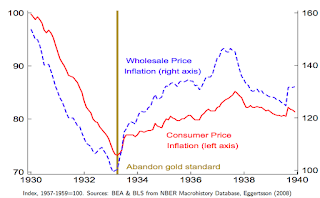

Margaret Jacobson presented her work with Eric Leeper and Bruce Preston on the end of the gold standard in the US in the 1930s. (Eric modestly stated his contribution to the paper as finding the matlab color code for gold, as shown in the graph.)  Margaret and Eric interpret the fiscal statements of the Roosevelt Administration to say that they would run unbacked deficits until the price level returned to its previous level, the \(P^\ast\) in my above equation.  Much discussion followed on how governments today, if they really want inflation, could achieve something similar.

 Part II Monetary Policy 

Chris Sims took on that issue directly. If you want inflation, just running big deficits might not help. Hundreds of years in which governments built up hard-won reputations that when they borrow money, they pay it off, are hard to upend immediately. Even if you want to break that expectation -- all our governments have mixed promises of stimulus now with deficit reduction later.  A devaluation would help, but we don't have a gold standard against which to devalue, and not everyone can devalue relative to each other's currency.

Chris' bottom line is a lot like Margaret and Eric's, and my fiscal Taylor rule,
Coordinating fiscal and monetary policy so that both are explicitly contingent on reaching an inflation target — not only interest rates low, but no tax increases or spending cuts until inflation rises. 
But,
• This might work because it would represent such a shift in political economy that people would rethink their inflation expectations.
Chris led a long discussion including thoughts on rational expectations -- it's a stretch to impose rational expectations on policies that have never been tried before (though our history lesson reminded us just how few genuinely novel policies there are!)

Steve Williamson followed with a thoughtful model full of surprising results. The stock of money does not matter, but fed transfers to the treasury do. (I hope I got that right!)

My presentation (slides also  here  on my webpage) took on the "agenda" question. The basic fiscal equation is
\[\frac{B_{t-1}}{P_t} = E_t \sum M_{t,t+j} s_{t+j} \]
For the project of matching history, data, analyzing policy and finding better regimes, I opined we have spent too much time on the \(s\) fiscal part, and not nearly enough time on the \(M\) discount rate part, or the \(B\) part, which I map to monetary policy.

I argued that in order to understand the cyclical variation of inflation -- in recessions inflation declines while \(B\) is rising and \(s\) is declining -- we need to focus on discount rate variation. More generally, changes in the value of government debt due to interest rate variation are plausibly much bigger than changes in expected surpluses. As interest rates rise, government debt will be worth a lot less, an additionan inflationary pressure that is often overlooked.

Then I presented short versions of recent papers analyzing monetary policy in the fiscal theory of the price level. Interest rate targets with no change in surpluses can determine expected inflation, but the neo-Fisherian conundrum remains.


Harald Uhlig presented a skeptical view, provoking much discussion.  Some main points: large debt and deficits are not associated with inflation, and M2 demand is stable.

I found Harald's critique quite useful. Even if you don't agree with something, knowing that this is how a really sharp and well informed macroeconomist perceives the issues is a vital lesson. I answered somewhat impertinently that we addressed these issues 15 years ago: High debt comes with large expected surpluses, just as in financing a war, because governments want to borrow without creating inflation. The stability of M2 velocity does not isolate cause and effect. The chocolate/GDP ratio is stable too, but eating more chocolate will not increase GDP.

But Harald knows this, and his overall point resonates: You guys need to find something like MV=PY that easily organizes historical events. The obvious graph doesn't work. Irving Fisher came up with MV=PY, but it took Friedman and Schwartz using it to make the idea come alive. That is the purpose of the whole conference.


Francesco Bianchi presented his work with Leonardo Melosi on the Great Recession. New Keynesian models typically predict huge deflation at the zero bound. Why didn't this happen? They specify a model with shifting fiscal vs money dominant regimes. The standard model specifies that once we leave the zero bound we go right back to a money-dominant, Taylor-rule regime with passive fiscal policy. However, if there is a chance of going back to a fiscal-dominant regime for a while, that changes expectations of inflation at the end of the zero bound. Even small changes in those expectations have big effects on inflation during the zero bound (Shameless plug for the New Keynesian Liquidity Trap which explains this point very simply.) So, as you see in the graph above, the "benchmark" model which includes a probability of reverting to a fiscal regime after the zero bound, produces the mild recession and disinflation we have seen, compared to the standard model prediction of a huge depression.


Fiscal policy is political of course. Campbell Leith presented, among other things,  an intriguing tour of how political scientists think about political determinants of debt and deficits. My snarky quip, we learned with great precision that political scientists don't know a heck of a lot more than we do! But if so, that is also wisdom.

Part III International

red line regime switching probability of 30%, blue line 0 % 

Alexander Kriwoluzky presented thoughts on a fiscal theory of exchange rates, applying it to the US vs. Germany, the abandonment of the gold standard and switch to floating rates in the early 1970s. An exchange rate peg means that Germany must import US fiscal policy as well, importing the deficits that support more inflation. Germany didn't want to do that.  People knew that, so a shift to floating rates was in the air. Expectations of that shift can explain the interest differential and apparent failure of uncovered interest parity.


Last but certainly not least, Bartosz Maćkowiak presented a thoughtful analysis of "Monetary-Fiscal Interactions and the Euro Area’s Malaise" joint work with Marek Jarosińsky.

Echoing the fiscal Taylor rule idea running through so many talks, they propose a fiscal rule
\[ S_{n,t} = \Psi_n + \Psi_B \left( B_{n,t-1} - \sum_n \theta_n B_{n,t-1} \right) + \psi_n (Y_{n,t}-Y_n) \]
In words, each country's surplus must react to that country's debt \(B_n\), but total EU surpluses do not react to total EU debt. In this way, the EU is "Ricardian" or "fiscal passive" for each country, but it is "non-Ricardian" or "fiscal active" for the EU as a whole. In their simulations, this fiscal commitment has the same beneficial effects running through Leeper and Jabcobson, Bianchi and Melosi, Sims, and others -- but maintaining the idea that individual countries pay their debts.

A big thanks to the Harris School and the Becker-Friedman Institute who sponsored the conference.


Thứ Ba, 8 tháng 3, 2016

Deflation Puzzle

Larry Summers writes an eloquent FT column "A world stumped by stubbornly low inflation"
Market measures of inflation expectations have been collapsing and on the Fed’s preferred inflation measure are now in the range of 1-1.25 per cent over the next decade.

Inflation expectations are even lower in Europe and Japan. Survey measures have shown sharp declines in recent months. Commodity prices are at multi-decade lows and the dollar has only risen as rapidly as in the past 18 months twice during the past 40 years when it has fluctuated widely

And the Fed is forecasting a return to its 2 per cent inflation target on the basis of models that are not convincing to most outside observers. 

Central bankers [at the G20 meeting] communicated a sense that there was relatively little left that they can do to strengthen growth or even to raise inflation. This message was reinforced by the highly negative market reaction to Japan’s move to negative interest rates.

So why is inflation slowly declining despite our central banks' best efforts? Here is a stab at an answer. I emphasize the central logical points with bullets.

  • Interest rates have two effects on inflation: a short-run "liquidity" effect, and a long-run "expected inflation" or "Fisher" effect.  

In normal times, to raise interest rates, the central bank sells bonds, which soaks up money. Less money drives up interest rates as people bid to borrow a smaller supply, and less money also reduces "demand," which reduces inflation.  In the long run, higher inflation and higher interest rates go together, as they did in the 1980s.

However, we are now in a classic "liquidity trap." Interest rates have been zero since 2008. Money and bonds are perfect substitutes. The proof of that is in the pudding: the Fed massively increased excess reserves from less than $50 billion to almost $3,000 billion, and inflation keeps trundling down.

  • In a liquidity trap, the liquidity effect is absent. 

The liquidity effect will remain absent as the Fed starts raising interest rates, and would remain absent if the Fed were to cut rates or reduce them below zero as other central banks are doing. You can't have more than perfect liquidity.

The Fed isn't even planning to try. It plans to keep the $3,000 billion of excess reserves outstanding and raise interest rates by raising the interest rate on reserves. There will be no open market operations, no "tightening" associated with this interest rate raise.  But even if it did, we're $2,950 billion of excess reserves away from any liquidity effect, so it wouldn't matter.

  • When the liquidity effect is absent, the expected inflation effect is all that remains. Inflation must follow interest rates. 

Central banks thought they were raising inflation by lowering interest rates, following experience from the normal-times liquidity-effect correlation between lower interest rates and higher inflation. But that experience does not apply when its liquidity effect is turned off.

With no liquidity effect, lowering interest rates further below zero can only, slowly, lower inflation further. Central banks desiring inflation may have followed a classic pedal mis-application.

Do I "believe" this story? Belief has no place in science. It is the simplest coherent story that explains the last few years, not needing lots of frictions, irrationalities, and other assumptions. I have some equations to back it up. But we don't "believe" anything at least until it's published and has survived critical examination, replication and dissection. Still, I think it merits consideration.

Shh. I like zero inflation. If central banks have the wrong pedal but are driving the right speed anyway, why wake them up? Even Larry seems to have given up on the Phillips curve:

...suppose that officials were comfortable with current policy settings based on the argument that Phillips curve models predicted that inflation would revert over time to target due to the supposed relationship between unemployment and price increases.

There is no sign of the dreaded "deflation vortex," any more than there is any sign of dreaded monetary hyperinflation. We're drifting down to the Friedman rule. As Larry emphasizes, don't get excited over forecasts from models that rather spectacularly did not forecast where we are today. 
Central banks' desire for 2% inflation, and the Fed's rather puzzling interpretation of its "price stability" mandate to mean perpetual 2% inflation may also be relics of the bygone liquidity-effect regime. 

Appreciate the first half of the column which turns the signs around. It's a great bit of rhetoric.

I have to register mild disagreement with Larry's "solution" to the supposed "problem," 

In all likelihood the important elements will be a combination of fiscal expansion drawing on the opportunity created by super low rates and, in extremis, further experimentation with unconventional monetary policies.

He doesn't say which monetary policies would work, given they have not done so yet. But these are topics for another day.

(Note: If quote and bullet formatting doesn't show up, come back to the original.)

Thứ Sáu, 26 tháng 2, 2016

Sanders multiplier magic

The critiques of Gerald Friedman's analysis of the Sanders economic plan  continue. The latest and most detailed and careful so far is by David and Christina Romer.

Bottom line:

  1. The central idea in Friedman's analysis is that taking $1 from Peter to give to Paul raises overall income by 55 cents.  From this, you get multipliers from raising taxes and spending, from higher minimum wages, more unions, and so forth. 
  2. I chuckle a little bit that so many economists who previously liked multipliers now don't like their logical conclusions. 
  3. The Romers charge a serious, elementary arithmetic mistake in treating levels vs. growth rates. If they're right Friedman's whole analysis is just wrong on arithmetic.

The analysis

One might have expected that a sympathetic analysis of the Sanders plan would say, look, this is going to cost us a bit of growth, but the fairness and (claimed) better treatment of disadvantaged people are worth it.

Friedman's having none of that. In his analysis, the Sanders plan will also unleash a burst of growth, claims for which would make a fervent supply-sider like Art Laffer blush.


"The Sanders program... will raise the gross domestic product by 37% and per capita income by 33% in 2026; the growth rate of per capita GDP will increase from 1.7% a year to 4.5% a year." And, apparently, raise the growth rate permanently.

More stunning still are Friedman's claims about employment, shown at left here

and here.

Multipliers

So, where does this spurt of growth come from? The answer is the magic of multipliers.

But it's not just run of the mill fiscal stimulus multipliers.  After all, Friedman also says that the Sanders program would reduce the deficit, and by 2025 turn the Federal Budget to surplus!

How are multipliers so strong?

There seem to be two basic answers. First, Sanders assumes that there is a large multiplier from income transfers.

If the government takes $1 from rich Peter, and gives that $1 to poor Paul, overall income rises 55 cents! The one quote that makes this clearest is
The stimulus from regulator[y] changes is in Table 9. In general, the assumption is that wages have a multiplier of 0.9 compared with a multiplier of 0.35 for profits accruing to high-income persons. A wage increase coming out of profits, therefore, has a multiplier of 0.55.
It's also visible here explaining how a balanced budget still has a multiplier
the average value of the (governent spending) multiplier from 2017-26 is 0.89, falling from 1.25 to 0.87 as the output gap closes 
Other taxes are assumed to reduce effective demand with a multiplier of 0.35
[The] balance of revenue and spending programs will increase employment and economic growth because the spending program has a larger fiscal multiplier than do progressive tax increases. 
So tax $1 and spend $1 raises GDP by 54 cents.

He cites many standard sources for multipliers. He does not give a theory.  The standard story is that poor Paul consumes a lot more of his income, while rich Peter was investing it all in venture capital startups.  Consumption is good, savings is bad, so GDP rises.

From this central assumption, the rest of the magic follows.  Friedman creatively goes far beyond conventional deficit multipliers, to conjure multipliers out of tax increases, raises in the minimum wage, greater unionization, increased social program spending, and so forth. For example
 I assume that the Paycheck Fairness Act will raise women’s wages by 1% relative to men’s, and there will be an increase of 0.2% a year for the next decade.  I assume that 50% of the increased cost goes to higher prices and 50% comes from profits, and these are assumed to lower spending by higher income people with a multiplier of 0.35.
This, I think, is the central case. Admire it for its courage, and creative use of Keynesian arguments. These are the kind of interventions that most economists admit reduce growth, but some argue for on other grounds. But in Keynesian economics, taking money from low marginal propensity to consume people, and giving it to high marginal propensity to consume people raises GDP.

Snark

At this point, I stop in a bit of amusement at all the criticism. After all, these are just standard Keynesian arguments. The individual multipliers in Friedman's analysis are all conservative, and cite standard middle-of-the-road sources. The economists now so critical of this analysis, including the Romers, former democratic administration CEA chairs who wrote the open letter from past CEA chairs, and Paul Krugman, have been making big multiplier arguments for years to argue for more spending.  The "new Keynesian" academic literature includes multipliers far above two, so one can point to "science" if you wish. (Gauti Eggertsson, Christiano, Eichenbaum and Rebelo ; a simple example with multipliers as large as you want.)

The Romers are right to emphasize that multipliers only operate where "demand" is slack, and monetary policy doesn't steal the show. But the asterisks about fixed interest rates and output below "capacity" have been overlooked by the mainstream many times before. It's a rare Keynesian economist who ever thinks the economy is operating at full capacity. And Friedman has the former monetary asterisk, and he addresses the latter by claiming a large return to the labor force and increased productivity.

Even that view is not so out of the mainstream. For example,  Brad DeLong and Larry Summers wrote an influential Brookings paper arguing for very large fiscal multipliers, with some of the same flavor. There is hysterisis; a multiplier will bring people back to the labor market (as Friedman claims), those people will regain skills, productivity will increase; higher investment will give us better capital and also increase productivity. Demand creates its own supply.

Friedman is apparently just taking the consumption-first, poor-people-spend-more-than-rich-people, undergraduate ISLM analysis, with a bit of Delong-Summers hysterisis, to its logical conclusion. I agree in a way: take those ideas to their logical conclusion and you get silly propositions (old essay on that). Robbing Peter to pay Paul raises income; wasted government spending is good; theft improves the economy, transfers even from thrifty poor to spendthrift rich improve the economy, hurricanes are good for us, social programs, unions, minimum wages raise GDP, and so forth. Well, if the logical conclusions are patently silly, maybe one shouldn't have been making small versions of those arguments all along. Economic Homeopathy is not wisdom. 

Arithmetic 

But the Romers uncover a deeper puzzle. Even with these assumptions -- government spending multipliers around 0.8, and a transfer multiplier of around 0.55 -- you still don't get the wild increase in growth that Friedman claims. So how does he do it? Their answer: 
We have a conjecture about how Friedman may have incorrectly found such large effects. Suppose one is considering a permanent increase in government spending of 1% of GDP, and suppose one assumes that government spending raises output one-for-one. Then one might be tempted to think that the program would raise output growth each year by a percentage point, and so raise the level of output after a decade by about 10%. In fact, however, in this scenario there is no additional stimulus after the first year. As a result, each year the spending would raise the level of output by 1% relative to what it would have been otherwise, and so the impact on the level of output after a decade would be only 1%.
If this is right, it's absolutely damning. This is a question of arithmetic, not economics. (And I would have to swallow some of my above snark!) 

A clearer (maybe) example: The government spends an extra $1 for one year.  With a 1.0 multiplier GDP goes up $1 that year, period. If the government stops spending next year, GDP goes back to where it was. That's the conventional definition of multiplier, and the one that all Fridman's cited sources have in mind. Per Romers, Friedman misread that calculation and assumed the first $1 of spending raises GDP by $1 forever. In 10 years, you have a multiplier of 10! 

The Romers are cautious, and don't directly make this charge. It's not my job to get into the Hilary vs. Bernie whose-numbers-add-up fight. (At least someone here actually seems to care about numbers and economic plans!) But whether the spreadsheets make this arithmetic mistake or not is an answerable question. I hope to inspire someone with a spreadsheet and a nose for such things to check. This is a great time for a replication exercise! 

(Note: This post has pictures and quotes, which don't translate well when the post is picked up elswhere. If you're not seeing them, come back to the original.)

Update: Joakim Book tries to reproduce the numbers and comes up way short.

Update 2: Justin Wolfers at the New York Times did some old-fashioned journalism: He called up Friedman for a reaction.  The article is great, and clear. Yes, Friedman did the calculation as the Romers allege: An extra dollar of government spending today raises GDP permanently; an extra dollar of permanent government spending raises GDP growth permanently. That is at least not what the cited sources have in mind.


Thứ Năm, 25 tháng 2, 2016

Negative rates and FTPL

I've devoted most of my monetary economics research agenda to the Fiscal Theory of the Price Level in the last two decades (collection here). This theory says, fundamentally, that money has value because the government accepts it for taxes, and inflation is fundamentally a fiscal phenomenon over which central banks' conventional tools -- open market operations trading money for government bonds -- have limited power.

Since I grew up in the 1970s, I figured the FTPL would have its day when inflation unexpectedly broke out, again, and central banks were powerless to stop it. I figured that the spread of interest-paying electronic money would so clearly undermine the foundations of MV=PY that its pleasant stories would be quickly abandoned as no longer relevant.

I may have been  exactly wrong on both points: It seems that uncontrolled disinflation or deflation will be the spark for adoption of FTPL ideas; that the equivalence of money and bonds at zero interest rates,  and central banks powerless to create inflation will be the trigger.

These thoughts are prodded by two pieces in the Economist, "Out of Ammo:" and "Unfamiliar Ways Forward" (HT and interesting discussion by Miles Kimball)

If you want inflation (a big if -- I don't, but let's go with the if) how do you get it? Ultra-low rates, huge bond purchases, and lots of talk (forward guidance, higher inflation targets) seem to have no effect. What can governments actually do?


"Out of ammo" explains
... At least some of them [politicians] have failed to grasp the need to have fiscal and monetary policy operating in concert....
... One such option is to finance public spending (or tax cuts) directly by printing money—known as a “helicopter drop”. Unlike QE, a helicopter drop bypasses banks and financial markets, and puts freshly printed cash straight into people’s pockets. The sheer recklessness of this would, in theory, encourage people to spend the windfall, not save it. 
The "recklessness" part is crucial. "Unfamiliar ways" has a more intricate scheme to communicate that recklessness
..a central bank and its finance ministry ... collude in printing money to pay for public spending (or tax cuts). ...the government announces a tax rebate and issues bonds to finance it, but instead of selling them to private investors swaps them for a deposit with the central bank. The central bank proceeds to cancel the bonds, and the government withdraws the money it has on deposit and gives it to citizens. “Helicopter money” of this sort—named in honour of a parable told by Milton Friedman, a famous economist—is as close as you can get to raining cash from a clear blue sky like manna from heaven, untouched by banks and financial markets.
Such largesse is, in effect, fiscal policy financed by money instead of bonds... But the unaccustomed drama—indeed, the apparent recklessness—of helicopter money could increase the expected inflation rate, encouraging taxpayers to spend rather than save.
Simpler, in my mind, the Treasury borrows and sends checks to voters. The Fed buys the bonds and then cancels them.

In addition to rather convoluted scheme, the pieces are not quite clear why the fiscal counterpart is necessary -- or why money has to be involved with fiscal policy.  That was not a central part of Friedman's helicopters. Miles is clearer about this:
the government give[s] away so much money that people would be convinced there was no way the government could ever sell enough bonds to soak that money up. 
This is clear and good FTPL thinking. The value of money is set by how much there is vs how much people expect the government to soak up via taxes -- or bond sales, backed by credible promises of future taxes.

If the government drops $100 in every voter's pocket but simultaneously announces "austerity" that taxes are going up $100 tomorrow, even helicopter drops would have no effect.

Helicopter drops are a clever fiscal signaling device. Canceling the bonds in the Economists plan is the crucial signaling device. They say "we are really going to be reckless."  When governments sell a lot of bonds, people think  the government is sooner or later going to soak up these bonds with taxes, and do not spend. That's the whole point -- bond sales are set up to raise revenue, not to create inflation.  The whole canceling the bonds thing in the Economists's plan, or the helicopter drama in Friedman's, is a clever psychological device, to convince people that no, the government is not going to raise taxes to soak money or underlying bonds up, so you'd better spend it now before it loses value.

Well if (if) our central banks want inflation, why not get out the helicopters?
Such shenanigans are not possible in the euro zone, where the ECB is forbidden by treaty from buying government bonds directly. Elsewhere they might work as follows: 
monetary financing is prohibited by the treaties underpinning the euro, for example
The US Federal reserve is similarly constrained to always buy something in return for creating money -- it can't send checks to voters.

Why?  The people who set up our monetary systems understood all this very well. Their memories were full of disastrous inflations, and they understood that printing money without clear promises that taxes would eventually soak up that money would lead quickly to inflation. So, yes, central banks are prohibited from doing the one thing that would most quickly produce inflation! For about the same reason that wise parents don't keep the car keys in the liquor cabinet.  (There are also all sorts of good political economy reasons that an independent central bank should not lend to specific businesses or send checks to voters.)

The Economist articles are also quite good at the evidence that current monetary policy is essentially powerless.
If policymakers appear defenceless in the face of a fresh threat to the world economy, it is in part because they have so little to show for their past efforts. The balance-sheets of the rich world’s main central banks have been pumped up to between 20% and 25% of GDP by the successive bouts of QE with which they have injected money into their economies (see chart 1). The Bank of Japan’s assets are a whopping 77% of GDP. Yet inflation has been persistently below the 2% goal that central banks aim for.
The power of open market operations -- buying bonds in return for money - is just dramatically refuted, at least at zero interest rates, by recent experience.
One way to get them back up might be to set a higher inflation target. But when inflation sits so persistently below today’s targets, persuading people that higher targets would produce higher rates will require action, not just words.
Or as I call it, the speak loudly because you have no stick policy. If central banks announce a 5% inflation target, and inflation goes down anyway, now what? Announce a 10% target?

Miles goes on about the power of negative interest rates to stoke inflation, which will be a topic for another day. If negative 2% real rates (2% inflation, 0% interest) didn't stoke "demand" and revive the extinct Phillips curve,  I don't see how negative 3% (2% inflation  -1% interest rate) or negative 5% will finally do the trick. In the standard models I've been playing with,  raising nominal interest rates, and committing to keep them there, is the way for central banks to raise expected inflation. That action would, however, also cool the economy, producing stagflation, and thus be particularly pointless.

I also fully admit that I'm cherry-picking the things I like from the Economist article, and ignoring all sorts of things that seem pretty silly to me. The point: I'm glad to see fiscal-theory thinking making its way out of academic debate into real-world commentary, if only in the "radical ideas" section.  Now, on to the "conventional wisdom" section!

Thứ Hai, 22 tháng 2, 2016

Greece and Taxes

An interview for the Greek Reporter, in English, perhaps cheering the like-minded and sure to infuriate some conventional wisdom.

I agree with the "anti-austerians" on one point: Raising taxes was a bad idea. In my emphasis what counts are marginal tax rates on growth-producing activities, rather than Keynesian pump-priming, however, which is an important distinction.

The article says "A recently released study by the Economics Department at the National Kapodistrian University of Athens revealed that Greece has the third highest taxation rate among 21 European countries." If anyone has a link, especially if it's in English, send it in the comments.