I did a short interview with the WSJ's Mary Kissel about my growth oped. If you can't see the embed above, try this direct link or this one.
Hiển thị các bài đăng có nhãn Taxes. Hiển thị tất cả bài đăng
Hiển thị các bài đăng có nhãn Taxes. Hiển thị tất cả bài đăng
Thứ Ba, 3 tháng 5, 2016

WSJ Growth Oped
I did an oped on growth in the Wall Street Journal, titled "Ending America’s Slow-Growth Tailspin." I'll post the full thing here in 30 days.
Blog readers will recognize a distilled version of my longer essay on growth (blog post here, html here, pdf here), and the graph from Smith v. Jones blog post. I think out loud. The growth essay is much more detailed on diagnosis and especially on policy.
There are three basic ideas (two too many for a good oped).
1) Growth is everything. Increasing growth will do way more for every problem you can name than anything else on the economic agenda. Even if workers in 1910 could have taken all of Rockefeller's wealth, they would have been disastrously poor compared to today.
2) Can policies actually improve growth? The tut-tutters mocked Jeb Bush's 4% aspiration. I outline the "we've run out of ideas" school of thought, most recently in Bob Gordon's thoughtful book; the "everything is right but the zero bound" secular-staglation school, and the view that the growth giant is being held back by a liliputian army of politicized regulators.
As evidence, I improved on the graph from an earlier post of the World Bank's ease of doing business score vs. GDP per capita,

(if you can't see the graph, click here)
This graph adds a few things relative to the one in WSJ. I added some outliers. Libya and Venzuela seem like countries with good reasons to have temporarily more GDP than their institutions can long support, Rwanda and Georgia the opposite. So the correlation is even better than it looks. Given how crude the world bank measure is, it's surprising it works so well. It's mostly about the difficulties of starting small businesses. I added Greece too to gives some sense of variation within the Euro-US world.
The point: Bad policies can do dramatic harm. Ipso facto, good policies must be able to do a lot of good. The US is not perfect!
A famous economist challenged my view that regulation is causing a lot of problems, noting that all of the big business types he talks to don't complain that much. But I think that's a horrendous selection bias. If you talk to the people still in business, you are talking to the ones that have figured out the political and regulatory game. Go talk to the ones whose businesses are closed, or not even started.
Another point, regulation has been getting worse for decades. Why the slump now? I think that a lot of the government onslaught's effect has been to make the economy less resilient. For example, social security disability is not a problem as long as you have a job. When you lose a job, and go on disability, now the huge disincentive to work, study, move, kicks in. Recovering from a recession needs new jobs, new businesses, new innovations.
3) A very brief outline of policies to get growth going again. I think the key is to move past the standard rhetoric that defines our current partisan bickering. It's not how much we spend, really, it's how we spend it. Free market economics is not "trickle-down" economics, it's about incentives, simplicity, rule of law, and so forth.
Blog readers will recognize a distilled version of my longer essay on growth (blog post here, html here, pdf here), and the graph from Smith v. Jones blog post. I think out loud. The growth essay is much more detailed on diagnosis and especially on policy.
There are three basic ideas (two too many for a good oped).
1) Growth is everything. Increasing growth will do way more for every problem you can name than anything else on the economic agenda. Even if workers in 1910 could have taken all of Rockefeller's wealth, they would have been disastrously poor compared to today.
2) Can policies actually improve growth? The tut-tutters mocked Jeb Bush's 4% aspiration. I outline the "we've run out of ideas" school of thought, most recently in Bob Gordon's thoughtful book; the "everything is right but the zero bound" secular-staglation school, and the view that the growth giant is being held back by a liliputian army of politicized regulators.
As evidence, I improved on the graph from an earlier post of the World Bank's ease of doing business score vs. GDP per capita,

(if you can't see the graph, click here)
This graph adds a few things relative to the one in WSJ. I added some outliers. Libya and Venzuela seem like countries with good reasons to have temporarily more GDP than their institutions can long support, Rwanda and Georgia the opposite. So the correlation is even better than it looks. Given how crude the world bank measure is, it's surprising it works so well. It's mostly about the difficulties of starting small businesses. I added Greece too to gives some sense of variation within the Euro-US world.
The point: Bad policies can do dramatic harm. Ipso facto, good policies must be able to do a lot of good. The US is not perfect!
A famous economist challenged my view that regulation is causing a lot of problems, noting that all of the big business types he talks to don't complain that much. But I think that's a horrendous selection bias. If you talk to the people still in business, you are talking to the ones that have figured out the political and regulatory game. Go talk to the ones whose businesses are closed, or not even started.
Another point, regulation has been getting worse for decades. Why the slump now? I think that a lot of the government onslaught's effect has been to make the economy less resilient. For example, social security disability is not a problem as long as you have a job. When you lose a job, and go on disability, now the huge disincentive to work, study, move, kicks in. Recovering from a recession needs new jobs, new businesses, new innovations.
3) A very brief outline of policies to get growth going again. I think the key is to move past the standard rhetoric that defines our current partisan bickering. It's not how much we spend, really, it's how we spend it. Free market economics is not "trickle-down" economics, it's about incentives, simplicity, rule of law, and so forth.
Thứ Ba, 5 tháng 4, 2016
Next Steps for FTPL
Last Friday April 1, Eric Leeper Tom Coleman and I organized a conference at the Becker-Friedman Institute, "Next Steps for the Fiscal Theory of the Price Level." Follow the link for the whole agenda, slides, and papers.
The theoretical controversies are behind us. But how do we use the fiscal theory, to understand historical episodes, data, policy, and policy regimes? The idea of the conference was to get together and help each other to map out this the agenda. The day started with history, moved on to monetary policy, and then to international issues.
A common theme was various forms of price-related fiscal rules, fiscal analogues to the Taylor rule of monetary policy. In a simple form, suppose primary surpluses rise with the price level, as
\[ b_t = \sum_{j=0}^{\infty} \beta^j \left( s_{0,t+j} + s_1 (P_{t+j} - P^\ast) \right) \]
where \(b_t\) is the real value of debt, \(s_{0,t}\) is a sequence of primary surpluses budgeted to pay off that debt, \(P^\ast\) is a price-level target and \(P_t\) is the price level. \(b_t\) can be real or nominal debt \( b_{t}= B_{t-1}/P_t\), but I write it as real debt to emphasize the point: This equation too can determine price levels \(P_t\). If inflation rises, the government raises taxes or cuts spending to soak up extra money. If inflation declines, the government does the opposite, putting extra money and debt in the economy but in a way that does not trigger higher future surpluses, so it does push up prices.
(Note: this post has embedded figures and mathjax equations. If the last paragraph is garbled or you don't see graphs below, go here.)
That idea surfaced in many of the papers.
The morning had several papers studying the gold standard and related historical arrangements. To a fiscal theorist the gold standard is really a fiscal commitment. No gold standard has ever backed its note issue 100%; and none has even dreamed of backing its nominal government debt 100%. If a government had that much gold, there would be no point to borrowing.
So a gold standard is a commitment to raise taxes, or to borrow against credible future taxes, to get enough gold should it ever be needed. The gold standard says, we commit to pay off this debt at one, and only one, price level. If inflation gets big, people will start to want to exchange money for gold, and we'll raise taxes. If inflation gets too low, people wills tart to exchange gold for money, and we'll print it up as needed. Usually, in the fiscal theory,
\[ \frac{B_{t-1}}{P_t} = E_t \sum_{j=0}^{\infty} \beta^j s_{t+j}\]
the expectation of future surpluses is a bit nebulous, so inflation might wander around a lot like stock prices. The gold standard is a way to commit to just the right path of surpluses that stabilize the price level.
A summary, with apologies in advance to authors whose points I missed or misunderstood:
Part I: History

George Hall presented his work with Tom Sargent on the history of US debt limits, together with a fantastic new data set on US debt that will be very useful going forward.
François Velde and Christophe Chalmley took us on a lighting tour of monetary arrangements across history, prompting a thoughtful discussion on just where Fiscal theory starts to matter and where it really is not relevant. (François easily gets the prize for the best set of slides. Picking just one was hard.)
Michael Bordo and Arunima Sinha presented an analysis of suspensions of convertibility: Governments temporarily abandon the gold standard during war, then go back at parity afterward. Maybe. By going back afterward, people are willing to hold a lot of unbacked debt and currency during the war. But sometimes the fiscal resources to go back afterward are tough to get, the benefits of establishing credibility so you can borrow in the next war seem further off. When people are unsure whether the country will go back, the wartime inflation is worse, and the cost of going back on parity are heavier. They analyze France vs. UK after WWI.

Martin Kleim took us on a tour of a big inflation in a previous European currency union, the Holy Roman Empire in the early 1600s. Europe has had currency union without fiscal union for a long time, under various metallic standards and coinages. In this case small states, under fiscal pressure from the 30 years' war, started to debase small coins, leading to a large inflation. It ended with an agreement to go back to parity, with the states absorbing the losses. (In my equation, they needed a lot of surpluses to match \(P\) with \(P^\ast\)). We had an interesting discussion on just where those funds came from. Disinflation is always and everywhere a fiscal reform.
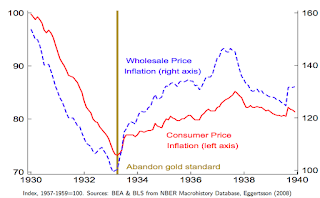
Margaret Jacobson presented her work with Eric Leeper and Bruce Preston on the end of the gold standard in the US in the 1930s. (Eric modestly stated his contribution to the paper as finding the matlab color code for gold, as shown in the graph.) Margaret and Eric interpret the fiscal statements of the Roosevelt Administration to say that they would run unbacked deficits until the price level returned to its previous level, the \(P^\ast\) in my above equation. Much discussion followed on how governments today, if they really want inflation, could achieve something similar.
Part II Monetary Policy
Chris Sims took on that issue directly. If you want inflation, just running big deficits might not help. Hundreds of years in which governments built up hard-won reputations that when they borrow money, they pay it off, are hard to upend immediately. Even if you want to break that expectation -- all our governments have mixed promises of stimulus now with deficit reduction later. A devaluation would help, but we don't have a gold standard against which to devalue, and not everyone can devalue relative to each other's currency.
Chris' bottom line is a lot like Margaret and Eric's, and my fiscal Taylor rule,
Steve Williamson followed with a thoughtful model full of surprising results. The stock of money does not matter, but fed transfers to the treasury do. (I hope I got that right!)
My presentation (slides also here on my webpage) took on the "agenda" question. The basic fiscal equation is
\[\frac{B_{t-1}}{P_t} = E_t \sum M_{t,t+j} s_{t+j} \]
For the project of matching history, data, analyzing policy and finding better regimes, I opined we have spent too much time on the \(s\) fiscal part, and not nearly enough time on the \(M\) discount rate part, or the \(B\) part, which I map to monetary policy.
I argued that in order to understand the cyclical variation of inflation -- in recessions inflation declines while \(B\) is rising and \(s\) is declining -- we need to focus on discount rate variation. More generally, changes in the value of government debt due to interest rate variation are plausibly much bigger than changes in expected surpluses. As interest rates rise, government debt will be worth a lot less, an additionan inflationary pressure that is often overlooked.
Then I presented short versions of recent papers analyzing monetary policy in the fiscal theory of the price level. Interest rate targets with no change in surpluses can determine expected inflation, but the neo-Fisherian conundrum remains.

Harald Uhlig presented a skeptical view, provoking much discussion. Some main points: large debt and deficits are not associated with inflation, and M2 demand is stable.
I found Harald's critique quite useful. Even if you don't agree with something, knowing that this is how a really sharp and well informed macroeconomist perceives the issues is a vital lesson. I answered somewhat impertinently that we addressed these issues 15 years ago: High debt comes with large expected surpluses, just as in financing a war, because governments want to borrow without creating inflation. The stability of M2 velocity does not isolate cause and effect. The chocolate/GDP ratio is stable too, but eating more chocolate will not increase GDP.
But Harald knows this, and his overall point resonates: You guys need to find something like MV=PY that easily organizes historical events. The obvious graph doesn't work. Irving Fisher came up with MV=PY, but it took Friedman and Schwartz using it to make the idea come alive. That is the purpose of the whole conference.

Francesco Bianchi presented his work with Leonardo Melosi on the Great Recession. New Keynesian models typically predict huge deflation at the zero bound. Why didn't this happen? They specify a model with shifting fiscal vs money dominant regimes. The standard model specifies that once we leave the zero bound we go right back to a money-dominant, Taylor-rule regime with passive fiscal policy. However, if there is a chance of going back to a fiscal-dominant regime for a while, that changes expectations of inflation at the end of the zero bound. Even small changes in those expectations have big effects on inflation during the zero bound (Shameless plug for the New Keynesian Liquidity Trap which explains this point very simply.) So, as you see in the graph above, the "benchmark" model which includes a probability of reverting to a fiscal regime after the zero bound, produces the mild recession and disinflation we have seen, compared to the standard model prediction of a huge depression.

Fiscal policy is political of course. Campbell Leith presented, among other things, an intriguing tour of how political scientists think about political determinants of debt and deficits. My snarky quip, we learned with great precision that political scientists don't know a heck of a lot more than we do! But if so, that is also wisdom.
Part III International
Alexander Kriwoluzky presented thoughts on a fiscal theory of exchange rates, applying it to the US vs. Germany, the abandonment of the gold standard and switch to floating rates in the early 1970s. An exchange rate peg means that Germany must import US fiscal policy as well, importing the deficits that support more inflation. Germany didn't want to do that. People knew that, so a shift to floating rates was in the air. Expectations of that shift can explain the interest differential and apparent failure of uncovered interest parity.

Last but certainly not least, Bartosz Maćkowiak presented a thoughtful analysis of "Monetary-Fiscal Interactions and the Euro Area’s Malaise" joint work with Marek Jarosińsky.
Echoing the fiscal Taylor rule idea running through so many talks, they propose a fiscal rule
\[ S_{n,t} = \Psi_n + \Psi_B \left( B_{n,t-1} - \sum_n \theta_n B_{n,t-1} \right) + \psi_n (Y_{n,t}-Y_n) \]
In words, each country's surplus must react to that country's debt \(B_n\), but total EU surpluses do not react to total EU debt. In this way, the EU is "Ricardian" or "fiscal passive" for each country, but it is "non-Ricardian" or "fiscal active" for the EU as a whole. In their simulations, this fiscal commitment has the same beneficial effects running through Leeper and Jabcobson, Bianchi and Melosi, Sims, and others -- but maintaining the idea that individual countries pay their debts.
A big thanks to the Harris School and the Becker-Friedman Institute who sponsored the conference.
The theoretical controversies are behind us. But how do we use the fiscal theory, to understand historical episodes, data, policy, and policy regimes? The idea of the conference was to get together and help each other to map out this the agenda. The day started with history, moved on to monetary policy, and then to international issues.
A common theme was various forms of price-related fiscal rules, fiscal analogues to the Taylor rule of monetary policy. In a simple form, suppose primary surpluses rise with the price level, as
\[ b_t = \sum_{j=0}^{\infty} \beta^j \left( s_{0,t+j} + s_1 (P_{t+j} - P^\ast) \right) \]
where \(b_t\) is the real value of debt, \(s_{0,t}\) is a sequence of primary surpluses budgeted to pay off that debt, \(P^\ast\) is a price-level target and \(P_t\) is the price level. \(b_t\) can be real or nominal debt \( b_{t}= B_{t-1}/P_t\), but I write it as real debt to emphasize the point: This equation too can determine price levels \(P_t\). If inflation rises, the government raises taxes or cuts spending to soak up extra money. If inflation declines, the government does the opposite, putting extra money and debt in the economy but in a way that does not trigger higher future surpluses, so it does push up prices.
(Note: this post has embedded figures and mathjax equations. If the last paragraph is garbled or you don't see graphs below, go here.)
That idea surfaced in many of the papers.
The morning had several papers studying the gold standard and related historical arrangements. To a fiscal theorist the gold standard is really a fiscal commitment. No gold standard has ever backed its note issue 100%; and none has even dreamed of backing its nominal government debt 100%. If a government had that much gold, there would be no point to borrowing.
So a gold standard is a commitment to raise taxes, or to borrow against credible future taxes, to get enough gold should it ever be needed. The gold standard says, we commit to pay off this debt at one, and only one, price level. If inflation gets big, people will start to want to exchange money for gold, and we'll raise taxes. If inflation gets too low, people wills tart to exchange gold for money, and we'll print it up as needed. Usually, in the fiscal theory,
\[ \frac{B_{t-1}}{P_t} = E_t \sum_{j=0}^{\infty} \beta^j s_{t+j}\]
the expectation of future surpluses is a bit nebulous, so inflation might wander around a lot like stock prices. The gold standard is a way to commit to just the right path of surpluses that stabilize the price level.
A summary, with apologies in advance to authors whose points I missed or misunderstood:
Part I: History

George Hall presented his work with Tom Sargent on the history of US debt limits, together with a fantastic new data set on US debt that will be very useful going forward.
 |
| Price of a Chariot Horse: 100,000 Denarii |
Michael Bordo and Arunima Sinha presented an analysis of suspensions of convertibility: Governments temporarily abandon the gold standard during war, then go back at parity afterward. Maybe. By going back afterward, people are willing to hold a lot of unbacked debt and currency during the war. But sometimes the fiscal resources to go back afterward are tough to get, the benefits of establishing credibility so you can borrow in the next war seem further off. When people are unsure whether the country will go back, the wartime inflation is worse, and the cost of going back on parity are heavier. They analyze France vs. UK after WWI.

Martin Kleim took us on a tour of a big inflation in a previous European currency union, the Holy Roman Empire in the early 1600s. Europe has had currency union without fiscal union for a long time, under various metallic standards and coinages. In this case small states, under fiscal pressure from the 30 years' war, started to debase small coins, leading to a large inflation. It ended with an agreement to go back to parity, with the states absorbing the losses. (In my equation, they needed a lot of surpluses to match \(P\) with \(P^\ast\)). We had an interesting discussion on just where those funds came from. Disinflation is always and everywhere a fiscal reform.

Margaret Jacobson presented her work with Eric Leeper and Bruce Preston on the end of the gold standard in the US in the 1930s. (Eric modestly stated his contribution to the paper as finding the matlab color code for gold, as shown in the graph.) Margaret and Eric interpret the fiscal statements of the Roosevelt Administration to say that they would run unbacked deficits until the price level returned to its previous level, the \(P^\ast\) in my above equation. Much discussion followed on how governments today, if they really want inflation, could achieve something similar.
Part II Monetary Policy
Chris Sims took on that issue directly. If you want inflation, just running big deficits might not help. Hundreds of years in which governments built up hard-won reputations that when they borrow money, they pay it off, are hard to upend immediately. Even if you want to break that expectation -- all our governments have mixed promises of stimulus now with deficit reduction later. A devaluation would help, but we don't have a gold standard against which to devalue, and not everyone can devalue relative to each other's currency.
Chris' bottom line is a lot like Margaret and Eric's, and my fiscal Taylor rule,
Coordinating fiscal and monetary policy so that both are explicitly contingent on reaching an inflation target — not only interest rates low, but no tax increases or spending cuts until inflation rises.But,
• This might work because it would represent such a shift in political economy that people would rethink their inflation expectations.Chris led a long discussion including thoughts on rational expectations -- it's a stretch to impose rational expectations on policies that have never been tried before (though our history lesson reminded us just how few genuinely novel policies there are!)
Steve Williamson followed with a thoughtful model full of surprising results. The stock of money does not matter, but fed transfers to the treasury do. (I hope I got that right!)
My presentation (slides also here on my webpage) took on the "agenda" question. The basic fiscal equation is
\[\frac{B_{t-1}}{P_t} = E_t \sum M_{t,t+j} s_{t+j} \]
For the project of matching history, data, analyzing policy and finding better regimes, I opined we have spent too much time on the \(s\) fiscal part, and not nearly enough time on the \(M\) discount rate part, or the \(B\) part, which I map to monetary policy.
I argued that in order to understand the cyclical variation of inflation -- in recessions inflation declines while \(B\) is rising and \(s\) is declining -- we need to focus on discount rate variation. More generally, changes in the value of government debt due to interest rate variation are plausibly much bigger than changes in expected surpluses. As interest rates rise, government debt will be worth a lot less, an additionan inflationary pressure that is often overlooked.
Then I presented short versions of recent papers analyzing monetary policy in the fiscal theory of the price level. Interest rate targets with no change in surpluses can determine expected inflation, but the neo-Fisherian conundrum remains.

Harald Uhlig presented a skeptical view, provoking much discussion. Some main points: large debt and deficits are not associated with inflation, and M2 demand is stable.
I found Harald's critique quite useful. Even if you don't agree with something, knowing that this is how a really sharp and well informed macroeconomist perceives the issues is a vital lesson. I answered somewhat impertinently that we addressed these issues 15 years ago: High debt comes with large expected surpluses, just as in financing a war, because governments want to borrow without creating inflation. The stability of M2 velocity does not isolate cause and effect. The chocolate/GDP ratio is stable too, but eating more chocolate will not increase GDP.
But Harald knows this, and his overall point resonates: You guys need to find something like MV=PY that easily organizes historical events. The obvious graph doesn't work. Irving Fisher came up with MV=PY, but it took Friedman and Schwartz using it to make the idea come alive. That is the purpose of the whole conference.

Francesco Bianchi presented his work with Leonardo Melosi on the Great Recession. New Keynesian models typically predict huge deflation at the zero bound. Why didn't this happen? They specify a model with shifting fiscal vs money dominant regimes. The standard model specifies that once we leave the zero bound we go right back to a money-dominant, Taylor-rule regime with passive fiscal policy. However, if there is a chance of going back to a fiscal-dominant regime for a while, that changes expectations of inflation at the end of the zero bound. Even small changes in those expectations have big effects on inflation during the zero bound (Shameless plug for the New Keynesian Liquidity Trap which explains this point very simply.) So, as you see in the graph above, the "benchmark" model which includes a probability of reverting to a fiscal regime after the zero bound, produces the mild recession and disinflation we have seen, compared to the standard model prediction of a huge depression.

Fiscal policy is political of course. Campbell Leith presented, among other things, an intriguing tour of how political scientists think about political determinants of debt and deficits. My snarky quip, we learned with great precision that political scientists don't know a heck of a lot more than we do! But if so, that is also wisdom.
Part III International
 |
red line regime switching probability of 30%, blue line 0 % |
Alexander Kriwoluzky presented thoughts on a fiscal theory of exchange rates, applying it to the US vs. Germany, the abandonment of the gold standard and switch to floating rates in the early 1970s. An exchange rate peg means that Germany must import US fiscal policy as well, importing the deficits that support more inflation. Germany didn't want to do that. People knew that, so a shift to floating rates was in the air. Expectations of that shift can explain the interest differential and apparent failure of uncovered interest parity.

Last but certainly not least, Bartosz Maćkowiak presented a thoughtful analysis of "Monetary-Fiscal Interactions and the Euro Area’s Malaise" joint work with Marek Jarosińsky.
Echoing the fiscal Taylor rule idea running through so many talks, they propose a fiscal rule
\[ S_{n,t} = \Psi_n + \Psi_B \left( B_{n,t-1} - \sum_n \theta_n B_{n,t-1} \right) + \psi_n (Y_{n,t}-Y_n) \]
In words, each country's surplus must react to that country's debt \(B_n\), but total EU surpluses do not react to total EU debt. In this way, the EU is "Ricardian" or "fiscal passive" for each country, but it is "non-Ricardian" or "fiscal active" for the EU as a whole. In their simulations, this fiscal commitment has the same beneficial effects running through Leeper and Jabcobson, Bianchi and Melosi, Sims, and others -- but maintaining the idea that individual countries pay their debts.
A big thanks to the Harris School and the Becker-Friedman Institute who sponsored the conference.
Thứ Sáu, 26 tháng 2, 2016
Sanders multiplier magic
The critiques of Gerald Friedman's analysis of the Sanders economic plan continue. The latest and most detailed and careful so far is by David and Christina Romer.
Bottom line:
The analysis
One might have expected that a sympathetic analysis of the Sanders plan would say, look, this is going to cost us a bit of growth, but the fairness and (claimed) better treatment of disadvantaged people are worth it.
Friedman's having none of that. In his analysis, the Sanders plan will also unleash a burst of growth, claims for which would make a fervent supply-sider like Art Laffer blush.

"The Sanders program... will raise the gross domestic product by 37% and per capita income by 33% in 2026; the growth rate of per capita GDP will increase from 1.7% a year to 4.5% a year." And, apparently, raise the growth rate permanently.

More stunning still are Friedman's claims about employment, shown at left here
Multipliers
So, where does this spurt of growth come from? The answer is the magic of multipliers.
 But it's not just run of the mill fiscal stimulus multipliers. After all, Friedman also says that the Sanders program would reduce the deficit, and by 2025 turn the Federal Budget to surplus!
How are multipliers so strong?
There seem to be two basic answers. First, Sanders assumes that there is a large multiplier from income transfers.
If the government takes $1 from rich Peter, and gives that $1 to poor Paul, overall income rises 55 cents! The one quote that makes this clearest is
He cites many standard sources for multipliers. He does not give a theory. The standard story is that poor Paul consumes a lot more of his income, while rich Peter was investing it all in venture capital startups. Consumption is good, savings is bad, so GDP rises.
From this central assumption, the rest of the magic follows. Friedman creatively goes far beyond conventional deficit multipliers, to conjure multipliers out of tax increases, raises in the minimum wage, greater unionization, increased social program spending, and so forth. For example
Snark
At this point, I stop in a bit of amusement at all the criticism. After all, these are just standard Keynesian arguments. The individual multipliers in Friedman's analysis are all conservative, and cite standard middle-of-the-road sources. The economists now so critical of this analysis, including the Romers, former democratic administration CEA chairs who wrote the open letter from past CEA chairs, and Paul Krugman, have been making big multiplier arguments for years to argue for more spending. The "new Keynesian" academic literature includes multipliers far above two, so one can point to "science" if you wish. (Gauti Eggertsson, Christiano, Eichenbaum and Rebelo ; a simple example with multipliers as large as you want.)
The Romers are right to emphasize that multipliers only operate where "demand" is slack, and monetary policy doesn't steal the show. But the asterisks about fixed interest rates and output below "capacity" have been overlooked by the mainstream many times before. It's a rare Keynesian economist who ever thinks the economy is operating at full capacity. And Friedman has the former monetary asterisk, and he addresses the latter by claiming a large return to the labor force and increased productivity.
Even that view is not so out of the mainstream. For example, Brad DeLong and Larry Summers wrote an influential Brookings paper arguing for very large fiscal multipliers, with some of the same flavor. There is hysterisis; a multiplier will bring people back to the labor market (as Friedman claims), those people will regain skills, productivity will increase; higher investment will give us better capital and also increase productivity. Demand creates its own supply.
(Note: This post has pictures and quotes, which don't translate well when the post is picked up elswhere. If you're not seeing them, come back to the original.)
Update: Joakim Book tries to reproduce the numbers and comes up way short.
Update 2: Justin Wolfers at the New York Times did some old-fashioned journalism: He called up Friedman for a reaction. The article is great, and clear. Yes, Friedman did the calculation as the Romers allege: An extra dollar of government spending today raises GDP permanently; an extra dollar of permanent government spending raises GDP growth permanently. That is at least not what the cited sources have in mind.
Bottom line:
- The central idea in Friedman's analysis is that taking $1 from Peter to give to Paul raises overall income by 55 cents. From this, you get multipliers from raising taxes and spending, from higher minimum wages, more unions, and so forth.
- I chuckle a little bit that so many economists who previously liked multipliers now don't like their logical conclusions.
- The Romers charge a serious, elementary arithmetic mistake in treating levels vs. growth rates. If they're right Friedman's whole analysis is just wrong on arithmetic.
The analysis
One might have expected that a sympathetic analysis of the Sanders plan would say, look, this is going to cost us a bit of growth, but the fairness and (claimed) better treatment of disadvantaged people are worth it.
Friedman's having none of that. In his analysis, the Sanders plan will also unleash a burst of growth, claims for which would make a fervent supply-sider like Art Laffer blush.

"The Sanders program... will raise the gross domestic product by 37% and per capita income by 33% in 2026; the growth rate of per capita GDP will increase from 1.7% a year to 4.5% a year." And, apparently, raise the growth rate permanently.

More stunning still are Friedman's claims about employment, shown at left here
and here. 

Multipliers
So, where does this spurt of growth come from? The answer is the magic of multipliers.

How are multipliers so strong?
There seem to be two basic answers. First, Sanders assumes that there is a large multiplier from income transfers.
If the government takes $1 from rich Peter, and gives that $1 to poor Paul, overall income rises 55 cents! The one quote that makes this clearest is
The stimulus from regulator[y] changes is in Table 9. In general, the assumption is that wages have a multiplier of 0.9 compared with a multiplier of 0.35 for profits accruing to high-income persons. A wage increase coming out of profits, therefore, has a multiplier of 0.55.It's also visible here explaining how a balanced budget still has a multiplier
the average value of the (governent spending) multiplier from 2017-26 is 0.89, falling from 1.25 to 0.87 as the output gap closes
Other taxes are assumed to reduce effective demand with a multiplier of 0.35
[The] balance of revenue and spending programs will increase employment and economic growth because the spending program has a larger fiscal multiplier than do progressive tax increases.So tax $1 and spend $1 raises GDP by 54 cents.
He cites many standard sources for multipliers. He does not give a theory. The standard story is that poor Paul consumes a lot more of his income, while rich Peter was investing it all in venture capital startups. Consumption is good, savings is bad, so GDP rises.
From this central assumption, the rest of the magic follows. Friedman creatively goes far beyond conventional deficit multipliers, to conjure multipliers out of tax increases, raises in the minimum wage, greater unionization, increased social program spending, and so forth. For example
I assume that the Paycheck Fairness Act will raise women’s wages by 1% relative to men’s, and there will be an increase of 0.2% a year for the next decade. I assume that 50% of the increased cost goes to higher prices and 50% comes from profits, and these are assumed to lower spending by higher income people with a multiplier of 0.35.This, I think, is the central case. Admire it for its courage, and creative use of Keynesian arguments. These are the kind of interventions that most economists admit reduce growth, but some argue for on other grounds. But in Keynesian economics, taking money from low marginal propensity to consume people, and giving it to high marginal propensity to consume people raises GDP.
Snark
At this point, I stop in a bit of amusement at all the criticism. After all, these are just standard Keynesian arguments. The individual multipliers in Friedman's analysis are all conservative, and cite standard middle-of-the-road sources. The economists now so critical of this analysis, including the Romers, former democratic administration CEA chairs who wrote the open letter from past CEA chairs, and Paul Krugman, have been making big multiplier arguments for years to argue for more spending. The "new Keynesian" academic literature includes multipliers far above two, so one can point to "science" if you wish. (Gauti Eggertsson, Christiano, Eichenbaum and Rebelo ; a simple example with multipliers as large as you want.)
The Romers are right to emphasize that multipliers only operate where "demand" is slack, and monetary policy doesn't steal the show. But the asterisks about fixed interest rates and output below "capacity" have been overlooked by the mainstream many times before. It's a rare Keynesian economist who ever thinks the economy is operating at full capacity. And Friedman has the former monetary asterisk, and he addresses the latter by claiming a large return to the labor force and increased productivity.
Friedman is apparently just taking the consumption-first, poor-people-spend-more-than-rich-people, undergraduate ISLM analysis, with a bit of Delong-Summers hysterisis, to its logical conclusion. I agree in a way: take those ideas to their logical conclusion and you get silly propositions (old essay on that). Robbing Peter to pay Paul raises income; wasted government spending is good; theft improves the economy, transfers even from thrifty poor to spendthrift rich improve the economy, hurricanes are good for us, social programs, unions, minimum wages raise GDP, and so forth. Well, if the logical conclusions are patently silly, maybe one shouldn't have been making small versions of those arguments all along. Economic Homeopathy is not wisdom.
Arithmetic
But the Romers uncover a deeper puzzle. Even with these assumptions -- government spending multipliers around 0.8, and a transfer multiplier of around 0.55 -- you still don't get the wild increase in growth that Friedman claims. So how does he do it? Their answer:
We have a conjecture about how Friedman may have incorrectly found such large effects. Suppose one is considering a permanent increase in government spending of 1% of GDP, and suppose one assumes that government spending raises output one-for-one. Then one might be tempted to think that the program would raise output growth each year by a percentage point, and so raise the level of output after a decade by about 10%. In fact, however, in this scenario there is no additional stimulus after the first year. As a result, each year the spending would raise the level of output by 1% relative to what it would have been otherwise, and so the impact on the level of output after a decade would be only 1%.
If this is right, it's absolutely damning. This is a question of arithmetic, not economics. (And I would have to swallow some of my above snark!)
A clearer (maybe) example: The government spends an extra $1 for one year. With a 1.0 multiplier GDP goes up $1 that year, period. If the government stops spending next year, GDP goes back to where it was. That's the conventional definition of multiplier, and the one that all Fridman's cited sources have in mind. Per Romers, Friedman misread that calculation and assumed the first $1 of spending raises GDP by $1 forever. In 10 years, you have a multiplier of 10!
The Romers are cautious, and don't directly make this charge. It's not my job to get into the Hilary vs. Bernie whose-numbers-add-up fight. (At least someone here actually seems to care about numbers and economic plans!) But whether the spreadsheets make this arithmetic mistake or not is an answerable question. I hope to inspire someone with a spreadsheet and a nose for such things to check. This is a great time for a replication exercise!
Update: Joakim Book tries to reproduce the numbers and comes up way short.
Update 2: Justin Wolfers at the New York Times did some old-fashioned journalism: He called up Friedman for a reaction. The article is great, and clear. Yes, Friedman did the calculation as the Romers allege: An extra dollar of government spending today raises GDP permanently; an extra dollar of permanent government spending raises GDP growth permanently. That is at least not what the cited sources have in mind.
Thứ Hai, 22 tháng 2, 2016
Greece and Taxes
An interview for the Greek Reporter, in English, perhaps cheering the like-minded and sure to infuriate some conventional wisdom.
I agree with the "anti-austerians" on one point: Raising taxes was a bad idea. In my emphasis what counts are marginal tax rates on growth-producing activities, rather than Keynesian pump-priming, however, which is an important distinction.
The article says "A recently released study by the Economics Department at the National Kapodistrian University of Athens revealed that Greece has the third highest taxation rate among 21 European countries." If anyone has a link, especially if it's in English, send it in the comments.
I agree with the "anti-austerians" on one point: Raising taxes was a bad idea. In my emphasis what counts are marginal tax rates on growth-producing activities, rather than Keynesian pump-priming, however, which is an important distinction.
The article says "A recently released study by the Economics Department at the National Kapodistrian University of Athens revealed that Greece has the third highest taxation rate among 21 European countries." If anyone has a link, especially if it's in English, send it in the comments.
Thứ Sáu, 22 tháng 1, 2016
Tax Oped -- full version
 |
| Source: Wall Street Journal |
Left and right agree that the U.S. tax code is a mess. The men and women running for president in 2016 are offering reform plans, and proposals to fix the code regularly surface in Congress. But these plans are, and should be, political documents, designed to attract votes. To prevent today’s ugly bargains from becoming tomorrow’s conventional wisdom, we should more frequently discuss the ideal tax structure.
The first goal of taxation is to raise needed government revenue with minimum economic damage. That means lower marginal rates—the additional tax people pay for each extra dollar earned—and a broader base of income subject to tax. It also means a massively simpler tax code.
In my view, simplification is more important than rates. A simple code would allow people and businesses to spend more time and resources on productive activities and less on attorneys and accountants, or on lobbyists seeking special deals and subsidies. And a simple code is much more clearly fair. Americans now suspect that people with clever lawyers are avoiding much taxation, which is corrosive to compliance and driving populist outrage across the political spectrum.
What would a minimally damaging, simple, fair tax code look like? First, the corporate tax should be eliminated. Every dollar of taxes that a corporation seems to pay comes from higher prices to its customers, lower wages to its workers, or lower dividends to its shareholders. Of these groups, wealthy individual shareholders are the least likely to suffer. If taxes eat into profits, investors pay lower prices for less valuable shares, and so earn the same return as before. To the extent that taxes do reduce returns, they also financially hurt nonprofits and your and my pension funds.
With no corporate tax, arguments disappear over investment expensing versus depreciation, repatriation of profits, too much tax-deductible debt, R&D deductions, and the vast array of energy deductions and credits.
Second, the government should tax consumption, not wages, income or wealth. When the government taxes savings, investment income, wealth or inheritance, it reduces the incentive to save, invest and build companies rather than enjoy consumption immediately. Taxes on capital gains discourage people from moving or reallocating capital toward their most productive uses.
Recognizing the distortion, the federal government provides a complex web of shelters, including IRAs, Roth IRAs, 527(b), 401(k), health-savings accounts, life-insurance exemptions, and the panoply of trusts that wealthy individuals use to shelter their wealth and escape the estate tax. If investment isn’t taxed, these costly complexities can disappear.
All the various deductions, credits and exclusions should be eliminated—even the holy trinity of tax breaks for mortgage interest, charitable donations and employer-provided health insurance. The extra revenue, over a trillion dollars annually, could finance a large reduction in marginal rates. This step would also simplify the code and make it fairer.
Imagine that Congress proposed to send an annual check to each homeowner. People with high incomes, who buy expensive houses, borrow lots of money or refinance often, would get bigger checks than people with low incomes, who buy smaller houses, save up more for down payments or pay down their mortgages. There would be rioting in the streets. Yet that is exactly what the mortgage-interest deduction accomplishes.
Similarly, suppose Congress proposed to match private charitable donations. But rich people would get a 40% match, middle class people only 10%, and poor people nothing. This is exactly what the charitable deduction accomplishes.
Zeroing out deductions, credits, and corporate and investment taxes matters—for permanence, for predictability and for simplicity. If the corporate rate is drastically reduced, or if deductions are capped, it seems that the economic distortions go away. But the thousands of pages of tax code are still in place, the army of lawyers and accountants and lobbyists is still in place, and the next administration will itch to raise the caps, and the rate.
Why is tax reform paralyzed? Because political debate mixes the goal of efficiently raising revenue with so many other objectives. Some want more progressivity or more revenue. Others defend subsidies and transfers for specific activities, groups or businesses. They hold reform hostage.
Wise politicians often bundle dissimilar goals to attract a majority. But when bundling leads to paralysis, progress comes by separating the issues. Thus, we should agree to first reform the structure of the tax code, leaving the rates blank. We will then separately debate rates, and the consequent overall revenue and progressivity.
Consumption-based taxes can be progressive. A simplified income tax, excluding investment income and allowing a full deduction for savings, could tax high-income earners’ consumption at a higher rate. Low-income people can receive transfers and credits. I think smaller government and less progressivity are wiser. But we can agree on an efficient, simple and fair tax, and debate revenues and progressivity separately.
We should also agree to separate the tax code from the subsidy code. We agree to debate subsidies for mortgage-interest payments, electric cars and the like—transparent and on-budget—but separately from tax reform.
Negotiating such an agreement will be hard. But the ability to achieve grand bargains is the most important characteristic of great political leaders.
Mr. Cochrane is a senior fellow at Stanford University’s Hoover Institution.
Đăng ký:
Bài đăng (Atom)