Hiển thị các bài đăng có nhãn Politics and economics. Hiển thị tất cả bài đăng

Thứ Sáu, 6 tháng 5, 2016

Delong and Logarithms

Brad Delong posted a response to my oped on growth  in the Wall Street Journal. He took issue with my graph, reproduced here,


by making his own graph, here


He characterizes the difference between our graphs with his usual gentlemanly restraint,

"Extraordinarily Unprofessional!!:" "total idiocy" The University of Chicago and the Wall Street Journal Have Very Serious Intellectual Quality Control Problems

and so forth.

If you read Brad, you may wonder what skulduggery I used to make the plot. I will now reveal the dark secret. It's a clever Chicago-school mathematical trick:

Logarithms.

Yes, I plotted log income vs. ease of doing business index.

Now just how much of a sin is this? Well, growth theory is about growth, so it's pretty hard to do without logarithms. If thinking about percentage growth and running regressions with log income on the left hand side is a devious right-wing trick, I'm afraid we're going to have to throw out about 99% of growth theory and empirical economics, including much done by Brad's colleagues at Berkeley.

Furthermore, just look at the graph.  I invite anybody who has sat through a first-year econometrics class where they teach this devious technique to ponder my and Brad's plot, and think whether a level or a log fit is appropriate.

Brad raises one valid concern with all of empirical economics: Endogeneity. The graph is a correlation. How do we know that better ease of doing business causes better business, and not the other way around? In Brad's view, it is equally likely, I guess, that first a contry gets rich, and then it improves its laws and regulations.

I didn't mention this in the Journal, simply for lack of space (try to write anything in 950 words). In a previous blog post, here, I wrote a little bit about it.
One might dismiss the correlation a bit as reverse causation. But look at North vs. South Korea, East vs. West Germany, and the rise of China and India. It seems bad policies really can do a lot of damage. And the US and UK had pretty good institutions when their GDPs were much lower. (Hall and Jones 1999 control for endogeneity in this sort of regression by using instrumental variables.)
(This post isn't hard to find. I linked to from my growth oped post. And if one is curious about "what does John have to say about endogeneity?" -- a rather obvious question, which I ask about twice at every seminar -- it is also possible to email me. )

That post goes on to survey a lot of academic literature on just how important good institutions are to economic growth.

But just think about it. Did North Korea or East Germany first get poor and then get bad institutions? Did the UK and US first get rich, and then develop our rule-of-law and property rights traditions? Is reverse causality at all a plausible explanation for the correlation? Just about every historical episode you can think of goes the other way.

Endogeneity is always an issue in economics, but Brad's case that I am too dumb to have even thought about it, or that this correlation obviously goes the other way,  does not hold up.

But apparently, Brad doesn't know about google, fact checking, or emailing for simple clarifications either. Otherwise he would know that I don't work at Chicago anymore, hardly a secret.

The notion that universities should practice "intellectual quality control" is interesting in this era of declining free speech. Brad, be careful what you wish for.  "Controlling" basic professional ethics may come first.

If anyone is still curious, I posted my data and program to my website, and this post describes it some more. I didn't clean it up well, as I never thought this would be controversial, but at least it documents what I did. Feel free to play with it as you wish.

Update: It's clear from many comments and the twitter storm that many readers, even trained economists, missed this basic point. My graph is an illustration of a conclusion reached by hundreds, if not more, papers in the academic literature. It is not The Evidence, or even particularly novel evidence. Were it so, standard errors, specification search, endogeneity, much better measures of institutions, etc. would be appropriate, as many suggest. My graph is just a quick graphical illustration of the conclusions of much growth economics, including much work by Jones, Acemoglu, Barro, Klenow, and many many others. Institutions matter to economic growth; bad governments have amazing power to ruin economies.  As always in writing, I should have made that clearer; but I thought this literature was familiar to the average economist-blogger.

Update 2: There is, I think, an important mis-specification in a regression of log income on the ease-of-doing business index, which Evan Soltas implicitly points out.  I referred to the index as "simple" and "crude" for this reason, but again it looks like this seemingly obvious point needs expanding.

The World bank's measure is mostly focused on the ease of starting small businesses. When we look at the regulatory sclerosis in the US, it is a much wider phenomenon, encompassing the tax code, social program disincentives, the  recent huge expansion of federal involvement in health and finance, general spread of cronyism, reduction in rule of law, and so forth. These affect large businesses as much or more than small businesses.

Clearly, as we look across countries, the ease of doing business is correlated with these wider legal and regulatory problems. Countries with bad institutions overall also have bad ease of doing business scores. But just as obviously, only fixing the ease of doing business indicators without fixing the larger legal and institutional failures that correlate with those indicators, won't do a whole lot of good, which is what Evan seems to find.

The regulatory program I outlined there and in the longer essay on growth (blog post herehtml here,   pdf here) went far beyond ease of doing business indicators, for just this reason.

Update 3: Or, seemingly obvious point #3 that seems to need an answer. A few commenters have questioned  how far "out of sample" one can go. At some point, yes, institutions are perfect and more income will not result from improving them. Where is that? 90? 100? 110? I don't know. But the local derivative is still high, no matter how you fit the "out of sample" points. If you don't think you can draw the line out to 100, going from 82 to 83 still has very large effects.

Thứ Tư, 4 tháng 5, 2016

Central Bank Governance and Oversight Reform

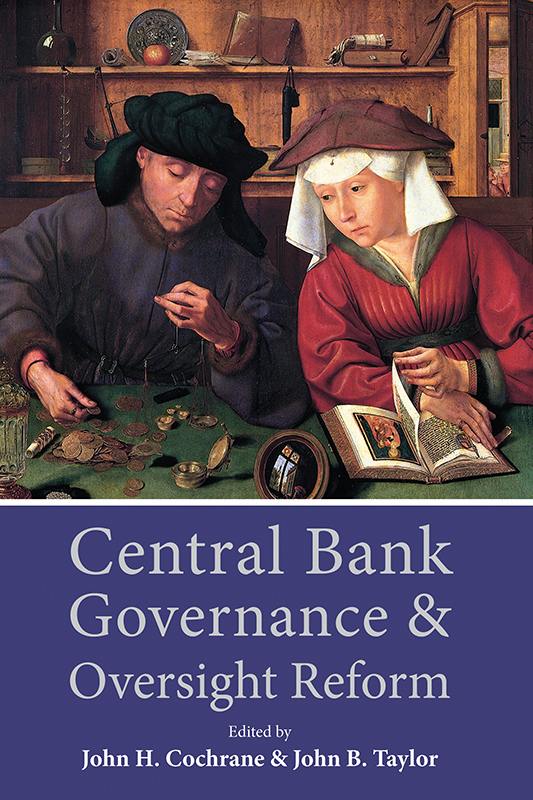
The Hoover Institution Press just published "Central Bank Governance and Oversight Reform," the collected volume of papers, comments, and discussion from last May's conference here by the same name. You can get the  book or e-book here at the Hoover press or here at amazon.com. The individual chapter pdfs are available here.  Press release here.

(My modest contributions are in the preface and a discussion of Paul Tucker's Chapter 1. I agree it would be nice to have a more rule-based approach to lender of last resort and bailout functions, but wouldn't lots of equity so you don't have to mop up so often be even better?)

This is part of an emerging series of monetary policy conferences at Hoover. Tomorrow we will have a conference on international monetary policy. Stay tuned...


The blurb:
How can we balance the central bank’s authority, including independence, with accountability and constraints? Drawn from a 2015 Hoover Institution conference, this book features distinguished scholars and policy makers’ discussing this and other key questions about the Fed. Going beyond the simple decision of whether to raise interest rates, they focus on a deeper set of questions, including, among others, How should the Fed make decisions? How should the Fed govern its internal decision-making processes? What is the trade-off between greater Fed power and less Fed independence? And how should Congress, from which the Fed ultimately receives its authority, oversee the Fed?

The contributors discuss, for instance, whether central banks can both follow rule-based policy in normal times but then take a discretionary, do-what-it-takes approach to stopping financial crises. They evaluate legislation, recently proposed in the U.S. House and Senate, that would require the Fed to describe its monetary policy rule and, if and when the Fed changed or deviated from its rule, explain the reasons. And they discuss to best ways to structure a committee—like the Federal Open Market Committee, which sets interest rates—to make good decisions, as well as offer historical reflections on the governance of the Fed and much more. They conclude with an important reminder: how important it is to have a “healthy separation between government officials who are in charge of spending and those who are in charge of printing money,” the most essential part of good governance.
The contents:

Preface
By John H. Cochrane and John B. Taylor

Chapter 1: How Can Central Banks Deliver Credible Commitment and Be “Emergency Institutions”?
By Paul Tucker

Chapter 2: Policy Rule Legislation in Practice
By David H. Papell, Alex Nikolsko-Rzhevskyy and Ruxandra Prodan

Chapter 3: Goals versus Rules as Central Bank Performance Measures
By Carl E. Walsh

Chapter 4: Institutional Design: Deliberations, Decisions, and Committee Dynamics
By Kevin M. Warsh

Chapter 5: Some Historical Reflections on the Governance of the Federal Reserve
By Michael D. Bordo

Chapter 6: Panel on Independence, Accountability, and Transparency in Central Bank Governance
By Charles I. Plosser, George P. Shultz, and John C. Williams

Thứ Ba, 3 tháng 5, 2016

Growth Interview


I did a short interview with the WSJ's Mary Kissel about my growth oped. If you can't see the embed above, try this direct link or this one

WSJ Growth Oped

I did an oped on growth in the Wall Street Journal, titled "Ending America’s Slow-Growth Tailspin." I'll post the full thing here in 30 days.

Blog readers will recognize a distilled version of my longer essay on growth (blog post herehtml here,   pdf here), and the graph from Smith v. Jones blog post. I think out loud. The growth essay is much more detailed on diagnosis and especially on policy.

There are three basic ideas (two too many for a good oped).

1) Growth is everything. Increasing growth will do way more for every problem you can name than anything else on the economic agenda. Even if workers in 1910 could have taken all of Rockefeller's wealth, they would have been disastrously poor compared to today.

2) Can policies actually improve growth? The tut-tutters mocked Jeb Bush's 4% aspiration. I outline the "we've run out of ideas" school of thought, most recently in Bob Gordon's thoughtful book; the "everything is right but the zero bound" secular-staglation school, and the view that the growth giant is being held back by a liliputian army of politicized regulators.

As evidence,  I improved on the graph from an earlier post of the World Bank's ease of doing business score vs. GDP per capita,


(if you can't see the graph, click here)

This graph adds a few things relative to the one in WSJ. I added some outliers. Libya and Venzuela seem like countries with good reasons to have temporarily more GDP than their institutions can long support, Rwanda and Georgia the opposite. So the correlation is even better than it looks. Given how crude the world bank measure is, it's surprising it works so well. It's mostly about the difficulties of starting small businesses. I added Greece too to gives some sense of variation within the Euro-US world.

The point: Bad policies can do dramatic harm. Ipso facto, good policies must be able to do a lot of good. The US is not perfect!

A famous economist challenged my view that regulation is causing a lot of problems, noting that all of the big business types he talks to don't complain that much. But I think that's a horrendous selection bias. If you talk to the people still in business, you are talking to the ones that have figured out the political and regulatory game. Go talk to the ones whose businesses are closed, or not even started.

Another point, regulation has been getting worse for decades. Why the slump now? I think that a lot of the government onslaught's effect has been to make the economy less resilient. For example, social security disability is not a problem as long as you have a job. When you lose a job, and go on disability, now the huge disincentive to work, study, move, kicks in.  Recovering from a recession needs new jobs, new businesses, new innovations.

3) A very brief outline of policies to get growth going again. I think the key is to move past the standard rhetoric that defines our current partisan bickering. It's not how much we spend, really, it's how we spend it. Free market economics is not "trickle-down" economics, it's about incentives, simplicity, rule of law, and so forth.


Thứ Bảy, 30 tháng 4, 2016

Equity-financed banking

My dream of equity-financed banking may be coming true under our noses. In "the Uberization of banking" Andy Kessler at the WSJ reports on SoFi, a "fintech" company. The article is mostly about the human-interest story of its co-founder Mike Cagney. But the interspersed economics are interesting.

SoFi started by making student loans to Stanford MBAs, after figuring out that the default rate on such loans is basically zero. It
has since expanded to student loans more generally and added mortgages, personal loans and wealth management. Mr. Cagney says SoFi has done 150,000 loans totaling $10 billion and is currently at a $1 billion monthly loan-origination rate. 
Where does the money come from?
SoFi doesn’t take deposits, so it’s FDIC-free. ... Instead, SoFi raises money for its loans, most recently $1 billion from SoftBank and the hedge fund Third Point, in exchange for about a quarter of the company. SoFi uses this expanded balance sheet to make loans and then securitize many of them to sell them off to investors so it can make more loans
Just to bash the point home, consider what this means:
  • A "bank" (in the economic, not legal sense) can finance loans, raising money essentially all from equity and no conventional debt. And it can offer competitive borrowing rates -- the supposedly too-high "cost of equity" is illusory.
     
  • There is no necessary link between the business of taking and servicing deposits and that of making loans. Banks need not (try to) "transform" maturity or risk.
     
  • To the extent that the bank wants to boost up the risk and return of its equity, it can do so by securitizing loans rather than by borrowing. (Securitized loans are not leverage -- there is no promise of your money back when you want it. Investors bear any losses immediately and without recourse.)
     
  • Equity-financed banking can emerge without new regulations, or a big new Policy Initiative.  It's enough to have relief from old regulations ("FDIC-free").
     
  • Since it makes no fixed-value promises, this structure is essentially run free and can't cause or contribute to a financial crisis. 

More. SoFi does not use the standard methods of evaluating credit risk:
Instead of relying on notoriously inaccurate backward-looking FICO scores, SoFi is “forward-looking.” That means asking basic questions—“Do you make more money than you spend?”—and calibrating where applicants went to college, how long they’ve been employed, how stable their income is likely to be over time.
Why can’t banks do this? Because if you use depositor money for loans, as all banks do, you fall under the jurisdiction of the Federal Deposit Insurance Corp. and the Community Reinvestment Act,...
And Basel and the FSOC and the Fed and so forth. FICO score based mechanical lending standards are also demanded by government-backed securitizers Fannie and Freddie.

Yes, bank "safety" regulations demand that banks purposely lend to people that one can pretty clearly see will not pay it back, and demand that they do not lend money to people that one can pretty clearly see will pay it back.

Now, what will the regulatory response be to this sort of innovation? The right answer, of course, should be hosannas: You have introduced run-free banking, that solves all the financial-crisis worries that 90 years of bank regulation could not solve. Let this spread, and the army of bank regulators, lobbyists, lawyers, and associated politicians can all go, well, drive for Uber.

Somehow I doubt that will be the response from foresaid army. And SoFi might well want to invest in its own lawyers, lobbyists and politicians in today's America.
Rather than by the FDIC, SoFi is monitored by the Consumer Financial Protection Bureau. The overbearing regulator that was Elizabeth Warren’s brainchild thus far hasn’t come down on SoFi—the CFPB is perhaps too preoccupied with using “disparate impact” analysis of old-school auto-loan businesses to focus on a relatively exotic, app-based form of banking. But Mr. Cagney should watch his back.
Indeed he should. In today's rather rule-free environment, the CFPB -- or Department of Justice -- might just discover it doesn't like the demographics of Stanford MBAs as target borrowers.
He’d like to get a national lending license, but that would entail federal-oversight entanglements he’d rather avoid.
If he can.

A little puzzle crops up at the end. For now, I gather SoFi does not issue public equity. The plan for expansion is
insurance companies and sovereign-wealth funds might rent him their balance sheets. 
I'm not sure what "rent a balance sheet" means, but it sounds a lot like private equity or long term debt.  It would be even better for stability and low cost to issue public equity, which is liquid -- investors who need money fast can sell. But public equity comes with its own regulatory scrutiny, and perhaps even that is too much for innovation these days.

Thứ Ba, 19 tháng 4, 2016

Chari and Kehoe on Bailouts

V. V. Chari and Pat Kehoe have a very nice article on bank reform, "A Proposal to Eliminate the Distortions Caused by Bailouts," backed up by a serious academic paper.

Their bottom line proposal is a limit on debt to equity ratios, rising with size. This is, I think, a close cousin to my view that a Pigouvian tax on debt could substitute for much of our regulation.

Banks pose a classic moral hazard problem. In a financial crisis, governments are tempted to bail out bank creditors. Knowing they will do so, bankers take too much risk and people lend to too risky banks. The riskier the bank, the stronger the governments' temptation to bail it out ex-post.

Chari and Pat write with a beautifully disciplined economic perspective: Don't argue about transfers, as rhetorically and politically effective as that might be, but identify the distortion and the resulting inefficiency. Who cares about bailouts? Well, taxpayers obviously. But economists shouldn't worry primarily about this as a transfer. The economic problem is the distortion that higher tax rates impose on the economy. Second, there is a subsidy distortion that bailed out firms and creditors expand at the expense of other, more profitable activities. Third there is a debt and size distortion. Since debt is bailed out but not equity, we get more debt, and the banks who can get bailouts become inefficiently large.
For sake of argument, I think, Chari and Pat take a benign view of orderly resolution and living wills. Their point is that even this is not enough. Though functioning resolution would solve the tax distortion and subsidy distortion, the debt-size externality remains.
The extent of regulator intervention depends on the aggregate losses due to threatened bankruptcies. Individual firms do not internalize the effect of their decisions on aggregate outcomes and, therefore, on the extent of such intervention. Just as with bailouts, individual firms have incentives to become too large relative to the sustainably efficient outcome 
Their alternative: A regulatory system that
limits the debt-equity ratio of financial firms and imposes a Pigouvian tax on the size of these firms.
The paper is not specific beyond this suggestion. It's intriguing for many reasons outside the paper.

First, they limit the ratio of debt to equity, not the ratio of debt to assets. Current bank regulation is centered on the ratio of debt to assets, but then we get in to the mess of measuring risk-weighted assets, many of them at book value.  Abandoning this whole mess is a great idea.

Thinking about some of the same issues, I came to the conclusion that a simple Pigouvian tax on debt would work better than current debt-to-asset regulations. If you borrow $1 (especially short) you pay an 5 cent tax per year.

There is an interesting question then whether this tax on debt or a regulatory debt-to-equity ratio limit will work better.

Chari and Pat don't say what the optimal debt/equity ratio should be, and how that should be enforced dynamically. If up against the limit, do they want banks to sell assets ("Fire sales" and "liquidity spirals" banks will complain), to issue equity ("agency costs", banks will complain) or what?  Chari and Pat also don't say whether they want regulators to target the ratio of debt to book value of equity or to market value of equity. I like market value, further avoiding accounting shenanigans. I suspect the regulatory community will choose book value, so inure themselves from responding to market signals.

I like announcing a price rather than a quantity -- a Pigouvian tax on debt rather than a debt-equity ratio -- as it avoids the whole argument, and the just this side vs. just that side of any cliff.   My tax could rise with size, to address their size externality as well.

But they don't analyze the idea of a tax on debt rather than their ratio, so perhaps both would work as well within their model. Their ratio of debt to equity is sufficient for their ends, but perhaps not necessary.

Chari and Pat take a benign view of debt, and the functioning of resolution authority: They
start from the perspective that because debt contracts are widespread, they must be privately valuable and, in all likelihood, also valuable to society in general.
They also posit that "orderly resolution" authority will in fact swiftly impose losses on creditors, and that by using "living wills" the offending banks can be quickly broken up.

I think they make these assumptions to focus on one issue. That's good for an academic paper. But in contemplating a larger regulatory scheme, I think we should question both assumptions.

In a modern economy, liquidity need not require fixed value, and I think we could get by with a lot less debt.  That leads me to much more capital overall. They implicitly head this way,  presuming that debt is vital, but then advocating debt equity ratio regulations that will presumably mean a lot more equity.

I suspect that resolution authorities, hearing screaming on the phone from large financial institution creditors of a troubled bank,  and with "systemic" and "contagion" in mind, will swiftly bail out creditors once again.  I think that a bank too complex to go through bankruptcy, even a reformed bankruptcy code, is hopeless for the poor Treasury secretary to carve up in a weekend. So another reason for more equity is to avoid this system that will not work, as well as to patch up its remaining limitations even if it works perfectly.

Chari and Pat also step outside the model, stating that the resolution authority
is worrisome because by giving extraordinary powers to regulators, it allows them to rewrite private contracts between borrowers and creditors...[this]... can do great harm to the well-being of their citizens. Societies prosper when citizens are confident that contracts they enter will be enforced
Their closing sentence is important
We emphasize that regulation is needed in our framework not because markets on their own lead to inefficient outcomes, but because well-meaning governments that lack commitment introduce distortions and externalities that need to be corrected.

Thứ Bảy, 16 tháng 4, 2016

A better living will


"US rejects 'living wills' of 5 banks," from FTWSJ puts this event in the larger story of Dodd Frank unraveling. Juicy quotes:
WSJ: “living wills,” ... are supposed to show in detail how these banking titans, in the event of failure, could be placed into bankruptcy without wrecking the financial system.

FT:...the shortcomings varied by bank but included flawed computer models; inadequate estimates of liquidity needs; questionable assumptions about the capital required to be wound up; and unacceptable judgments on when to enter banktruptcy.

FT: David Hirschmann of the US Chamber of Commerce, the biggest business lobby, said the living wills process was “broken”. “When you can’t comply no matter how much money you put into legitimately trying to comply, maybe it’s time to ask: did we get the test wrong?” he said.

WSJ: Six years after the law was passed, and eight years since the financial crisis, regulators given broad authority to remake American finance, with thousands of regulatory officials on their payroll, cannot figure out a system to allow financial giants to fail, even in theory. What are we paying these people for?
It seems like a good moment to revisit an idea buried deep in "Toward a run-free financial system."  How could we structure banks to fail transparently?


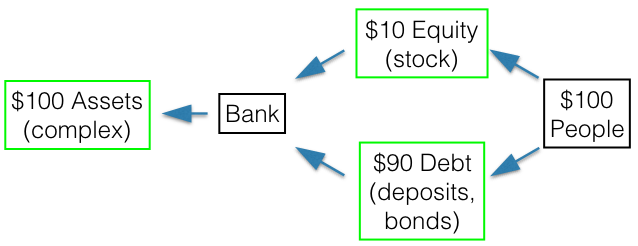
Picture of bank structure

Recall, here is how banks are structured now (extremely simplified). Banks hold assets like loans, mortgages and securities. Banks get money to fund these assets by selling a tiny amount of equity, i.e. stock, and by a huge amount of borrowing, including deposits, long-term bonds, and short-term debt.

The trouble with this system is, if the value of the assets falls by more than $10 in my example, the equity is wiped out, and the bank can't pay its debts. If short-term debt holders worry about this event, they all clamor to get paid first, so a run can happen. That's not really a problem either; bankruptcy is set up exactly to handle this situation. The creditors who lent money to the bank split up the assets. Yes, they don't get their full money back, but if you lend to a bank that's leveraged like this, that's the risk you take.

The trouble is the widespread feeling that big banks are too big, too complex, too illiquid, to utterly muddy, to carve up this way. If it takes years in court, and if all the value of the assets is drained away by lawyers, you have a real problem. Furthermore, we often want the profitable parts of the bank to remain in operation while the creditors squabble about assets. (Ben Bernanke's classic paper on banking in the great depression makes this point beautifully.) The ATM machines should not go dark, the offices where people know their customers and can keep things going should stay in operation.

Hence, big banks become too big -- or too something -- to fail. In that situation, the government is mighty tempted to bail out the creditors and keep the thing limping along. Given that temptation, a lot of large, politically well connected creditors also scream that there will be ``systemic dangers'' if they don't get their cash now, adding to the bailout pressure. A "living will" is supposed to stop this chain, by allowing  bank assets to very quickly get divvied up among creditors.

But the large banks are, apparently, so large and complex that nobody can figure out a living will. That's debateable, for example Kenneth Scott and John Taylor argue bankruptcy can work.  But let's go with the idea. Is there an alternative to Bernie Sanders' bust up the banks? Here's one.

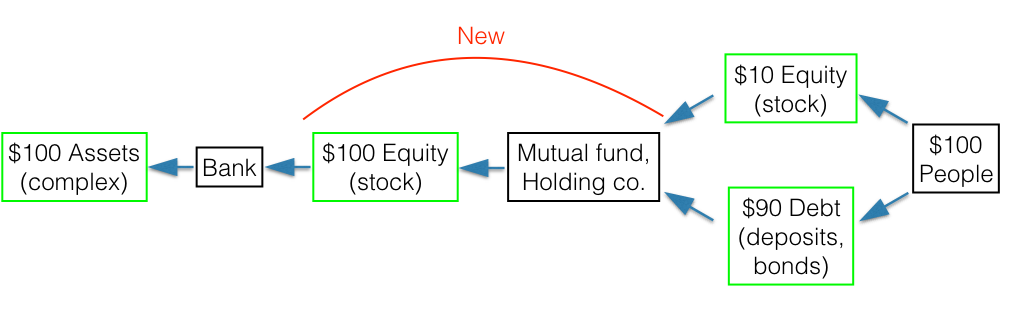
picture of altered bank structure that is easy to resolve


Starting from the left, suppose the bank holds all the same assets it does today. But, it issues 100% equity to finance its assets. Now, a 100% equity financed bank cannot fail. If you don't have any debt, you can't fail to pay debts. Yes, the bank can lose money and slowly go out of business. But it cannot go bankrupt. As it loses money, the value of its equity declines, until shareholders get mad and liquidate the carcass. Nobody can run to get their money out ahead of the other person. End of bankruptcy, end of bank runs, end of financial crises.

(Technical note. Yes, that's a bit overstated. A bank can potentially invest in derivatives and other securities where it can lose more than all of the investment. The amount of monitoring needed to make sure this doesn't happen is trivial next to the Basel sort of thing required to make sure a bank never loses more than a few percent of its value.)

OK, gulp, you say. But don't people "need" to have bank accounts? Isn't "transformation" of debt into loans the crucial feature of the financial system? Don't equity holders "require" high risk, high-return stock? No, argues the "run-free financial system" essay. But let's not go there. Let's just restructure things so that the bank can hold exactly the same assets it has today, and its investors can hold exactly the same assets they hold today.

So, moving to the right in my little picture, suppose bank stock is held in a mutual fund, exchange traded fund, or a special-purpose "bank." Bank stock is the only asset these companies hold, and that stock is also traded on exchanges. These banks fund themselves by the same mix of debt, equity, deposits, and heck even overnight wholesale debt, commercial paper, and so forth.

Now, if the value of the bank stock falls, these holding companies fail, just as my original bank failed. But there is a huge difference. You can resolve the holding company in a morning and still make it to play golf in the afternoon.  The only asset is common stock, commonly traded! There are no derivatives positions to unwind, no strange positions in offshore investment trusts, or whatever.  The "living will" simply specifies how much common equity each debtholder gets in the event of bankruptcy. There is never any need to break up, liquidate, assess, or transfer bits and pieces of the big bank.

Furthermore, there is no more obscurity over the value of  the holding company assets. We see the value of bank assets, marked to market, on a millisecond basis.

The holding companies can provide all the retail deposit services banks now provide. In fact, they could contract out to the banks to provide those on a fee basis, so the customer might not even need to know.

In addition, any sane holding company would hold the stock of several banks, diversifying the risk, and thus reducing the chances of ever needing to be wound up. Come to think of it, any sane holding company would also diversify out of banking, but now we're back to my larger vision of equity-financed banking and sensible small changes in financial structure to achieve it.

In the meantime, there you have it. 100% equity financed banks can still give bank creditors exactly the same assets they hold today, and allow failures of those debts to be resolved in a morning.


Thứ Sáu, 25 tháng 3, 2016

Central banks as central planners

Two news items cropped up this week on the general topic of central banks as emergent central planers.: a nice WSJ editorial by James Mackintosh on QE extended to buying corporate debt, and the Fed's proposed rule governing "Macroprudential" countercyclical capital buffers. The ECB also has a new Macroprudential Bulletin with similar ideas that I will not cover because the post is already too long. (Some earlier thoughts on the issue here. As usual, if the quotes aren't showing right, come back to the original of this post here.)

The WSJ editorial:
..as the central banks become more desperate to boost inflation and growth, they are starting to break one of the modern tenets of the profession by funneling that cash directly to what they regard as “good” uses.
The Bank of Japan’s conditions for companies to qualify for central bank funding include
offering an "improving working environment, providing child-care support, or expanding employee-training programs".... increasing capital spending, expanding spending on research and development or boosting what the Bank of Japan calls “human capital.” The latter means pay raises for staff, taking on more people or improving human resources.

The ECB
... plans to pay banks to borrow from it for up to four years so long as they use the money to help the “real” economy, meaning that they don’t simply pump up the housing markets by offering more mortgage finance.
The ECB is also causing a ruckus by stating plans for which private bonds it will buy and which it won't.

What's wrong with this?
“It’s a massive politicization of credit: Here are the legitimate things for lending, and here are the illegitimate things,” said Russell Napier,...“It’s capitalism with Chinese characteristics.”
Indeed. But just "politicization" or "central planning" is not the real danger. Our governments do all sorts of highly politicized credit allocation and subsidization -- energy boondoggles, student loans, export financing, housing housing and more housing, community reinvestment act, and so forth. On that scale, it seems hard to get excited about a little more.

But central banks so far don't, at least in well run countries. Why not? Independence. The deal for central banks has been: The bank gets great independence. In return, it accepts sharply limited powers. It handles money and interest rates, but it does not funnel credit to specific borrowers, nor does it target asset prices.  Branches of government that handle such political decisions are subject to quadrennial electoral wrath.  So, though any expansion of financial meddling is unwelcome, the big danger is the inevitable politicization and loss of independence of the Central bank.

And that will happen sooner than you think. Congressional hearings and bills to contain the Fed are already in Congress.

A bit more under the radar, but needing much more attention, the Fed has unveiled rules for implementing "macro-prudential" policy with "counter-cyclical capital buffers."

The proposed rule makes for fun reading. The
countercyclical capital buffer (CCyB) ...is a macroprudential policy tool that the Board can increase during periods of rising vulnerabilities in the financial system and reduce when vulnerabilities recede.
 [CCyB? OMG, DC alphabet soup is now case-sensitive?]
The CCyB is designed to increase the resilience of large banking organizations when the Board sees an elevated risk of above-normal losses. ... Above-normal losses often follow periods of rapid asset price appreciation or credit growth that are not well supported by underlying economic fundamentals....the Board would most likely use the CCyB ... to address circumstances when potential systemic vulnerabilities are somewhat above normal. By requiring advanced approaches institutions to hold a larger capital buffer during periods of increased systemic risk and removing the buffer requirement when the vulnerabilities have diminished, the CCyB has the potential to moderate fluctuations in the supply of credit over time.
Decoded into English, this is what they're saying: Replay the end of the boom, 2005-2007. This time we really will see the crisis coming. This time we will force banks to issue more stock, hold back on paying dividends and bonuses to conserve capital during the boom when things are going great. This time we will directly tell banks to stop lending even though customers are lining up at the doors for cash-out no-doc refis. Replay the beginning of the bust,  2007-2008. This time we really will demand that banks get even more private capital, and stop paying dividends and bonuses, in the middle of a crisis, even though the same banks may be screaming of its impossibility.

(And... "to hold a larger capital buffer. This entire document uses the incorrect verb "hold" to describe capital, as if capital are reserves. One hopes the ideas are not as confused as the language.)

Hayek's famous criticism of central planning is that planners can't possibly have the information needed to properly supply toilet paper. Which they didn't. So as you read this gobbledy-gook, you should ask just that question -- not whether the Fed is well intentioned or not (it is), but how will Fed officials "assess vulnerabilities,"  "potential systemic vulnerabilities" or tell whether "asset price appreciation or credit growth" are or are not "well supported by underlying economic fundamentals?"

The proposal lays out the answer:
.. by synthesizing information from a comprehensive set of financial-sector and macroeconomic indicators, supervisory information, surveys, and other interactions with market participants. In forming its view about the appropriate size of the U.S. CCyB, the Board will consider a number of financial-system vulnerabilities, including but not limited to, asset valuation pressures and risk appetite, ...

The decision will reflect the implications of the assessment of overall financial-system vulnerabilities as well as any concerns related to one or more classes of vulnerabilities. ...

"valuation pressures" and "risk appetite" are not measurable or even defined quantities. "Classes of vulnerabilities" even less so.

If this sounds pretty wooly, you might be a bit reassured by
The Board intends to monitor a wide range of financial and macroeconomic quantitative indicators including, but not limited to, measures of relative credit and liquidity expansion or contraction, a variety of asset prices, funding spreads, credit condition surveys, indices based on credit default swap spreads, options implied volatility, and measures of systemic risk. In addition, empirical models that translate a manageable set of quantitative indicators of financial and economic performance into potential settings for the CCyB, when used as part of a comprehensive judgmental assessment of all available information, can be a useful input to the Board's deliberations. Such models may include those that rely on small sets of indicators—such as the credit-to-GDP ratio, its growth rate, and combinations of the credit-to-GDP ratio with trends in the prices of residential and commercial real estate... Such models may also include those that consider larger sets of indicators...
Though they might as well say "we will look at every number that comes across the wires." It is painfully obvious though that nobody has any clue how to turn this mass of data into a useful real-time index of "vulnerabilities."

The key is to distinguish a "boom" from a "bubble."  In real time. When all the bankers in your "surveys" and "interactions with market participants" are telling you it's a boom. "We'll look at every vaguely plausible number that comes in" is hardly a reassuring tie to the mast.

But in case even this smorgasbord data-dump seems too limiting; in case some congressional committee member says "you looked at the price of barbecue in setting the first bank of Texas' capital buffer, and that violates the regulation,"
However, no single indictor or fixed set of indicators can adequately capture all the key vulnerabilities in the U.S. economy and financial system. Moreover, adjustments in the CCyB that were tightly linked to a specific model or set of models would be imprecise due to the relatively short period that some indicators are available, the limited number of past crises against which the models can be calibrated, and limited experience with the CCyB as a macroprudential tool. As a result, the types of indicators and models considered in assessments of the appropriate level of the CCyB are likely to change over time based on advances in research and the experience of the Board with this new macroprudential tool.
Translation to English: We will be shooting from the hip, but we will cover up the communique's with a lot of numbers and models and mumbo jumbo to give the illusion of technical competence.

To be clear, I'm all for capital. Lots and lots of capital. Capital issued or retained, not "held," please. I'm for so much capital that the precise amount doesn't really matter.

And that's the point. By pretending that the Fed will set capital ratios down to the second decimal point, and then pretending to be able to adjust that ratio up or down by a few percentage points in response to a Rube-Goldberg model, the Fed pretends there is a very important cost to demanding too much capital, that it knows exactly where the cost-benefit optimum is, not just on average, but with great precision vary it over time. All of this is not just false, it is completely pie-in-the sky.  How can anyone with a straight face claim such an absurd level of competence?

So my objection really is the effort to dress this up with the aura of technocratic competence, or pretend the Fed is putting in rules that it will follow. (The link is, after all, a rule-making proposal.) It would be far more honest to issue one line: "The Federal Reserve will adjust capital requirements as it sees fit." Period.

The result is easy to foresee. "Counter-cyclical capital" and "macro-prudential policy" will become one more completely discretionary and judgmental policy tool for the Fed to command the banks.  It will be subject to intense political forces. The Fed will get it wrong, and feed the flames.  The fallout for the Fed, for good monetary policy, and for the economy will not be good.

While we're on gobbledy-gook language and the revealed confusion by our aspiring technocrats, the  "real economy" language is sad. From WSJ, the ECB
 will cut the interest rate to as low as minus 0.4%—the ECB paying the banks—if the banks lend more to the real economy than a benchmark amount linked to their recent loans.
Here we are in 2016, and our central bankers are peddling the medieval distinction between "real" and "financial" investment. Yes, ordinary Joe can be excused from this fallacy. But people with economics PhDs are supposed to understand that every asset is also a liability. Individually we can "buy paper, not real things." Collectively, we cannot.
“The market would much rather companies take the ECB’s cheap money and use it to buy each other,” said Robert Buckland, an equity strategist at Citigroup Inc.
OK, so even private sector equity strategists can get it wrong. But central bankers are supposed to understand accounting identities. I hope these are journalistic misunderstandings and not an accurate reflection of thinking at the ECB.

Oh, and on negative rates:
German reinsurer Munich Re said it plans to store more than €10 million ($11.3 million) of physical bank notes in vaults to test the feasibility of avoiding negative rates.
The ECB may have to get going on Miles' Kimball's plan to devalue currency relative to bank reserves!

Thứ Sáu, 26 tháng 2, 2016

Sanders multiplier magic

The critiques of Gerald Friedman's analysis of the Sanders economic plan  continue. The latest and most detailed and careful so far is by David and Christina Romer.

Bottom line:

  1. The central idea in Friedman's analysis is that taking $1 from Peter to give to Paul raises overall income by 55 cents.  From this, you get multipliers from raising taxes and spending, from higher minimum wages, more unions, and so forth. 
  2. I chuckle a little bit that so many economists who previously liked multipliers now don't like their logical conclusions. 
  3. The Romers charge a serious, elementary arithmetic mistake in treating levels vs. growth rates. If they're right Friedman's whole analysis is just wrong on arithmetic.

The analysis

One might have expected that a sympathetic analysis of the Sanders plan would say, look, this is going to cost us a bit of growth, but the fairness and (claimed) better treatment of disadvantaged people are worth it.

Friedman's having none of that. In his analysis, the Sanders plan will also unleash a burst of growth, claims for which would make a fervent supply-sider like Art Laffer blush.


"The Sanders program... will raise the gross domestic product by 37% and per capita income by 33% in 2026; the growth rate of per capita GDP will increase from 1.7% a year to 4.5% a year." And, apparently, raise the growth rate permanently.

More stunning still are Friedman's claims about employment, shown at left here

and here.

Multipliers

So, where does this spurt of growth come from? The answer is the magic of multipliers.

But it's not just run of the mill fiscal stimulus multipliers.  After all, Friedman also says that the Sanders program would reduce the deficit, and by 2025 turn the Federal Budget to surplus!

How are multipliers so strong?

There seem to be two basic answers. First, Sanders assumes that there is a large multiplier from income transfers.

If the government takes $1 from rich Peter, and gives that $1 to poor Paul, overall income rises 55 cents! The one quote that makes this clearest is
The stimulus from regulator[y] changes is in Table 9. In general, the assumption is that wages have a multiplier of 0.9 compared with a multiplier of 0.35 for profits accruing to high-income persons. A wage increase coming out of profits, therefore, has a multiplier of 0.55.
It's also visible here explaining how a balanced budget still has a multiplier
the average value of the (governent spending) multiplier from 2017-26 is 0.89, falling from 1.25 to 0.87 as the output gap closes 
Other taxes are assumed to reduce effective demand with a multiplier of 0.35
[The] balance of revenue and spending programs will increase employment and economic growth because the spending program has a larger fiscal multiplier than do progressive tax increases. 
So tax $1 and spend $1 raises GDP by 54 cents.

He cites many standard sources for multipliers. He does not give a theory.  The standard story is that poor Paul consumes a lot more of his income, while rich Peter was investing it all in venture capital startups.  Consumption is good, savings is bad, so GDP rises.

From this central assumption, the rest of the magic follows.  Friedman creatively goes far beyond conventional deficit multipliers, to conjure multipliers out of tax increases, raises in the minimum wage, greater unionization, increased social program spending, and so forth. For example
 I assume that the Paycheck Fairness Act will raise women’s wages by 1% relative to men’s, and there will be an increase of 0.2% a year for the next decade.  I assume that 50% of the increased cost goes to higher prices and 50% comes from profits, and these are assumed to lower spending by higher income people with a multiplier of 0.35.
This, I think, is the central case. Admire it for its courage, and creative use of Keynesian arguments. These are the kind of interventions that most economists admit reduce growth, but some argue for on other grounds. But in Keynesian economics, taking money from low marginal propensity to consume people, and giving it to high marginal propensity to consume people raises GDP.

Snark

At this point, I stop in a bit of amusement at all the criticism. After all, these are just standard Keynesian arguments. The individual multipliers in Friedman's analysis are all conservative, and cite standard middle-of-the-road sources. The economists now so critical of this analysis, including the Romers, former democratic administration CEA chairs who wrote the open letter from past CEA chairs, and Paul Krugman, have been making big multiplier arguments for years to argue for more spending.  The "new Keynesian" academic literature includes multipliers far above two, so one can point to "science" if you wish. (Gauti Eggertsson, Christiano, Eichenbaum and Rebelo ; a simple example with multipliers as large as you want.)

The Romers are right to emphasize that multipliers only operate where "demand" is slack, and monetary policy doesn't steal the show. But the asterisks about fixed interest rates and output below "capacity" have been overlooked by the mainstream many times before. It's a rare Keynesian economist who ever thinks the economy is operating at full capacity. And Friedman has the former monetary asterisk, and he addresses the latter by claiming a large return to the labor force and increased productivity.

Even that view is not so out of the mainstream. For example,  Brad DeLong and Larry Summers wrote an influential Brookings paper arguing for very large fiscal multipliers, with some of the same flavor. There is hysterisis; a multiplier will bring people back to the labor market (as Friedman claims), those people will regain skills, productivity will increase; higher investment will give us better capital and also increase productivity. Demand creates its own supply.

Friedman is apparently just taking the consumption-first, poor-people-spend-more-than-rich-people, undergraduate ISLM analysis, with a bit of Delong-Summers hysterisis, to its logical conclusion. I agree in a way: take those ideas to their logical conclusion and you get silly propositions (old essay on that). Robbing Peter to pay Paul raises income; wasted government spending is good; theft improves the economy, transfers even from thrifty poor to spendthrift rich improve the economy, hurricanes are good for us, social programs, unions, minimum wages raise GDP, and so forth. Well, if the logical conclusions are patently silly, maybe one shouldn't have been making small versions of those arguments all along. Economic Homeopathy is not wisdom. 

Arithmetic 

But the Romers uncover a deeper puzzle. Even with these assumptions -- government spending multipliers around 0.8, and a transfer multiplier of around 0.55 -- you still don't get the wild increase in growth that Friedman claims. So how does he do it? Their answer: 
We have a conjecture about how Friedman may have incorrectly found such large effects. Suppose one is considering a permanent increase in government spending of 1% of GDP, and suppose one assumes that government spending raises output one-for-one. Then one might be tempted to think that the program would raise output growth each year by a percentage point, and so raise the level of output after a decade by about 10%. In fact, however, in this scenario there is no additional stimulus after the first year. As a result, each year the spending would raise the level of output by 1% relative to what it would have been otherwise, and so the impact on the level of output after a decade would be only 1%.
If this is right, it's absolutely damning. This is a question of arithmetic, not economics. (And I would have to swallow some of my above snark!) 

A clearer (maybe) example: The government spends an extra $1 for one year.  With a 1.0 multiplier GDP goes up $1 that year, period. If the government stops spending next year, GDP goes back to where it was. That's the conventional definition of multiplier, and the one that all Fridman's cited sources have in mind. Per Romers, Friedman misread that calculation and assumed the first $1 of spending raises GDP by $1 forever. In 10 years, you have a multiplier of 10! 

The Romers are cautious, and don't directly make this charge. It's not my job to get into the Hilary vs. Bernie whose-numbers-add-up fight. (At least someone here actually seems to care about numbers and economic plans!) But whether the spreadsheets make this arithmetic mistake or not is an answerable question. I hope to inspire someone with a spreadsheet and a nose for such things to check. This is a great time for a replication exercise! 

(Note: This post has pictures and quotes, which don't translate well when the post is picked up elswhere. If you're not seeing them, come back to the original.)

Update: Joakim Book tries to reproduce the numbers and comes up way short.

Update 2: Justin Wolfers at the New York Times did some old-fashioned journalism: He called up Friedman for a reaction.  The article is great, and clear. Yes, Friedman did the calculation as the Romers allege: An extra dollar of government spending today raises GDP permanently; an extra dollar of permanent government spending raises GDP growth permanently. That is at least not what the cited sources have in mind.


Thứ Sáu, 19 tháng 2, 2016

Right Wing NPR

I was listening to NPR this morning over coffee, and nearly spilled it. Host Steve Inskeep was interviewing Mark Surman, Mozilla founder, on the topic of Apple refusing to hand over the keys to the Iphone to the Federal Government (and anyone who might be able to hack the Federal Government. Oh, right, that's never happened!)
INSKEEP: One last thing, coming back to this San Bernardino case, we don't know what's in that iPhone. We don't even know if it's important. But let's spin out the worst case scenario as a prosecutor might. Suppose your side wins, that phone is never opened, and as a result, the government misses a chance to find some other suspect and disrupt some attack. The attack goes forward, and people are killed. Will that have been worth it in order to protect encryption?
Surman, probably flabbergasted that anyone should ask such a question, changed the subject
SURMAN: We need to find ways to really be able to seek communications before they're sent or after they're sent and actually work with law enforcement on doing this well. There are alternative ways to get information, getting access to it before or after it's encrypted. What we want to avoid is creating a precedent where encryption can be broken by an arbitrary third party.
But Inskeep kept at it
INSKEEP: So you're saying, in essence, it may well be harder to catch terrorists, but you can still work at it, and the extra difficulty is worth it.
Remember, this is cloyingly liberal NPR, not some foaming at the mouth right wing program!

Like Surman, I often am too polite to give the right answer to such shocking questions in real time. But with the benefit of hindsight, here's a better answer
COCHRANE: Well, come to think of it, you're right there Steve. And while you're at it, let's keep going. These pesky first and fourth amendments sure get in the way of law enforcement, don't they? I mean all this business about going out and getting warrants, and waiting for a judge is so time consuming. If a terrorist gets away while you're busy getting a warrant, and people are killed, will that really have been worth it to protect some sort of centuries old procedures? If someone stirs up trouble on a Jihadi website, why do we have to allow that? And this annoying business about grand juries, and presenting evidence, and discovery, and Miranda warnings, it's so burdensome. What if some terrorist gets away and kills someone?  The police surely should be allowed to just throw anyone suspicious in jail, to make sure they don't do anything bad. Heck, while you're at it, what's with these prohibitions against torture? Bring back the rack, or start chopping people's fingers off until they talk. If you hold back, and some terrorist kills someone, was your little sense of ethics really worth it?  
There is a reason we have all these protections. There is a reason we need to defend them even in times of turmoil.

Perhaps a President Hillary Clinton will bring a sympathetic ear to the right to digital privacy. She undoubtedly wishes her email had been bullet-proof encrypted, not just from the FBI and NSA, but from the Chinese and Russian hackers likely reading every line.

Update: I realize from some of the comments that the point may not have been clear. This isn't about the Apple decision. It's moot, really, anyway, as even Apple can't open the new Iphones. And one can make cost/benefit arguments either way. My point was about the argument: We will hear quite often in coming years and decades, the argument that even one terrorist caught is worth sacrificing privacy and civil liberty. Be prepared to answer, to point out there are costs as well as benefits, and to list what they are. And, finally, I sound more critical of Inskeep than I should. In fairness, he does not offer an opinion. He asks a question, one commonly asked, and may well have been floating a t-ball in the hope Surman would smash it out of the park as I attempted to do.  Many people will ask that question. It's worth asking, over and over, and rehearsing the answer.

Thứ Tư, 17 tháng 2, 2016

Sad CEA Letter

And just as I was getting all weepy about how great and a-political, obejective, non-partisan and all that the CEA is, along comes an open letter from past CEA chairs Alan Krueger, Austan Goolsbee, Chirstina Romer, and Laura D'Andrea Tyson to Senator Sanders, to restore my cynicism.

The heart of the letter is worthy, and commendable: to call out the fact that Senator Sander's campaign is making promises that don't add up, beyond even the usual stretches of campaign rhetoric from both sides.

But read
 When Republicans have proposed large tax cuts for the wealthy..
Hmm. I wonder if Republicans would characterize their proposals that way? How many speeches have you heard saying "we want  large tax cuts for the wealthy!" No, they say they want tax reform to reduce distorting marginal rates and rampant cronyism.

Really, dear colleagues and friends, how would you respond if Republican CEA chairs were to write a similar letter addressing the shortcomings of Trump's plan that started,
When Democrats have proposed incentive-killing growth-killing marginal tax rate increases with lots of exemptions for their donors... 
and goes on to trumpet their sober-minded analysis of the plans, would you be inspired to plaud their "reputation" for objective evidence-based analysis?

So this is just a poke in the eye, a repetition of partisan Democratic campaign rhetoric, stirring up the base by bulverizing the other party.

Why is Washington so polarized? Because even once-respectable academic economists, transported to Washington, cannot stop themselves from this sort of schoolyard taunting, tribalistic attacks, and repetition of their bosses' propaganda.


Moreover,
For many years, we have worked to make the Democratic Party the party of evidence-based economic policy.
Largely as a result of efforts like these, the Democratic party has rightfully earned a reputation for responsibly estimating the effects of economic policies.
our reputation as the party of responsible arithmetic.
Oh. I thought you were simply doing what all good economists, do, all good CEA chairs do, and you were working to make evidence-based policy a routine feature of all government policy under all administrations. I thought you were working for the benefit of the country, not just the Democratic party.

Worst of all, it's counterproductive. Once you start repeating propaganda -- "tax cuts for the wealthy" -- once you start schoolyard taunts -- the CEA chairs who serve under Republicans are apparently not even capable of arithmetic --  the other side, feeling exactly the intended sling of insult, turns off. You do not gain a reputation for evidence-based policy, you gain a reputation for pandering to political opportunity, and all your "evidence" is immediately suspect of the same partisan bias.

So I don't know in whose eyes the "Democratic party has rightfully earned a reputation for responsibly estimating the effects of economic policies." Among Democrats? Sure. But they often don't care a lot about evidence, as in, say GMO foods or nuclear power. Among Republicans? That's where it might count. I don't go to fancy Republican cocktail parties in DC, but I sort of doubt the chatter goes "well, those Democrats, they have a lot of looney ideas, but you have to hand it to them, they always stick with the science and the evidence."  Evidence is only evidence if it is objective.

So if there ever was such a reputation, you four just threw it away with "large tax cuts for the wealthy" and the insinuation that Republicans can't even add. Instead, you reinforced what I sense your party's reputation actually is among Republicans. And then you're surprised when they don't play nice.

Thứ Ba, 16 tháng 2, 2016

CEA History

The Council of Economic Advisers has released a history of the CEA on its' 70th anniversary, as  Chapter 7 of the  Economic Report of the President. This piece is very interesting for economists interested in policy.

It's a nice reminder on how much economic policy ideas have changed. In the late 1940s, when the CEA was set up, fiscal policy was everything. Solow's growth model had not been invented, let alone Romer's. Monetary policy was a twinkle in Milton Friedman's eye. Adam Smith had more or less been forgotten. Economic policy was widely thought to consist of just setting the right level of fiscal stimulus, let multipliers work their magic, to achieve "full employment" and economic growth. The piece tracks well the rediscovery of microeconomics and regulation, as well as the shifts in macroeconomic thinking.

It reminds us how much the stage has changed. In the early years there were really no economists working elsewhere in government, and there were no think tanks. Now every agency has a chief economist and a staff, and the CEA isn't (!) the only game in town for producing policy-oriented research. Its role has changed as a consequence.

The CEA has long had many roles,  adviser, calculator of numbers, cheerleader for the Administration's policies, spinner for the Sunday talk shows, and interagency warrior.

One of its most important and least appreciated roles is just to stop silly stuff.

Joe Stiglitz:
 the money saved from just one of the many bad projects the CEA had helped stop ... would have been enough to provide us with a permanent endowment
Ben Bernanke, even better:
Economics is a highly sophisticated field of thought that is superb at explaining to policymakers precisely why the choices they made in the past were wrong. About the future, not so much. However, careful economic analysis does have one important benefit, which is that it can help kill ideas that are completely logically inconsistent or wildly at variance with the data. This insight covers at least 90 percent of proposed economic policies.
Some examples
...the Heller Council argued against a proposal during the Kennedy Administration to use nuclear explosives to widen the Panama Canal. In the Nixon Administration, CEA played a leading role in the analysis that led to the conclusion that the government should not subsidize the development of a supersonic transport or SST plane, dubbed the “sure-to-be-subsidized transport” (Schultze 1996). Under President Ronald Reagan, CEA participated in a Gold Commission, which investigated the feasibility of returning to the gold standard, and ultimately advised against doing so. 
In my brief time at CEA while very young I got to see this role up close.  There would be an interagency meeting on something like tariffs and quotas for goose down. Every other agency would show up at a meeting all for it -- defense wants to make sure there are American suppliers of American goose down from patriotic American Geese, so our boys fighting the Russkies in Canada someday will stay warm. The American Goose Down production board is screaming about unfair dumping from China. The Goose Feather Plucker's union is all for it, along with the merchant marine -- under the Jones Act, American geese must travel on American made and staffed ships. State is all for it too, so long as we can carve an exception for special down from Berlin. The Congressional liaison says the Congressman from the one county in the country that makes goose down is screaming about it and will cause all sorts of trouble if we don't do it. And so on and so forth. It was the CEAs lonely role to stick up for the poor consumer who might want a cheap warm jacket. (Note: I'm mostly making all this up as a composite of a large number of different cases.)

There has always been a tension, how much the CEA is there to provide disinterested advice, and how much it is there to cheerlead the Administration's policies, though many of those are at least limited by political considerations, if not downright driven entirely by politics.  Just how much time should the chair spend on Sunday talk shows spinning the latest numbers to show how great the Administration's policies are?
As many commentators and former CEA chairs have observed, there can be a tension between CEA’s duty to advance the President’s agenda and its responsibility to provide expert economic advice. 
Important: You can't be pure and also effective:
CEA chairs and members need to be able to operate effectively within a political environment without it affecting the integrity of their economic advice. 
The Chapter offers good advice, coming from long experience:
Former CEA chairs, members, and staff offer several specific pieces of advice as to how to successfully strike this balance: they advise that CEA should not publicly advocate for policies that are not supported by economic analysis, and that CEA should stick to giving economic advice, not political advice. CEA’s comparative advantage is economics, 
A former chair told me a great story of offering a president political advice, only to be told "you stick to the economics, and let me do the politics."

A big lesson is not to become an administrative agency:
Others advise that the Council should not get too involved in policy coordination. ... One episode that illustrates this lesson occurred during the Johnson Administration, when CEA was responsible for the day-to-day administration of wage-price guideposts to combat inflation.
Stuart Eizenstat, President Carter’s domestic policy adviser, argues that “[t]he CEA cannot provide both detached, Olympian economic advice and become enmeshed in the daily, inter-agency compromises and political log-rolling” (1992).
In 1993, President Clinton created a National Economic Council inside the White House. It seemed to me a sort of parallel CEA. Governments often don't cancel an agency, they just create a new parallel one, and let the old one rot. The report handles this question carefully, but seems to suggest that the arrangement is working, with the NEC allowing the CEA to do less political work and better economic work:
Since 1993, the National Economic Council has been responsible for coordinating economic policymaking. These arrangements have largely served to augment CEA’s effectiveness by permitting it to focus on providing economic advice and analysis and giving the Council greater exposure to the President
The CEA is, rather unabashedly, the representative of the economics profession in the government. The chapter covers it well.
The final function of CEA is to engage with the economics community, by staying abreast of the latest academic research and by sharing new insights with policymakers, and in turn, by communicating the administration’s actions and plans to the economics community. This function helps to support the administration’s efforts to develop economic policies and to articulate and advance the President’s agenda. While the academic character of CEA may not have been originally intended by Congress when it created CEA, this engagement has arguably made the Council a more effective and durable institution.
I'm a little leery of this paragraph. I think the distance from research to policy might productively be a little greater -- let's make sure the latest research is solid first. And the vision that the CEA is there to sell a political agenda to economists is a bit frightening.

But inaugurated by the CEA, there has been a much more active participation by academic economists in policy making. I think policy is better for it -- or at least not as catastrophically bad as it might be otherwise -- and so is academia.  Academics are also taking over from bankers and politicians at the Fed, with positive impact in my view.  Marty Feldstein's box speaks to this issue nicely.

A nice summary:
Many of CEA’s contributions are due to its unique institutional structure: that it is a small organization with no regulatory authority of its own, few direct operational responsibilities, and populated by academic economists. Yet its contributions are also dependent on the ability of its staff to balance operating effectively in a necessarily political environment without being overly influenced by politics, and to be effective in advocating for their positions while providing objective economic advice. All in all, given the divergent objectives reflected in the Employment Act of 1946, CEA’s turbulent early years, and its unusual institutional structure, CEA has proven to be a durable and effective advocate for the public interest.
A small personal note: I got the lucky chance to be a junior staff economist -- basically an RA -- while I was in graduate school. It was a great experience. I worked on a new project every two weeks, largely under Bill Poole. Unlike my academic training, we quickly went from idea, to data, to report or memo and on to the next. Bill taught me a lot. I saw quite a bit of how policy is made. I learned that most of the people in Washington are really smart, hard working, informed, and public spirited. It cured a lot of cynicism.  And it got me to work on much better ideas for my research, to break out of the literature-driven world 3d year graduate students live in, and to make sure my research ideas matter to the larger world.

If you get the chance, go.

An don't worry about politics. At the staff level, it's pretty a-political. In fact, working for an administration whose general philosophy you disagree with would be good for you. (See Martin Feldstein's little essay on this point. Quite a few of the Reagan-era staff were democrats.)

Update: "On February 11, the Hutchins Center on Fiscal and Monetary Policy at Brookings marked this anniversary by examining the ways the CEA and other economists succeed and fail when they set out to advise elected politicians and tap the expertise of some of the “exceptionally qualified” economists who have chaired the Council over the past four decades."

Video and other links here.  And here is their photo from the event, with many past CEA chairs and economists.

Source: Brookings institution. 


Thứ Hai, 15 tháng 2, 2016

Brooks v. Krugman

I usually try to steer away from Presidential politics, and especially from commentators' habit of analyzing character. But last week's New York Times had two particularly interesting columns that invite breaking the rule: "I Miss Barack Obama" by David Brooks and "How America Was Lost" by Paul Krugman.

As we contemplate a Clinton, Sanders, Trump, or Cruz presidency, we may well continue the pattern that each president's main accomplishment is to burnish nostalgia for his (so far) predecessor. Brooks is feeling that.

And he's right. Say what you will about policy, the Obama Administration has, as Brooks points out,  been staffed by people of basic personal integrity and remarkably scandal-free. (In the conventional sense of "scandal." I'm sure some commenters will contend that the bailouts, Lois Lerner, the EPA, and Dodd-Frank and Obamacare are "scandals," but that's not what we're talking about here.) On economic issues, his main advisers have been thoughtful, credentialed, mainstream Democrats. Obama's speeches on many topics have, as David says, been full of "basic humanity," even if one disagrees with his solutions.


Brooks finishes,
No, Obama has not been temperamentally perfect. Too often he’s been disdainful, aloof, resentful and insular. 
Brooks leaves out many faults, including a tendency to hector and demonize opponents and a desire for quick spin successes.  Demonizing opponents is simply ineffective in getting them to see things your way, and has made polarization much worse. Too much short term spin control causes long term damage -- think of the Syrian line in the sand, or the Benghazi cover story.

But recognize what David is doing: Bending over backwards to be nice. Trying to build a  bridge. Finding common ground. Listening. Appreciating an opponent's good intentions and motivations, which lets us move on to craft solutions. Overlooking faults. We'll need a lot of that, and it requires letting festering wounds heal. Because
...there is a tone of ugliness creeping across the world, as democracies retreat, as tribalism mounts, as suspiciousness and authoritarianism take center stage.
Krugman's column is an interesting contrast. It offers a great display of just how our politics got so bad.  It starts well:
How did we get into this mess?
At one level the answer is the ever-widening partisan divide. Polarization has measurably increased in every aspect of American politics, from congressional voting to public opinion, with an especially dramatic rise in “negative partisanship” — distrust of and disdain for the other side.
That would be a terrible thing, wouldn't it. It would be terrible if, for example, people said "distrustful and disdainful" things like
only one of our two major political parties has gone off the deep end.
Polarization and triablism mount when one passes on conspiracy theories and plain untruths. Such as
Democrats don’t routinely deny the legitimacy of presidents from the other party; Republicans did it to both Bill Clinton and Mr. Obama.
"Democrats" have never gone unhinged about who "stole an election," repeating endlessly that President Bush was not legitimate?  It's such a whopper, I don't understand how Krugman thinks his readers (and editors) wouldn't notice it.  Especially given how much coverage Bush v. Gore is getting in the wake of Justice Scalia's death. I can only hope it's a delicious tongue-in-cheek self-parody.

And only a lunatic fringe of Republicans seriously challenged President Obama's legitimacy. Attempting to tar a whole, varied group with a lunatic fringe is a classic demonization tactic.

Or the column's premise:
Republicans have more or less unanimously declared that President Obama has no right even to nominate a replacement for Mr. Scalia
That is also simply factually incorrect. "Republicans" -- not notice tarring  half the population with the subject of the sentence, rather than the potentially correct "some Republican senators" -- are more or less unanimously enamored of one thing, the Constitution. Every statement of every Republican Senator I have read recognizes that the President has every right to nominate a replacement. And they have the right to vote on it. Or not. And all of this is so clearly pre-negotiation posturing it's silly to take seriously anyway.

Krugman's column strikes me therefore as a great example of the polarization process. Right now, the obvious thing for both sides to do is to reach out to find a consensus peacemaker nominee, someone who will preserve the most important parts of what each side wants. Perhaps they could agree to someone who will keep the social advances like gay marriage, abortion rights, and immigration rights, but have a sharper eye to economic freedom and limited government. Such a nominee would be a great capstone for President Obama's term, rather than a bitter fight with a blocked senate. And all sides might be a bit afraid of President Trump/Cruz or Sanders/Clinton making the next nomination at the beginning of a term.

But no, Krugman prefers to assume the fight will be lost and to fulminate in ex-ante demonization:
 The G.O.P.’s new Supreme Court blockade is, fundamentally, in a direct line of descent from the days when Republicans used to call Mr. Clinton “your president.” 
And the Bork nomination, and the Clarence Thomas hearings... well, those never happened.

So Krugman's is a great column in the end. Read it closely and it shows very effectively just what is wrong with our political system: Demonization -- there is good and there is evil, and everything that's wrong comes from the evil side; Mendacity (a good Krugman word) -- passing on known falsehoods; Tribalization -- everything bad comes from "Republicans," a uniform army of orcs.

Brooks ends
Obama radiates an ethos of integrity, humanity, good manners and elegance that I’m beginning to miss, and that I suspect we will all miss a bit, regardless of who replaces him.
Well, at least who replaces him of the current front-runners. Let us hope the electorate wakes up soon to value these characteristics, together with basic competence, in their candidates and in their opinion writers.

Thứ Sáu, 12 tháng 2, 2016

The Libertarian Case for Bernie Sanders

The Libertarian Case for Bernie Sanders, from Will Wilkinson at the Niskanen Center. Yes, Denmark scores much above the US on ease of doing business indices. An interesting case. A welfare state is not necessarily a politicized regulatory state, with strong two-way political-industry capture. The latter may be more dangerous economically.  Those who wish to eat golden eggs have an incentive to let the Goose grow fat.

Update: Megan McArdle brilliantly demolishes the case.  "It's fun, but not convincing." My view as well.

Thứ Sáu, 22 tháng 1, 2016

Tax Oped -- full version

Source: Wall Street Journal
An Oped at the Wall Street Journal, "Here's what genuine tax reform looks like." I posted the teaser a month ago, now I can post the whole thing.

Left and right agree that the U.S. tax code is a mess. The men and women running for president in 2016 are offering reform plans, and proposals to fix the code regularly surface in Congress. But these plans are, and should be, political documents, designed to attract votes. To prevent today’s ugly bargains from becoming tomorrow’s conventional wisdom, we should more frequently discuss the ideal tax structure.

The first goal of taxation is to raise needed government revenue with minimum economic damage. That means lower marginal rates—the additional tax people pay for each extra dollar earned—and a broader base of income subject to tax. It also means a massively simpler tax code.


In my view, simplification is more important than rates. A simple code would allow people and businesses to spend more time and resources on productive activities and less on attorneys and accountants, or on lobbyists seeking special deals and subsidies. And a simple code is much more clearly fair. Americans now suspect that people with clever lawyers are avoiding much taxation, which is corrosive to compliance and driving populist outrage across the political spectrum.

What would a minimally damaging, simple, fair tax code look like? First, the corporate tax should be eliminated. Every dollar of taxes that a corporation seems to pay comes from higher prices to its customers, lower wages to its workers, or lower dividends to its shareholders. Of these groups, wealthy individual shareholders are the least likely to suffer. If taxes eat into profits, investors pay lower prices for less valuable shares, and so earn the same return as before. To the extent that taxes do reduce returns, they also financially hurt nonprofits and your and my pension funds.

With no corporate tax, arguments disappear over investment expensing versus depreciation, repatriation of profits, too much tax-deductible debt, R&D deductions, and the vast array of energy deductions and credits.

Second, the government should tax consumption, not wages, income or wealth. When the government taxes savings, investment income, wealth or inheritance, it reduces the incentive to save, invest and build companies rather than enjoy consumption immediately. Taxes on capital gains discourage people from moving or reallocating capital toward their most productive uses.

Recognizing the distortion, the federal government provides a complex web of shelters, including IRAs, Roth IRAs, 527(b), 401(k), health-savings accounts, life-insurance exemptions, and the panoply of trusts that wealthy individuals use to shelter their wealth and escape the estate tax. If investment isn’t taxed, these costly complexities can disappear.

All the various deductions, credits and exclusions should be eliminated—even the holy trinity of tax breaks for mortgage interest, charitable donations and employer-provided health insurance. The extra revenue, over a trillion dollars annually, could finance a large reduction in marginal rates. This step would also simplify the code and make it fairer.

Imagine that Congress proposed to send an annual check to each homeowner. People with high incomes, who buy expensive houses, borrow lots of money or refinance often, would get bigger checks than people with low incomes, who buy smaller houses, save up more for down payments or pay down their mortgages. There would be rioting in the streets. Yet that is exactly what the mortgage-interest deduction accomplishes.

Similarly, suppose Congress proposed to match private charitable donations. But rich people would get a 40% match, middle class people only 10%, and poor people nothing. This is exactly what the charitable deduction accomplishes.

Zeroing out deductions, credits, and corporate and investment taxes matters—for permanence, for predictability and for simplicity. If the corporate rate is drastically reduced, or if deductions are capped, it seems that the economic distortions go away. But the thousands of pages of tax code are still in place, the army of lawyers and accountants and lobbyists is still in place, and the next administration will itch to raise the caps, and the rate.

Why is tax reform paralyzed? Because political debate mixes the goal of efficiently raising revenue with so many other objectives. Some want more progressivity or more revenue. Others defend subsidies and transfers for specific activities, groups or businesses. They hold reform hostage.

Wise politicians often bundle dissimilar goals to attract a majority. But when bundling leads to paralysis, progress comes by separating the issues. Thus, we should agree to first reform the structure of the tax code, leaving the rates blank. We will then separately debate rates, and the consequent overall revenue and progressivity.

Consumption-based taxes can be progressive. A simplified income tax, excluding investment income and allowing a full deduction for savings, could tax high-income earners’ consumption at a higher rate. Low-income people can receive transfers and credits. I think smaller government and less progressivity are wiser. But we can agree on an efficient, simple and fair tax, and debate revenues and progressivity separately.

We should also agree to separate the tax code from the subsidy code. We agree to debate subsidies for mortgage-interest payments, electric cars and the like—transparent and on-budget—but separately from tax reform.

Negotiating such an agreement will be hard. But the ability to achieve grand bargains is the most important characteristic of great political leaders.

Mr. Cochrane is a senior fellow at Stanford University’s Hoover Institution.